Parties, Responsibilities and Appointments
In this chapter 5.1–5.6
5.1. Information Management Is a Multi-Party Activity#
Information Logistics connects information demand with the Providers, exchanges and dependencies through which required information becomes available to its Receivers. As Chapter 4 established, however, organising information supply involves more than identifying what must be delivered and when. It also requires cooperation between organisations and specialists working with different types of information, technologies and professional objectives. Their contributions must remain sufficiently consistent and reliable to support the management of a project or asset, even when information is produced and maintained by independent participants.
Consider a modern construction project. Architects and engineers prepare models, calculations and specifications; cost consultants work with quantities and financial data; contractors develop schedules and construction records; equipment suppliers provide technical information needed for installation and subsequent operation. These resources may be produced in different applications, stored in different systems and maintained by independent organisations. Nevertheless, they must collectively support decisions about the same physical asset.

Digital technologies make it possible to bring these contributions together within a federated Information Model, but technological interoperability alone does not guarantee their consistency or suitability. A structural model may be technically correct yet inconsistent with an architectural model. Equipment information may satisfy a supplier’s internal documentation requirements while remaining insufficient for the asset operator’s maintenance system. A document may be accessible to all participants, but its revision or permitted purpose of use may still be unclear.
These problems illustrate a fundamental distinction between producing information and managing its production and use.
Professionals apply their specialist knowledge and tools to create models, documents, databases and other information resources. Information management establishes the conditions under which these contributions can be planned, coordinated, assessed, delivered and used for their intended purposes. It connects the activities of individual information producers with the requirements of those who depend on their results.
Four interrelated conditions provide the common basis for collaborative information production:
The Information Production Standard establishes shared rules for representing, identifying, classifying and organising information.
Agreed Methods define how particular information-production activities are performed.
Documented Procedures establish how information is checked, coordinated, authorised, exchanged and accepted under agreed governance arrangements.
A Common Data Environment (CDE) provides the governed environment in which information is managed, shared and exchanged through appropriate technical capabilities.
These conditions are complementary. The Information Production Standard establishes common conventions, Methods guide production activities, Procedures govern the relevant actions and decisions, and the CDE supports their implementation in a shared information-management environment. None can substitute for the others. Their combined purpose is to make collaborative information production more predictable, reduce unnecessary rework and ensure that information remains suitable and available for its intended Receivers.
The growing complexity of digital information production requires the information-management function to be explicitly organised across the participants involved.
Three Levels of Information Management Functions#
The need to organise information management across multiple participants raises a practical question: how are the necessary functions distributed among organisations, teams and individuals?
In IMC, these functions operate at three complementary levels, as summarised in Table 5.1.
Level | How the functions are performed |
|---|---|
Organisational functions | Parties establish requirements, organise and coordinate information production, and fulfil defined information-management responsibilities. |
Team functions | Project or Asset Teams, Information Production Teams and Task Groups coordinate activities involved in producing, exchanging and using information. |
Individual functions | Managers and specialists perform information-management activities alongside, or as part of, their professional responsibilities. |
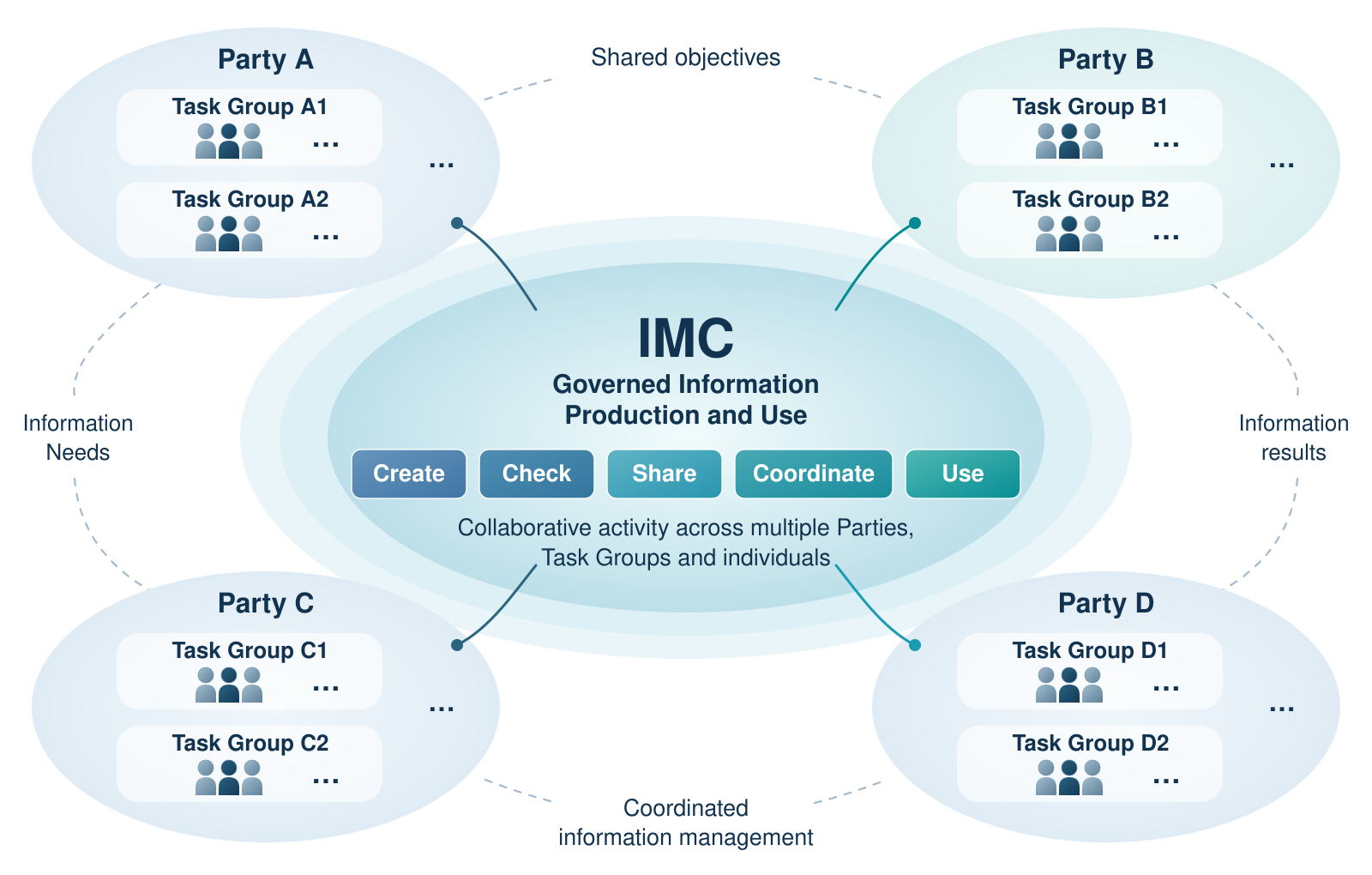
These levels describe different dimensions of information management, not separate organisational hierarchies. They do not imply that every function requires an independent organisation, a dedicated team or a specialist employee. The practical arrangements depend on the scope and complexity of the Information Management Cycle and on the capabilities of the participants involved.
Consider an industrial company modernising one of its production facilities primarily through internal resources. Executive management establishes the objectives and information needs. An in-house design institute coordinates engineering information, while specialist departments prepare models, calculations and specifications. A construction division uses the resulting information to plan and supervise implementation.
The participating departments perform distinct information-management and production functions without necessarily being separate legal organisations. Some functions may be assigned to dedicated Information Managers, while others remain part of the responsibilities of engineering, construction or operations managers.
The same principle applies to an existing asset. An asset operator may coordinate internal maintenance teams, inspection specialists and external service providers, each contributing information needed to evaluate equipment condition, plan interventions or maintain the Asset Information Model. The organisational arrangements differ from those of a construction project, but the need to manage information collaboratively remains.
Figure 5.1 illustrates how information-management functions are distributed among Parties, teams and individuals within a collaborative production arrangement.
Parties and Their Organisational Relationships#
The term Party identifies a participant in a defined information-management relationship. A Party may be an independent organisation or an identifiable part of an organisation acting within a particular organisational arrangement.
This distinction matters because organisational identity and information-management function are not the same. A company may coordinate information production in one context and provide information to another organisation in a different context. Similarly, an internal department may receive information from one part of an enterprise while producing information for another. The function performed by a Party depends on its position in the relevant Information Management Cycle and its relationships with other participants, rather than solely on its legal status, professional specialisation or place in an organisational hierarchy.
However, identifying the participating Parties and their functions is only the beginning. Collaborative information production also requires clear arrangements establishing which Party is expected to produce or provide particular information, which Information Requirements apply and under what conditions the corresponding responsibilities are undertaken.
The relationships between Information Receivers and Information Providers, introduced in Chapter 4, describe information demand and supply. To turn these relationships into organised commitments for information production, IMC requires an additional organisational mechanism: Appointment.
5.2. From Information Exchange to Appointment#
Chapter 4 established how Information Requirements are translated into information supply arrangements involving Providers, Receivers and dependent exchanges. These relationships explain how information demand can be fulfilled, but they do not, by themselves, establish who has undertaken responsibility for producing the required information.
Consider an industrial enterprise preparing to modernise its production equipment. Management needs information about the equipment’s technical condition, remaining service life and possible replacement options. An internal engineering department or an external consultant may have the necessary expertise, but identifying a suitable Provider does not yet establish a commitment to perform the work.
The participants must also determine the scope of the work, which Information Requirements will apply, when the results must become available and how the information will be provided and assessed. These conditions cannot be established solely through the technical exchange of information; they require an organisational arrangement through which the relevant responsibilities are undertaken.
An Appointment provides that arrangement. It connects the information demand established by a Receiver with a Party that undertakes responsibility for fulfilling the applicable requirements within an agreed scope.
What Is an Appointment?#
An Appointment is a formal organisational arrangement through which one Party assigns a defined scope of work, applicable requirements and associated responsibilities to another Party. It establishes the organisational relationship within which the appointed Party undertakes responsibility for fulfilling those requirements.
In IMC, an Appointment connects information demand with the organisational arrangements needed to fulfil it. It does not merely identify a Provider or request an individual document or model. Nor does each Information Result necessarily require a separate contract. Instead, an Appointment establishes a governed relationship within which information-production activities can be planned, performed, coordinated and assessed.
Two concepts must therefore remain distinct:
Information Requirement specifies what information is needed for a particular Intended Purpose, including the characteristics and conditions that the information must satisfy.
Appointment establishes the organisational relationship through which the applicable Information Requirements become part of a Party’s defined responsibilities.
An Information Requirement defines what information is needed. An Appointment establishes the organisational relationship through which responsibility for fulfilling the applicable requirements is assigned.
This distinction matters because an Information Requirement may exist before a Provider has been identified or selected. Conversely, a Party may already participate in a project or asset-management activity without having undertaken responsibility for every Information Requirement associated with that activity. Participation alone does not establish an information-production commitment.
Figure 5.2 illustrates the difference between an information-exchange relationship and the organisational governance established through an Appointment.
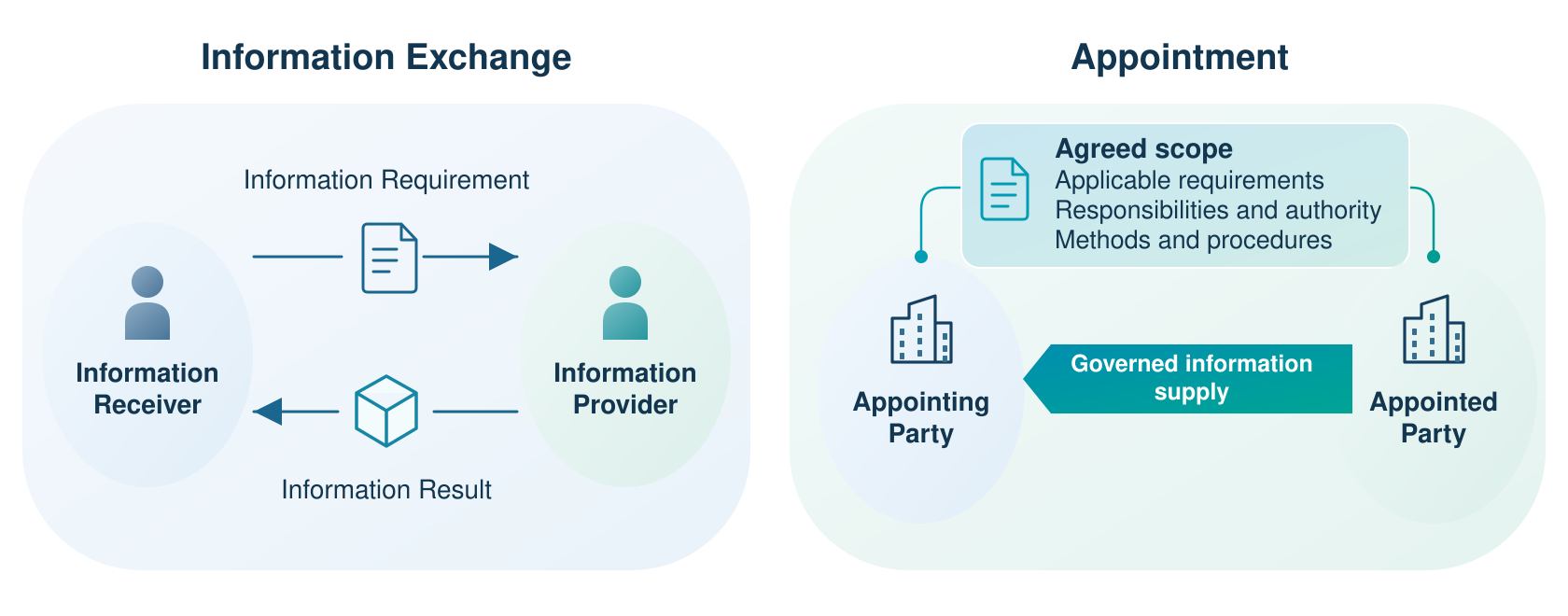
Returning to the industrial enterprise, management may require a technical assessment supported by inspection records, operating data and recommendations for further action. The applicable Information Requirements describe the expected information and the conditions it must satisfy. The Appointment establishes which engineering organisation or department undertakes the corresponding work and defines the scope and conditions within which those requirements become its responsibility.
Appointments Within and Between Organisations#
In construction, Appointments frequently form part of contractual relationships between clients, consultants, contractors and suppliers. A client may appoint a design consultancy to develop engineering information, while a contractor may appoint a specialist organisation to provide information about installed equipment. Such arrangements establish responsibilities between separate organisations and are commonly formalised through contracts or professional-services agreements.
An Appointment, however, does not necessarily require two separate legal organisations. An industrial company may assign its own design department to prepare information for a facility upgrade, while an asset operator may instruct an internal maintenance team to inspect equipment and update technical records. Although these arrangements do not involve contracts between independent legal entities, they still require clearly established production scopes, applicable Information Requirements and responsibilities.
Table 5.2 compares these organisational arrangements.
Aspect | External Appointment | Internal Appointment |
|---|---|---|
Participants | Separate organisations | Departments, divisions or identifiable organisational units |
Possible formalisation | Contract, professional-services agreement or other contractual instrument | Authorised management decision, internal agreement or documented assignment |
IMC purpose | Establish applicable information responsibilities between organisations | Establish applicable information responsibilities within an organisation |
These are not two fundamentally different forms of information management. In both cases, the Appointment establishes the organisational relationship through which information-production responsibilities are undertaken and governed. The difference lies primarily in the organisational and legal means through which the arrangement is established.
This distinction is particularly relevant to enterprises combining internal production capabilities with external specialist services. A single Information Management Cycle may involve both internal and external Appointments, while the information produced under them must remain coordinated and suitable for the same management purposes.
What Does an Appointment Establish?#
An Appointment must establish a sufficiently clear basis for the participating Parties to understand the work undertaken, the Information Requirements that apply and the conditions under which the resulting information will be provided and assessed. Its specific provisions depend on the nature of the work and the organisational relationship, but several elements normally need to be addressed:
Scope of work: the activities and information-related results covered by the Appointment.
Applicable Information Requirements: the Requirements that govern the agreed scope of information production.
Expected Information Results: the information to be created, updated, checked or provided.
Timing and delivery conditions: when information is required and how it must become available to its Receiver.
Responsibilities and governing rules: the relevant responsibilities, the applicable Information Production Standard, Methods, Procedures and arrangements for assessing or accepting information.
These elements are connected but serve different purposes. The scope defines the work undertaken; the Requirements establish what the resulting information must satisfy; timing connects production with the Management Activities it supports; and the governing arrangements determine how work is coordinated, controlled and assessed.
Consider a maintenance contractor appointed to replace ventilation equipment in an office building. Completing the physical work does not, by itself, ensure that the asset operator receives suitable information for future operation and maintenance. The Appointment may also establish requirements for updated equipment records, commissioning results, operating instructions and corresponding updates to the Asset Information Model.
Such information-related conditions can form part of a broader agreement covering equipment replacement or maintenance services. A separate contract for every Information Result is neither necessary nor generally desirable. What matters is that the applicable information-production responsibilities and conditions are explicitly established and can be managed throughout the work.
An important distinction must therefore be made between the Appointment and the instrument through which it is formalised. A contract, internal instruction or other organisational document may record the agreed conditions and give them contractual or administrative effect. From an IMC perspective, however, the Appointment is the organisational relationship within which those conditions govern information production and provision.
This distinction becomes particularly important when Information Requirements or production arrangements change. Suppose a design consultant is asked to provide additional information after the client’s project objectives have been revised. The new Requirement does not automatically become part of the consultant’s existing responsibilities. The Parties must determine whether it falls within the agreed scope and, where necessary, revise the Appointment and its applicable conditions.
A similar situation may arise when an asset operator changes the required structure or format of maintenance information. Although the change may appear technically straightforward, its implementation could involve additional work, different software capabilities or adjustments to established Methods and Procedures. These consequences must be considered within the relevant organisational arrangement rather than treated as an automatic extension of the Provider’s obligations.
Appointments therefore maintain the connection between information demand, agreed responsibilities and the conditions of information production, including when those conditions change. Part II examines the instruments used to formalise particular rights and obligations, especially Information Protocols. At this stage, the essential point is that an Appointment is a fundamental organisational mechanism of IMC, not the name of a particular contractual document.
From Appointments to Information Supply Chains#
A single Appointment may be sufficient to organise information production for a relatively simple activity. An asset manager, for example, may appoint an engineering team to inspect equipment and prepare a condition report. The Appointment establishes the relevant production scope, applicable Information Requirements and responsibilities within one organisational relationship.
More complex information production requires contributions from several participants whose activities and information results depend on one another. Consider the modernisation of an industrial facility. Process engineers, structural designers, equipment suppliers and construction specialists may each undertake different portions of the work, while their information must ultimately contribute to a consistent Information Model.
Individual Appointments establish the responsibilities undertaken by these participants, but the existence of separate Appointments does not, by itself, ensure coordinated information production. The Parties must also understand how their respective production scopes are related, which information they depend upon and how their contributions will be brought together.
As a result, collaborative information production may involve successive Appointments through which responsibilities are distributed across several organisational levels. Together, these relationships form the organisational basis of Information Supply Chains. Importantly, the flow of information does not necessarily follow the hierarchy of Appointments: specialists may exchange information directly under agreed arrangements even when their organisational relationships follow different paths.
The essential question is therefore no longer simply which Party has undertaken a particular information-production responsibility, but how multiple Parties fulfil their responsibilities as part of a coordinated production arrangement. This requires distinguishing the functions performed by Appointing Parties, Lead Appointed Parties and Appointed Parties and understanding how their relationships support information production across the supply chain.
5.3. Party Functions and Information Supply Chains#
Information production in a construction project or asset-management activity often depends on several Parties undertaking different but interrelated responsibilities. As established in § 5.2, Appointments provide the organisational basis for these relationships. However, assigning separate production scopes does not, by itself, ensure that their results will form a coherent Information Model. The participants must also organise the coordination of their contributions so that the information produced can fulfil the intended Management Activities.
Consider an industrial company preparing to reconstruct one of its production facilities. The company needs information to evaluate engineering alternatives, estimate investment costs, plan construction and prepare the facility for operation. It appoints a design organisation to coordinate engineering information and a construction contractor to organise information production during implementation. Both may involve specialist departments, consultants, subcontractors and equipment suppliers. Although these participants contribute to the same overall objectives, they perform different functions in initiating, coordinating and carrying out information production.
IMC distinguishes these organisational functions through the concept of IMC Party Function. An IMC Party Function defines the function performed by a Party within a particular Information Management Cycle. It reflects the Party’s responsibilities and position in that Cycle, not necessarily its legal status, professional specialisation or permanent position in an organisational hierarchy.
Three principal IMC Party Functions are distinguished: Appointing Party, Lead Appointed Party and Appointed Party. Together, they explain how information demand is established, how its fulfilment is coordinated and how the required information is produced within the organisational relationships established through Appointments.
Three Principal IMC Party Functions#
Appointing Party — Establishing Information Demand
The Appointing Party initiates the Information Management Cycle and acts as the principal client of the Information Model being developed or maintained. It establishes the management context in which information is needed, determines the applicable Information Requirements and organises the conditions necessary for their fulfilment. Its primary concern is not the direct production of individual information resources, but ensuring that the information produced serves the Management Activities and Decisions for which it is required.
In our industrial reconstruction project, the Appointing Party is the company responsible for developing and operating the facility. Its management needs information to evaluate investment options, assess proposed engineering solutions, monitor construction and determine whether the completed facility meets its objectives. These management purposes establish the basis for deciding what information is required, when it must become available and what conditions it must satisfy.
The Appointing Party’s principal information-management functions throughout the Information Management Cycle include:
Establishing Information Needs and Requirements: identifying the information needed to support management objectives, activities and Decisions.
Setting common rules and ways of working — establishing the applicable Information Production Standard and Information Production Methods and Procedures for collaborative information production.
Organising Appointments: identifying or selecting the Parties responsible for coordinating information production and establishing the relevant Appointments.
Providing information-production conditions: ensuring that the necessary Reference Information, Shared Resources and CDE arrangements are available to participating Parties.
Assessing and accepting information: organising the assessment of information received and making appropriate acceptance Decisions against established Requirements and criteria.
Governing the Information Model: ensuring that the resulting Information Model is maintained and available for its intended management purposes.
These functions extend across the Information Management Cycle, from identifying information demand to governing the resulting information. They are closely connected: Requirements cannot be fulfilled reliably without appropriate production conditions, while the value of information ultimately depends on its suitability for the Management Activities that created the demand.
The Appointing Party may engage internal departments or external specialists to perform particular activities. For example, the industrial company may use a consultancy to help develop an Information Production Standard or a technology provider to configure its Common Data Environment. Such support does not change its function as the Appointing Party. The Appointing Party remains responsible for establishing the overall information demand and ensuring that information-management arrangements serve its management objectives, even when specific activities are performed by others.
Lead Appointed Party — Coordinating Information Production#
The Lead Appointed Party is a Party appointed directly by the Appointing Party to lead and coordinate an Information Production Team and to be accountable for the coordinated production and delivery of information within its appointed scope. Its defining function is not simply to manage its own information production, but to organise the contributions of several participants into a coherent information result.
In our industrial reconstruction project, the lead design organisation is responsible for coordinating the design Information Model. This involves information produced by process engineers, structural designers, building-services specialists and other participants. Their contributions must satisfy compatible Requirements, become available at appropriate times and undergo the necessary checking and coordination before the combined result can be delivered.
The dependencies between these participants are often substantial. A structural Task Group may require equipment loads and technical characteristics from process engineers, while the latter may depend on preliminary layouts or structural constraints established by other specialists. Such relationships make information production an interconnected activity rather than a collection of independent assignments.
The Lead Appointed Party’s principal information-management functions include:
Planning and coordinating production: establishing how the required information will be produced and how the work of different participants will be organised.
Distributing applicable Requirements: ensuring that participants understand the Information Requirements relevant to their production scopes.
Managing information dependencies: coordinating necessary exchanges, resolving interfaces and ensuring that participants receive the information required for their work.
Assessing and coordinating results: organising the checking, coordination and preparation of information for delivery.
These functions extend beyond collecting separately produced Information Containers. The Lead Appointed Party must ensure that the contributions of different participants can be combined into a coherent information result fulfilling the applicable Information Requirements. It remains accountable to the Appointing Party for that coordinated result, even when substantial portions of information production are assigned to other Parties.
An Information Management Cycle may involve several Lead Appointed Parties responsible for different production scopes. In the industrial reconstruction project, the company may appoint a lead design organisation and a construction contractor. The former coordinates design information, while the latter organises information production during construction, including installation records, inspection results and information about installed equipment.
Each Lead Appointed Party coordinates its own Information Production Team and remains accountable for the information result within its Appointment. Their respective contributions must nevertheless remain consistent with the Requirements established for the wider Information Management Cycle.
Appointed Party — Performing Information Production#
An Appointed Party performs a defined scope of information-production work under an Appointment. Its function is to produce, update, check or provide information in accordance with the applicable Information Requirements and agreed working arrangements. Depending on the activity, this may involve developing specialist models, preparing calculations and reports, creating or updating Information Containers, recording construction activities or maintaining information about an existing asset.
In our industrial reconstruction project, a structural engineering department may prepare calculations and structural models, an equipment supplier may provide technical specifications, and a specialist contractor may produce installation records. Each Party contributes information required for the wider project within its own production scope. However, the work of one Party may depend on information supplied by others, while its results may become inputs to subsequent activities. A structural model may require information about process equipment, for example, while installation records may need to reference approved design information.
Within its assigned scope, the Appointed Party’s principal information-management and production functions include:
Planning assigned production work: determining the activities, resources and timing required to fulfil applicable Information Requirements.
Producing information: creating or updating Information Containers and other information results according to the agreed Information Production Standard, Methods and Procedures.
Checking produced information: verifying information within its scope before making it available for coordination or delivery.
Participating in collaborative coordination: exchanging information with other participants, resolving identified inconsistencies and incorporating necessary changes.
Managing information within the CDE Process: following applicable Procedures for Container Revisions, states, metadata, sharing and authorisation.
Providing information results: making the required information available or delivering it under the conditions established by the relevant Appointment.
These functions are closely connected. Information production rarely proceeds as a single uninterrupted sequence from an assigned task to a completed result. It may require successive exchanges, checks, coordination activities and revisions before information becomes suitable for its intended use. An Appointed Party must therefore fulfil its own production responsibilities while participating in the wider collaborative process.
An Appointed Party may also engage other Parties through subsequent Appointments, assigning them defined portions of its production scope. Such arrangements can extend an Information Supply Chain across several organisational levels without requiring the Appointing Party to appoint every specialist directly. The responsibilities and production activities of each participant remain governed by its relevant Appointment.
The distinction between the three IMC Party Functions is therefore functional rather than simply hierarchical. The Appointing Party establishes information demand and the conditions for its fulfilment; the Lead Appointed Party coordinates a defined Information Production Team and remains accountable for its coordinated information result; and the Appointed Party undertakes information-production responsibilities within an Appointment.
These functions describe how information-production responsibilities are established, coordinated and fulfilled across multiple Parties. They do not prescribe how many organisations must participate or require each function to be performed by a different organisation.
How Information Supply Chains Are Formed#
The three IMC Party Functions provide the organisational basis for collaborative information production. The Appointing Party establishes the overall information demand and appoints Lead Appointed Parties responsible for coordinating defined production scopes. Each Lead Appointed Party organises an Information Production Team comprising the Parties involved in fulfilling its Appointment. These Parties may, in turn, appoint further Parties to undertake particular portions of their assigned work.
An Information Production Team may therefore include participants engaged through several successive levels of Appointments. Its boundaries are determined by the coordinated information-production scope, not by the number of organisational levels or direct Appointment relationships. Participants engaged through subsequent Appointments remain part of the wider production arrangement insofar as their contributions support that scope.
Through these relationships, Information Supply Chains are formed. An Information Supply Chain is an organised arrangement of Parties and their information-production relationships through which required information is produced, coordinated and supplied to its intended Receivers. It may involve a small number of participants or extend across multiple organisations and levels of appointment. Its purpose is to ensure that individual contributions support the coordinated information results required by the ultimate Receiver.
Unlike a conventional supply chain concerned primarily with physical goods or services, an Information Supply Chain must account for both the distribution of production responsibilities and the dependencies between information results. A Party may need information produced elsewhere before completing its own work, while information created for one purpose may also support another participant or Management Activity. Organising the supply chain therefore requires attention not only to who produces information, but also to how that information becomes available to those who depend upon it.
Effective information production requires both a clear distribution of organisational functions and coordinated information flows between the Parties performing them.
Figure 5.3 illustrates an organisational arrangement with two parallel Information Production Teams in our industrial reconstruction project. The design and construction teams are coordinated by different Lead Appointed Parties. Each team includes the Appointed Parties contributing to its production scope, including participants engaged through subsequent Appointments. Information exchanges may also occur directly between participants belonging to different teams.
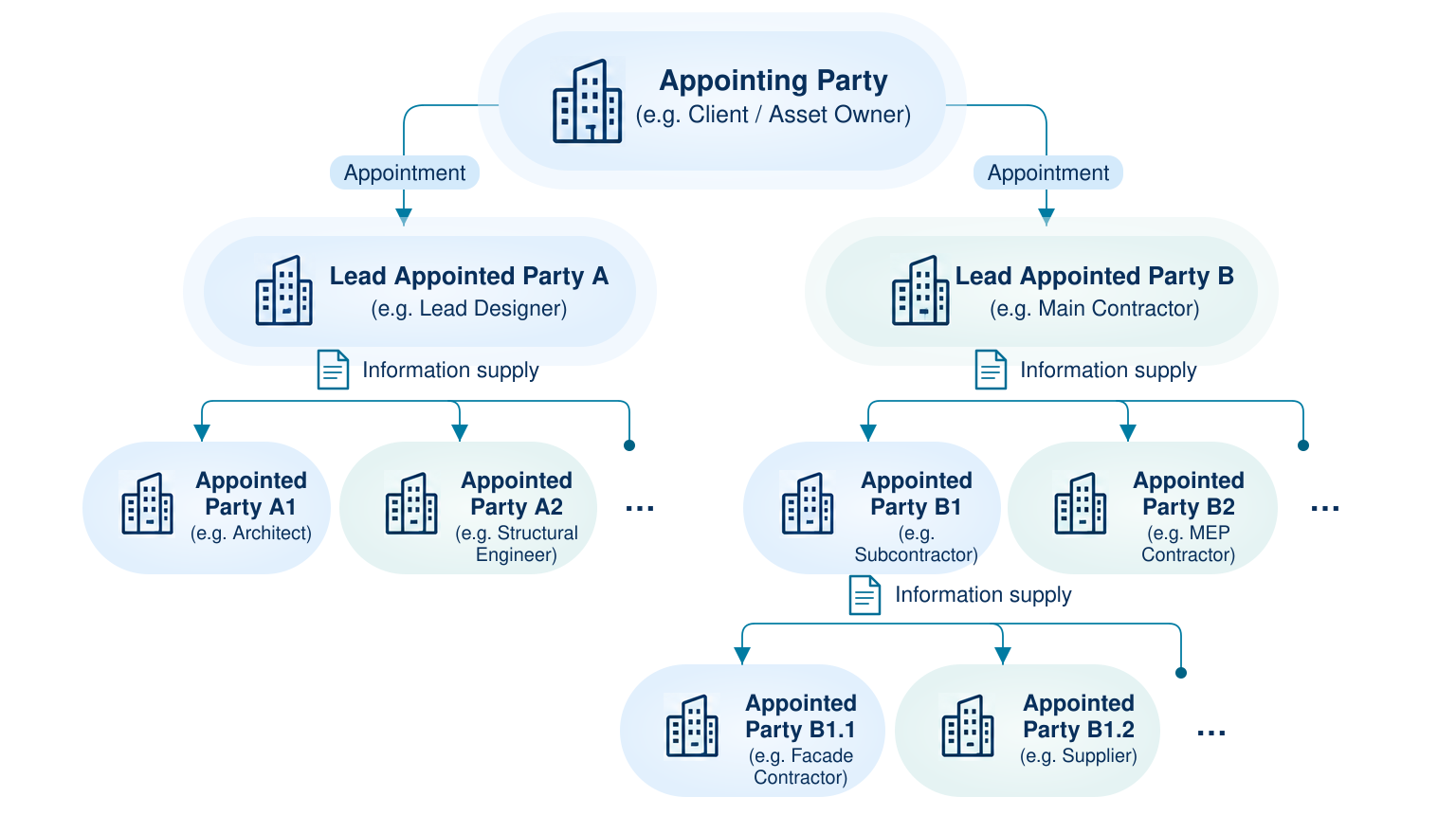
The arrangement shown in Figure 5.3 is illustrative rather than prescriptive. Projects and asset-management activities may involve different numbers of participants, production branches and levels of Appointment. Importantly, not every subsequent level of Appointment creates a new Lead Appointed Party. Within a particular Information Management Cycle, that function belongs to a Party appointed directly by the Appointing Party to coordinate a defined Information Production Team.
Appointment Relationships and Information Flows#
Appointments establish organisational relationships through which responsibilities for information production are undertaken and distributed. However, information does not necessarily move along the same paths as the hierarchy of Appointments. In multidisciplinary production, specialists frequently depend on information created by participants with whom they have no direct Appointment relationship.
Consider our industrial reconstruction project. A structural engineer working within the design Information Production Team may require equipment loads or technical characteristics from a supplier participating in the construction team. The necessary information may be exchanged directly between these specialists under agreed CDE arrangements, even though their organisational responsibilities are established through different Appointments.
Similar dependencies arise within a single Information Production Team. Architectural, structural and building-services specialists may repeatedly exchange information as their designs develop, without establishing a separate Appointment for each exchange. An information exchange connects the participants involved in supplying and receiving information; it does not, by itself, create a new organisational commitment.
Two related structures must therefore be distinguished:
Appointment relationships establish how information-production responsibilities are assigned and distributed among Parties. They provide the organisational relationships through which the relevant work is governed.
Information flows and dependencies connect the Providers and Receivers whose activities depend on the production, availability and exchange of information. They reflect the practical relationships required for collaborative production.
These structures are connected, but they are not identical. A clearly defined hierarchy of Appointments cannot ensure effective information production if necessary exchanges and dependencies have not been identified and coordinated. Conversely, efficient technical communication between specialists does not automatically establish Responsibility or Authority for producing, checking, authorising or delivering the information exchanged.
This distinction explains why the coordinating function of a Lead Appointed Party extends beyond administering separate production assignments. The Lead Appointed Party must ensure that relevant information dependencies are understood, necessary exchanges take place and individual contributions can be combined, assessed and delivered as a coherent result.
An Information Supply Chain must therefore be managed as an interconnected production arrangement, not merely as a hierarchy of Appointments.
One Party, More Than One Function#
The distinction between IMC Party Functions does not mean that each function must be performed by a separate organisation. A small engineering consultancy appointed directly by an asset owner to coordinate information for a building refurbishment may organise specialist surveys while also preparing much of the engineering information itself. In this situation, the same Party performs both Lead Appointed Party and Appointed Party functions: it coordinates the Information Production Team and undertakes part of the information-production scope.
In a larger project, these functions may be distributed among more organisations and organisational units. The underlying management logic remains the same: information demand must be translated into coordinated production, and the resulting information must satisfy the applicable Requirements. IMC Party Functions describe the functions that must be fulfilled, not the number of organisations required to fulfil them.
Identifying the participating Parties and their functions establishes an essential organisational foundation, but it does not resolve every question about how information-production activities are governed. A Party may remain accountable for a coordinated information result without performing all the work required to produce it. A specialist may be assigned to create an Information Container without having the right to authorise its issue. Similarly, permission to access information does not automatically imply responsibility for producing it or Authority over its use.
These distinctions lead to four connected but separate governance concepts: Responsibility, Authority, Assignment and Access. They establish how obligations, decision-making rights, production work and permitted interactions are distinguished within the organisational relationships created through Appointments.
5.4. Responsibility, Authority, Assignment and Access#
The preceding sections established how Appointments and IMC Party Functions organise collaborative information production. They explain which Parties participate, how information-production responsibilities are undertaken and how individual contributions are coordinated within Information Supply Chains. Yet identifying the organisational structure does not resolve every question about the governance of particular activities and information results.
Consider an engineering organisation preparing the structural design of an industrial facility. A Task Group produces structural calculations and the corresponding Information Containers. The information undergoes the required technical checks, after which an authorised representative decides whether it may be issued for coordination with other disciplines. The Lead Appointed Party remains accountable for the coordinated information result within its Appointment, even though different participants may perform production, checking and coordination activities.
At the same time, the Common Data Environment (CDE) provides the technical means for controlling which participants may view, modify, share or issue the information. These permissions must support the established organisational arrangements, but they do not themselves determine who is responsible for the result or authorised to make the relevant decisions.
All these relationships concern the same information, yet they describe different aspects of its management. Calling everyone involved responsible for the structural model would conceal distinctions essential for effective coordination and control.
IMC therefore distinguishes four connected but separate governance concepts: Responsibility, Authority, Assignment and Access. Together, they clarify the obligations, decision-making rights, allocation of work and permitted interactions through which collaborative information production is governed.
Four Dimensions of Information Governance#
Each of the four governance concepts answers a different management question. Together, they establish how obligations, decisions, work and permitted interactions are organised in collaborative information production. Table 5.3 summarises these distinctions.
Concept | Governing question | Meaning in IMC |
|---|---|---|
Responsibility | Responsible for what? | The obligation to fulfil a defined function, perform an activity or achieve an expected result. |
Authority | Who may decide? | The formally established right to make particular decisions or authorise actions. |
Assignment | Who performs the work? | The allocation of defined activities or Information Tasks to a Party, team or Task Group. |
Access | What interactions are permitted? | The permissions governing how a participant may interact with information and the systems through which it is managed. |
These concepts describe different dimensions of the same governance arrangement. A Task Group may be assigned to produce an Information Container without having Authority to authorise its issue. A Party may remain responsible for a coordinated information result even when other participants perform much of the production work. Similarly, a participant may possess technical permissions within a CDE without being authorised to exercise the corresponding management decision rights.
The essential distinction is that being responsible for a result, being authorised to make a decision, being assigned to perform work and having technical access are not equivalent. Each dimension must be established within the relevant management context and remain consistent with the others.
Effective information governance requires these four dimensions to operate together, but none can substitute for another.
Responsibility — What Must Be Achieved?#
Responsibility is an obligation associated with a defined function, activity or expected result. It must always be understood in relation to a particular subject: responsible for what, within which scope and under which conditions? Without this context, statements about Responsibility may appear clear while leaving important obligations undefined.
Consider the structural design of our industrial facility. An Appointed Party may be responsible for producing the structural information required under its Appointment. The Lead Appointed Party, meanwhile, is responsible for coordinating that information with contributions from other disciplines and ensuring that the resulting design Information Model satisfies the applicable Information Requirements. Both Parties have responsibilities, but the subjects and scopes of those responsibilities differ.
Within this context, Accountability means being answerable for the fulfilment of an undertaken responsibility and its outcome. Assigning work to another participant does not, by itself, transfer the Accountability established through an Appointment. For example, when a Lead Appointed Party engages a specialist engineering organisation to produce structural information, the specialist becomes responsible for its agreed production scope, while the Lead Appointed Party remains accountable to the Appointing Party for the coordinated information result.
This distinction is essential in multi-party information production. Individual Parties may undertake particular production responsibilities, and Task Groups may be assigned the corresponding Information Tasks. Nevertheless, the distribution of work does not automatically alter the obligations established through the relevant Appointments.
Responsibility is therefore context-specific rather than a permanent attribute of a participant. It must be established in relation to particular functions, Requirements, activities and results, and it must remain clear even when information-production work is distributed among several Parties.
Authority — Who May Make the Decision?#
Authority is the formally established right to make particular decisions or authorise actions within a defined management context. It determines who is entitled to make a decision and under which conditions that decision has recognised consequences for the information or the Parties involved.
Information production involves decisions that cannot be reduced to creating or checking information content. An Information Container may need to be authorised for sharing, a coordinated information result may require approval, and information formally submitted to a Receiver may need to be accepted or rejected. Although these decisions concern related information, they have different purposes and may require different Authorities.
Consider the structural design example. A Task Group prepares a calculation report and performs the required technical checks. Successful checking establishes that the information has undergone the relevant verification activities, but it does not necessarily authorise the Information Container for issue. That decision may belong to a designated representative acting under the applicable Information Management Procedures.
Similarly, the Lead Appointed Party may authorise a coordinated information result for delivery, while the Appointing Party retains the Authority to accept or reject the submitted information against the applicable Information Requirements and Acceptance Criteria. These decisions belong to different governance contexts: authorisation for issue concerns permission to release information; Acceptance concerns the Receiver’s decision about whether the submitted information satisfies the relevant requirements.
The distinction matters because neither decision should be assumed to follow automatically from the other. Information authorised for issue may subsequently fail to satisfy the Receiver’s Acceptance Criteria. Conversely, the responsibility to assess information does not, by itself, grant a participant the right to modify or authorise the information being assessed.
Authority must therefore be established explicitly and exercised within defined limits. Technical competence, participation in an activity or Assignment to perform work does not automatically confer the right to approve, authorise or accept the resulting information. Where Authority is delegated, the scope, conditions and limits of that delegation must remain clear.
Assignment — Who Performs the Work?#
Assignment concerns the allocation of specific activities or Information Tasks to a Party, team or Task Group. It translates organisational responsibilities into work that can be planned, performed and monitored, without automatically changing the obligations established through the relevant Appointments.
Consider a structural engineering organisation responsible for producing a defined part of the design Information Model. The corresponding Information Tasks may be assigned to a Task Group preparing structural calculations and the required Information Containers. Other Task Groups may be assigned activities whose results provide necessary inputs for this work. These Assignments determine how production is organised, while the relevant Parties retain their responsibilities under their Appointments.
Assignment is particularly important because information-production activities are often interdependent. A structural Task Group may require equipment loads before completing its calculations, while another group may depend on the resulting structural information to develop foundations or construction arrangements. The work must therefore be allocated and coordinated so that necessary inputs, intermediate results and completed Information Containers become available when required.
The essential distinction is between being responsible for an information result and being assigned the work required to produce it. Responsibility establishes an obligation associated with a defined function or outcome; Assignment establishes who will perform the corresponding activities. These dimensions must remain consistent, but they operate at different levels of information management.
Information Tasks provide a structured basis for planning and allocating the activities necessary to fulfil applicable Information Requirements. Task Groups provide the operational units through which those activities are performed, as discussed in § 5.5. The detailed development, allocation and scheduling of Information Tasks are addressed in Part II.
Access — What May the Participant Do?#
Access determines which interactions a participant is permitted to perform with information and the systems through which it is managed. Within a Common Data Environment, participants may have different permissions to view, create, modify, share, issue or otherwise interact with Information Containers according to the applicable governance arrangements.
Access permissions are essential for implementing information-management rules, but technical permission to perform an operation is not equivalent to Authority to make the corresponding management decision. The two must be related without being confused.
For example, a Task Group may have permission to modify an Information Container during production without having Authority to authorise its formal issue. Conversely, a representative authorised to accept a submitted information result may need access to the relevant Information Containers and supporting evidence without requiring permission to modify their content.
The distinction becomes particularly important when a technical system makes an operation possible even though the governing conditions for performing it have not been satisfied. The ability to execute an action within a CDE does not, by itself, make that action legitimate within the Information Management Cycle. Equally, a properly authorised activity must be supported by suitable technical permissions so that the participants concerned can perform their assigned functions.
Access arrangements should therefore implement the applicable governance conditions, not establish them. This principle applies whether information is managed within a single CDE solution or across several connected Information Systems. Technical mechanisms may differ, but the relationship between permitted interactions and formally established Authority must remain consistent.
Applying the Four Concepts Together#
The practical value of distinguishing Responsibility, Authority, Assignment and Access becomes clear when an Information Container moves from production towards formal issue. Although the same information is involved throughout, the participants may have different obligations, decision-making rights, assignments and technical permissions.
Consider a Task Group assigned to prepare a structural calculation report for coordination with other engineering disciplines. The report must satisfy the applicable Information Requirements, undergo the required checks and become available through the agreed CDE Process. Several participants may contribute to these activities, but their involvement does not imply identical responsibilities or decision-making rights.
Four questions must be answered:
Responsibility: Which Party is responsible for the required calculation report, and which Party remains accountable for the coordinated information result under its Appointment?
Authority: Who may authorise the report for issue, and who has Authority to make subsequent approval or Acceptance decisions where required?
Assignment: Which Task Group is assigned to produce the report and perform the relevant Information Tasks?
Access: Which participants are permitted to create, modify, view or issue the Information Container under the applicable CDE arrangements?
Figure 5.4 illustrates these four governance dimensions in relation to the same information-production activity.
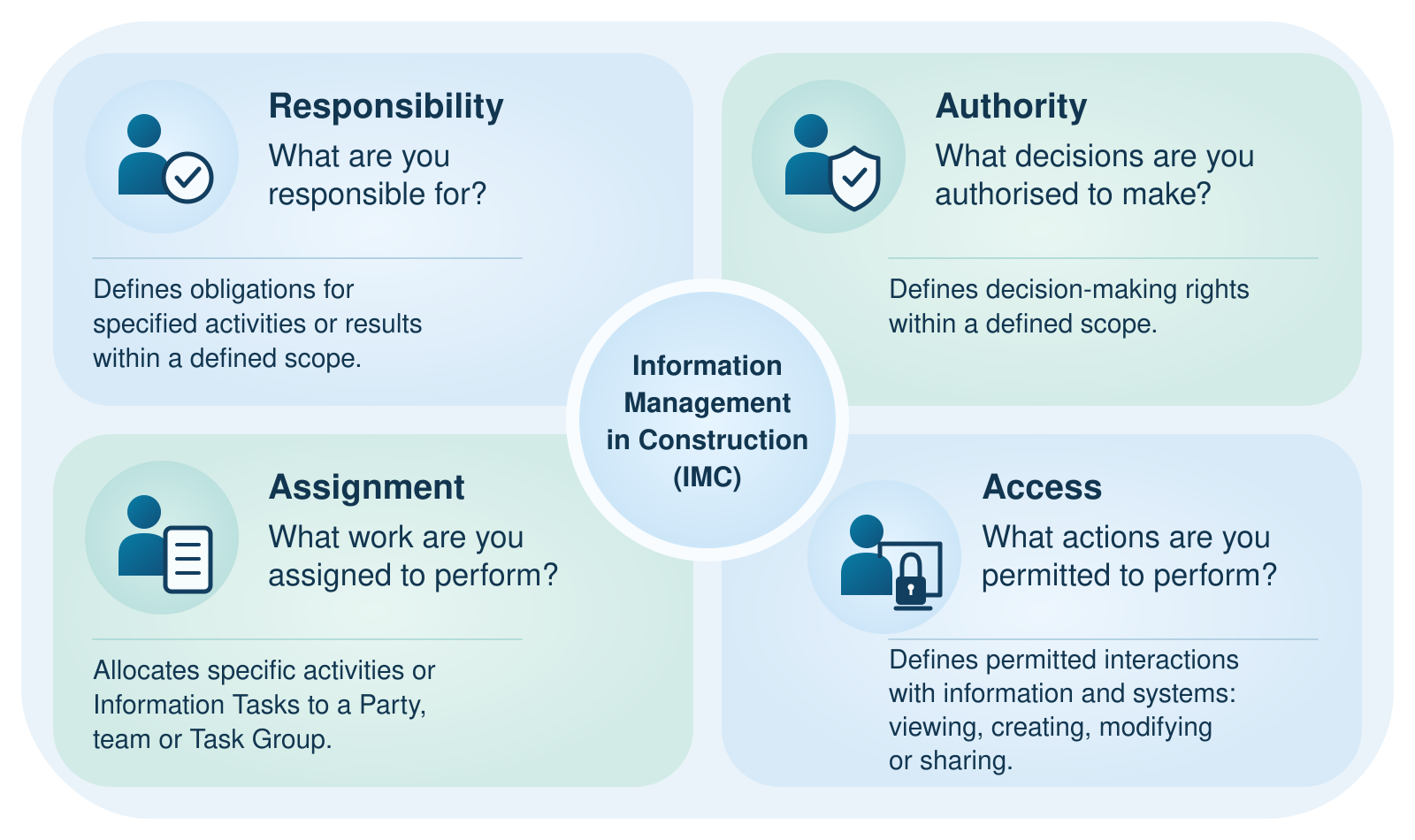
The four dimensions shown in Figure 5.4 are not successive stages of a prescribed workflow. They describe complementary governance relationships that must remain consistent throughout information production and exchange. Responsibility establishes the relevant obligations; Assignment organises the work; Authority governs the decisions; and Access determines the permitted interactions with information.
Confusing these dimensions can create several recurring problems:
Unclear Responsibility: information is expected, but no Party has a clearly established obligation to provide a suitable result.
Insufficient Authority: a participant is expected to make a decision without the formally established right to do so.
Missing Assignment: an agreed information result has no corresponding Information Tasks allocated for its production.
Inappropriate Access: technical permissions either permit actions beyond a participant’s Authority or prevent legitimate work from being performed.
These problems may appear as technical failures, coordination difficulties or delays in information delivery. Their underlying causes, however, often lie in the organisation of information management rather than in the technology itself.
Responsibility, Authority, Assignment and Access must be defined consistently, but none can substitute for another. Assigning work does not automatically transfer Accountability or decision-making Authority, and technical Access does not create governance rights.
Why RACI Alone Is Not Enough#
Organisations commonly use RACI matrices to clarify participation in activities and decisions. The categories Responsible, Accountable, Consulted and Informed help identify who performs work, who is answerable for its outcome and which participants should be consulted or informed. RACI can therefore be a useful instrument for organising collaboration and making the distribution of responsibilities more transparent.
However, a RACI matrix is not a complete model of information governance. It does not, by itself, establish which Information Requirements apply under a particular Appointment, which Authorities are needed for specific management decisions or which technical Access permissions must support those decisions. Nor does it fully describe the different governance contexts in which the same Party may participate.
Consider a manager identified as Accountable for an information-delivery activity. That designation does not automatically establish the manager’s Authority to accept a submitted Information Model on behalf of the Appointing Party. Similarly, identifying a Task Group as Responsible for producing information does not determine who may authorise the corresponding Information Containers for issue. Accountability for an outcome, Authority to make a decision and Assignment to perform work must remain distinguishable.
RACI is therefore best understood as a supporting instrument for describing participation and accountability, rather than a substitute for the Appointments, applicable Information Requirements, established Authorities and governance rules through which information management is organised. Its practical value depends on how accurately it represents those arrangements.
Management and Production Responsibilities#
The distinction between information management and information production, introduced in § 5.1, also applies when establishing Responsibilities and Assignments. Some activities are primarily concerned with creating, checking or modifying information content, while others establish and maintain the conditions under which that information is produced, assessed, exchanged and used.
Developing a structural model or updating equipment records is principally an information-production activity. Establishing checking arrangements, coordinating the authorisation of information for issue or determining whether a submitted result satisfies applicable Information Requirements is principally an information-management activity. The distinction concerns the purpose of the activity, not necessarily the professional position of the person performing it.
In practice, the two kinds of activity are closely connected. A technical check may identify the need to revise an Information Container, while coordinating production may require substantial engineering knowledge. A manager may participate in technical assessments, and a professional specialist may perform certain information-management functions alongside production work. Distinguishing the functions should not create an artificial separation between the people performing them.
What matters is that information-production activities and the management of those activities are organised consistently. Responsibilities must be established, necessary work assigned, decision-making Authorities defined and appropriate Access provided. These governance dimensions apply across organisational boundaries and throughout the Information Management Cycle.
The next question is how the participating Parties organise the actual work of producing information. While Appointments establish organisational relationships and responsibilities, Information Production Teams and Task Groups provide the practical structure through which information-production activities are coordinated and performed. This relationship is examined in § 5.5.
5.5. Teams and Task Groups#
Appointments and IMC Party Functions establish the organisational relationships through which information-production responsibilities are undertaken and governed. As discussed in § 5.4, these responsibilities must be distinguished from the Assignment of particular activities and the Authority and Access required to perform them. Yet establishing responsibility for an information result does not, by itself, determine how the work needed to produce it will be organised.
An Information Production Team may involve several Parties, multiple professional disciplines and successive levels of Appointment. Its participants must fulfil applicable Information Requirements, coordinate their contributions and follow the agreed CDE Process. This requires more than distributing production scopes among organisations: the necessary Information Tasks must be assigned to identifiable groups of specialists capable of performing and coordinating the work.

In IMC, these operational units are called Task Groups. They provide the practical structure through which Information Tasks are performed and the corresponding Information Containers are produced, checked and coordinated.
The distinction between Information Production Teams and Task Groups is therefore essential. The former provide the organisational framework for fulfilling a coordinated production scope; the latter organise the practical work required within that framework. Their relationship cannot always be reduced to the formal hierarchy of Appointments or to the organisational structure of the participating Parties.
Information Production Teams — The Framework for Collaboration#
An Information Production Team brings together the Parties and participants involved in producing and delivering information within a defined scope of an Information Management Cycle. It is coordinated by a Lead Appointed Party and may include participants engaged through several levels of Appointments.
As established in § 5.3, the boundaries of an Information Production Team are determined by its coordinated production scope, not by the number of organisations or levels in its Information Supply Chain. A Lead Appointed Party may coordinate several Appointed Parties, each of which may engage further participants for particular production activities. These participants contribute to the same Information Production Team insofar as their work supports its defined scope.
Consider the industrial reconstruction project discussed in § 5.3. The lead design organisation coordinates an Information Production Team responsible for developing the design Information Model. The team includes internal engineering departments and specialist organisations contributing process, structural, building-services and equipment information. Their results must be developed under compatible requirements and coordinated so that they form a coherent Information Model suitable for the intended project Management Activities.
The Information Production Team provides the organisational framework for planning, coordinating and assessing the collective information-production scope. However, the actual Information Tasks must still be distributed among specialists capable of performing them. This is the function of Task Groups, which provide the operational structure through which the constituent production activities are organised and carried out.
The distinction is therefore between the collective responsibility for a coordinated information result and the practical organisation of the work needed to produce it. Both are necessary, but they operate at different levels of collaborative information production.
Task Groups — The Basic Units of Information Production#
A Task Group is a group of one or more specialists organised to perform defined Information Tasks within an Information Production Team. It is the basic operational unit through which information-production work is carried out.
The term Group does not imply that several people must necessarily be involved. A Task Group may consist of a single specialist or several professionals contributing to a common production scope. What defines a Task Group is the work it is organised to perform, not the number of people involved. Depending on the production arrangements, it may be established for a specific assignment or maintained across several related activities.
In a construction project, Task Groups are often organised around professional disciplines such as structural engineering, building services or process engineering. However, disciplinary specialisation is only one possible basis for their organisation. A Task Group may instead be formed to survey an existing facility, develop information about installed equipment, update asset records or coordinate a particular component of a federated Information Model. The appropriate structure depends on the Information Requirements, production methods and coordination needs involved.
Within their assigned scopes, Task Groups perform the activities necessary to fulfil applicable Information Requirements. These activities may include:
Producing information: creating or updating Information Containers in accordance with the applicable Information Production Standard, Methods and production requirements.
Checking information: performing the required checks before information becomes available for coordination or further assessment.
Coordinating information: working with other Task Groups to resolve dependencies, inconsistencies and coordination issues between Information Containers.
Following CDE Procedures: applying the established procedures for managing Container Revisions, metadata, sharing and other controlled actions.
Providing information results: making the produced information available for the intended exchanges and subsequent activities.
These activities are closely connected. Producing an Information Container is rarely an isolated technical operation. A Task Group may depend on information created elsewhere, must check its own results and may need to revise them following coordination with other participants. Information production therefore involves creating information and preparing it to become a reliable input for subsequent activities, not merely completing an individual technical assignment.
The internal distribution of work among specialists remains a matter for the Task Group and its organisation. From the perspective of IMC, the essential requirement is that the Task Group has a defined production scope, receives the necessary Information Tasks and participates in the agreed CDE Process. These arrangements connect practical production activities with the responsibilities established through the relevant Appointments.
Appointed Parties and Task Groups — Two Organisational Dimensions#
An important distinction must be made between an Appointed Party and a Task Group. Both participate in information production, but they describe different dimensions of its organisation.
An Appointed Party performs an organisational function within an Information Supply Chain. Its Appointment establishes the relevant production scope, applicable Information Requirements and responsibilities in relation to the Party that appointed it. The Appointment therefore provides the governance context within which the Party undertakes information-production responsibilities.
A Task Group, by contrast, is an operational unit organised to perform Information Tasks and work with the corresponding Information Containers. Its composition reflects practical production needs and does not necessarily follow the organisational boundaries established through Appointments.
The distinction can be expressed simply: an Appointed Party is defined by its Appointment, while a Task Group is defined by the information-production work it performs. Consequently, the relationship between Appointed Parties and Task Groups is not necessarily one-to-one.
A small specialist organisation may perform its appointed scope through a single Task Group. A larger engineering organisation may establish several Task Groups to produce different components of the Information Model. Conversely, one Task Group may bring together specialists from several Appointed Parties when their joint participation is needed to fulfil a particular production scope.
Consider the development of information about industrial equipment in our reconstruction project. The design organisation is responsible for the relevant engineering solutions, while an equipment supplier provides technical characteristics, installation requirements and equipment-related information. A Task Group organised for this work may include specialists from both organisations, allowing their contributions to be developed and coordinated together.
However, participation in a common Task Group does not merge the participating Parties or change their responsibilities under their respective Appointments. Each Party remains responsible for its agreed scope, even where practical information production involves shared Task Groups.
This distinction also matters within the CDE Process. Appointments establish the organisational responsibilities associated with information supply, while Task Groups provide a basis for organising production activities and the corresponding working arrangements, permissions and restrictions. These relationships must remain consistent without being treated as interchangeable.
Figure 5.5 illustrates how several Appointed Parties may participate in different Task Groups within the same Information Production Team. One Party may contribute to several Task Groups, while a single Task Group may include specialists from multiple Parties.
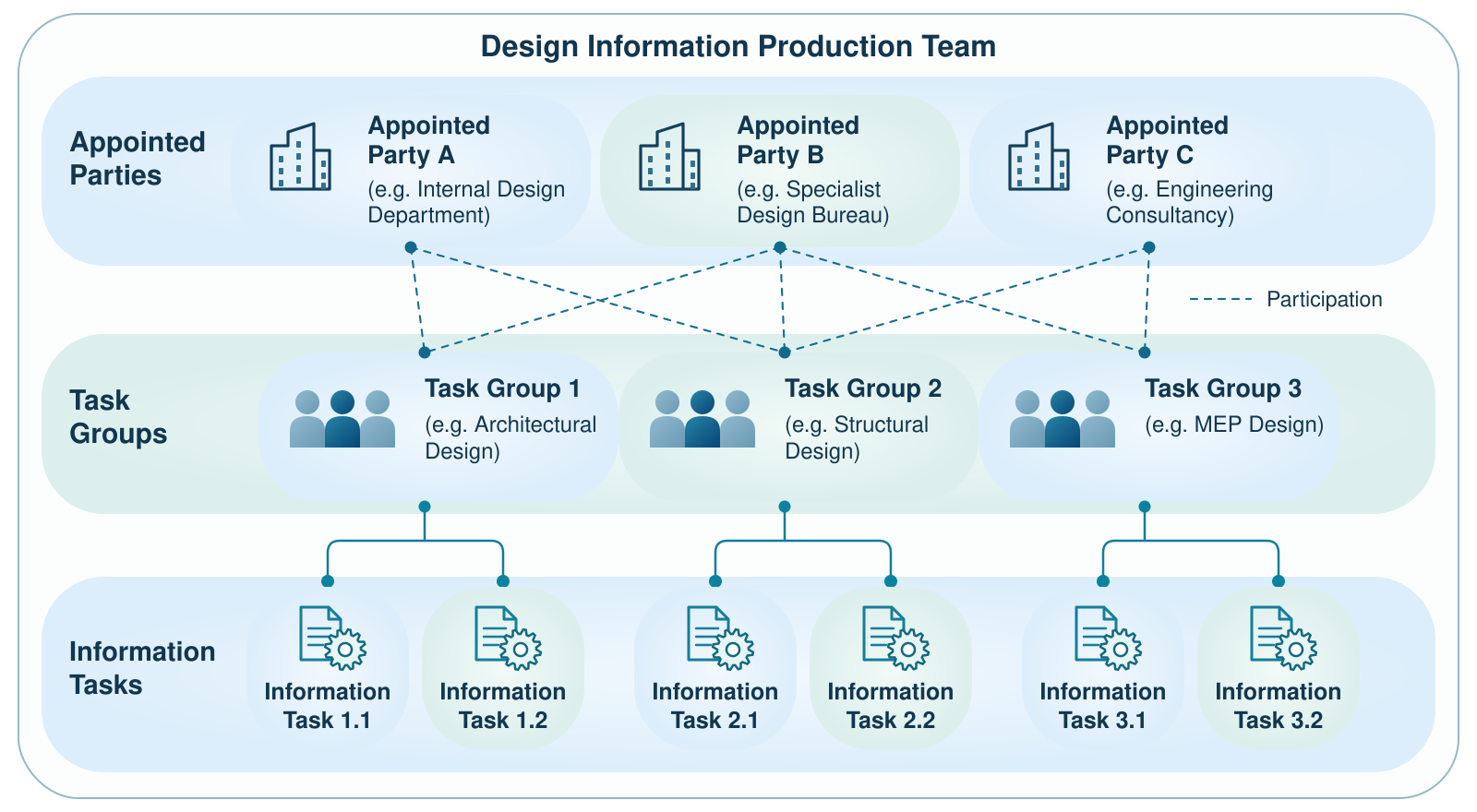
The relationships shown in Figure 5.5 represent participation in information-production activities, not organisational subordination or additional Appointments. The arrangement is illustrative rather than prescriptive. In many projects, one Appointed Party may correspond to one Task Group, and such an organisation may be entirely appropriate.
The essential requirement is that the chosen production structure supports effective collaboration while preserving the responsibilities established through Appointments.
Information Tasks and Information Containers#
Task Groups provide the operational structure for information production, while Information Tasks define the work to be performed. The relationship between them is fundamental to translating Information Requirements into actual information results.
An Information Requirement specifies what information is needed and the conditions it must satisfy. Fulfilling that Requirement requires corresponding production activities to be identified, planned and assigned. An Information Task provides a defined unit of such work, which can be assigned to an appropriate Task Group and coordinated with other necessary activities. A Requirement describes the expected information; a Task describes the work necessary to produce or prepare it.
Consider the structural engineering work in our industrial reconstruction project. A Task Group may be assigned to develop a calculation model and prepare the corresponding Information Containers. Before completing its work, it may require equipment loads from another Task Group. The resulting structural information may subsequently be needed by specialists developing foundations or planning construction.
These dependencies connect separate Information Tasks through the information they require and produce. Coordinating production therefore involves more than assigning Tasks and monitoring their completion. The necessary inputs must become available at the appropriate time, intermediate results must be checked and exchanged, and the resulting Information Containers must be sufficiently consistent to contribute to the coordinated Information Model.
Information production is rarely a single progression from an assigned Task to a completed Container. It often involves repeated checking, coordination and revision before information is ready for the intended exchange or use. An Information Task may therefore concern creating new information, updating existing information, resolving coordination issues or preparing information for controlled sharing and delivery.
Nor is there necessarily a one-to-one relationship between Information Tasks and Information Containers. Several Tasks may contribute to producing and preparing one Container, while a single Task may involve checking or coordinating several Containers. Information Tasks and Information Containers represent different aspects of information production: the work performed and the information managed. Their relationships depend on the production scope, applicable Requirements and chosen methods of organising the work.
Information-production planning must consequently address not only the expected information results, but also the activities, inputs, dependencies and exchanges necessary to achieve them. This connects the practical organisation of Task Groups with the wider management of production schedules and Information Delivery Milestones.
The detailed methods for planning, allocating and coordinating Information Tasks are examined in Part II.
Forming and Coordinating Task Groups#
There is no single correct way to organise Task Groups. Their structure should reflect the nature of the required information, the federation strategy adopted for the Information Model, the relevant production methods and the practical conditions of collaboration. Task Groups should be formed around the work that must be performed, rather than simply reproducing an existing organisational chart.
The way the Information Model is divided into components and Information Containers influences how Information Tasks are distributed and coordinated. A federation strategy may suggest particular production scopes, while the availability of professional capabilities and the dependencies between information results may require those scopes to be adjusted. The relationship between the Information Model and the organisation of its production is therefore one of mutual adjustment rather than rigid correspondence.
In established engineering organisations, Task Groups often follow professional disciplines or departmental boundaries. Such arrangements can be effective when the required information-production work aligns with those boundaries. However, collaborative production may also require multidisciplinary groups, particularly where different kinds of expertise must contribute to the same Information Containers or closely related information results.
When forming Task Groups, an Information Production Team should consider five connected factors:
Applicable Information Requirements and expected Information Results: what information must be produced, what conditions it must satisfy and which Management Activities it must support.
Federation Strategy and Container Breakdown: how the Information Model is organised into coordinated components and manageable Information Containers.
Information Tasks and production methods: what work must be performed and which professional capabilities are required to produce, check and prepare the information.
Information dependencies and exchanges: which inputs are needed from other Task Groups, how their work is interconnected and when information must become available.
Information Delivery Milestones: when coordinated information results must be available for exchange, assessment or use.
These factors are interdependent. The Federation Strategy influences how production work can be divided, but the capabilities of participating specialists and the practical needs of coordination may also lead to adjustments in the proposed Container Breakdown or Task Group structure. The objective is a coherent production arrangement, not conformity with a predetermined organisational formula.
Consider an industrial facility undergoing reconstruction. Establishing a dedicated Task Group to survey the existing facility may be more effective than distributing the survey among several design disciplines, particularly when all those disciplines require a common set of reliable reference information. Similarly, a multidisciplinary Task Group may be appropriate for developing information about industrial equipment whose geometry, performance, structural loads and installation requirements must be coordinated.
Coordination between Task Groups takes place within the Information Production Team under the leadership of the Lead Appointed Party and according to the agreed information-management arrangements. Each group must understand its production scope, the information it requires from others, the results it is expected to provide and the conditions under which those results may be checked, shared and incorporated into the Information Model.
Responsibility matrices, production assignments and information-production plans can help make these relationships explicit. Their purpose is to support the agreed production structure by clarifying responsibilities, Information Tasks, dependencies and timing. They should not prescribe unnecessarily how each Task Group distributes work among its individual specialists.
Appointed Parties establish the organisational relationships and responsibilities of information supply, while Task Groups organise the practical production of information within the CDE Process.
Changes in Production Organisation#
The organisation of information production may change during an Information Management Cycle. New Information Requirements may arise, production scopes may be refined, additional Parties may be appointed, or previously unidentified information dependencies may require different arrangements for collaboration. The production structure must remain adaptable without weakening the governance of information already produced.
Consider the reconstruction of our industrial facility. An additional survey may reveal that specialist information about existing foundations is needed before structural design can proceed. The Information Production Team may respond by establishing a new Task Group or modifying the scope of an existing one. This adjustment may also affect Information Tasks, production schedules and exchanges involving other groups.
Changes of this kind should be reflected in the relevant production plans, Assignments, responsibility arrangements and Access permissions. Where they affect obligations established through Appointments, the corresponding Appointment conditions may also need to be revised. Changing the allocation of work within a production team does not necessarily change an Appointment, but changing the obligations undertaken by a Party may require such a change.
It is equally important that adjustments in production organisation do not obscure the history of earlier responsibilities, decisions or completed activities. Information produced under a previous arrangement must remain traceable to the governance context in which it was created and managed. Changes in production organisation should not erase the provenance of existing information or the responsibilities under which it was produced.
At the same time, the organisation of smaller projects or less complex production scopes should remain proportionate to their needs. One Party may perform several IMC Party Functions, and a small number of specialists may be sufficient to form the required Task Groups. Methodological distinctions remain applicable even when the practical organisational arrangement is simple.
The purpose of defining Information Production Teams and Task Groups is therefore not to prescribe a universal organisational structure. It is to ensure that information-production work is appropriately organised, participating Parties retain clearly established responsibilities and the resulting Information Containers can be managed collaboratively throughout the Information Management Cycle.
Yet organisational structure alone does not ensure that these arrangements will function effectively. Their execution also depends on the capabilities and professional functions of the individuals involved — including Information Managers, information-producing specialists and CDE Specialists. This brings us to the distinction between information management, information production and enabling technology developed in § 5.6.
5.6. Information Management Functions and Specialist Roles#
The preceding sections have established the organisational basis for collaborative information production. Appointments define the relationships between participating Parties, responsibilities and Authorities govern their involvement, and Task Groups organise the practical work of producing information. Yet a clearly defined organisational structure does not, by itself, ensure that the required information will be produced, coordinated and made available for its intended use. The necessary management, production and technical functions must also be performed effectively.
These functions are not necessarily associated with separate departments or dedicated professional positions. In an engineering organisation, existing managers already organise work, allocate responsibilities and make decisions. Engineers and other specialists produce technical information, while IT personnel maintain the systems supporting their activities. IMC connects these familiar professional functions through common requirements, governed arrangements and appropriate digital capabilities.
Three complementary functional domains can therefore be distinguished: Information Management, Information Production and Enabling Technology. Each serves a different purpose, but all three contribute to the same Information Management Cycle. The distinction helps explain the contribution of Information Managers, information-producing specialists and CDE Specialists without implying that these functions must be performed by separate individuals or that specialist roles replace the responsibilities of participating Parties.
Three Complementary Functional Domains#
The three functional domains of IMC differ in their primary purposes. Information Management establishes and coordinates the conditions under which information is required, produced, assessed, delivered and used. Information Production comprises the professional activities through which the required information is created, updated, checked and coordinated. Enabling Technology provides the digital capabilities necessary to support these activities within the agreed information-management arrangements.
Table 5.4 summarises the purposes of the three domains and the participants typically involved.
Functional domain | Principal functions | Typical participants |
|---|---|---|
Information Management | Requirements, responsibilities, Appointments, planning, governance rules, coordination of assessments and support for authorised decisions | Managers, authorised representatives, Information Managers |
Information Production | Creation, updating, checking, coordination and provision of Information Containers | Task Groups and their professional participants |
Enabling Technology | CDE configuration and operation, system integration, technical Access controls, user support and information security | CDE Specialists, IT personnel and technical service providers |
The distinction is functional rather than organisational. An engineering department may produce information while its manager also performs information-management functions associated with planning, coordination and checking. Similarly, a technical specialist may maintain the CDE environment while supporting the implementation of agreed Information Management Procedures.
The same organisation may therefore perform activities belonging to all three domains, and an individual may contribute to more than one. What matters is that the necessary functions are performed competently, with sufficient resources and appropriately established responsibilities and Authorities. Their distribution should reflect the scale and complexity of the Information Management Cycle rather than a prescribed organisational structure.
Figure 5.6 illustrates how the three functional domains complement one another in supporting governed information production and use.
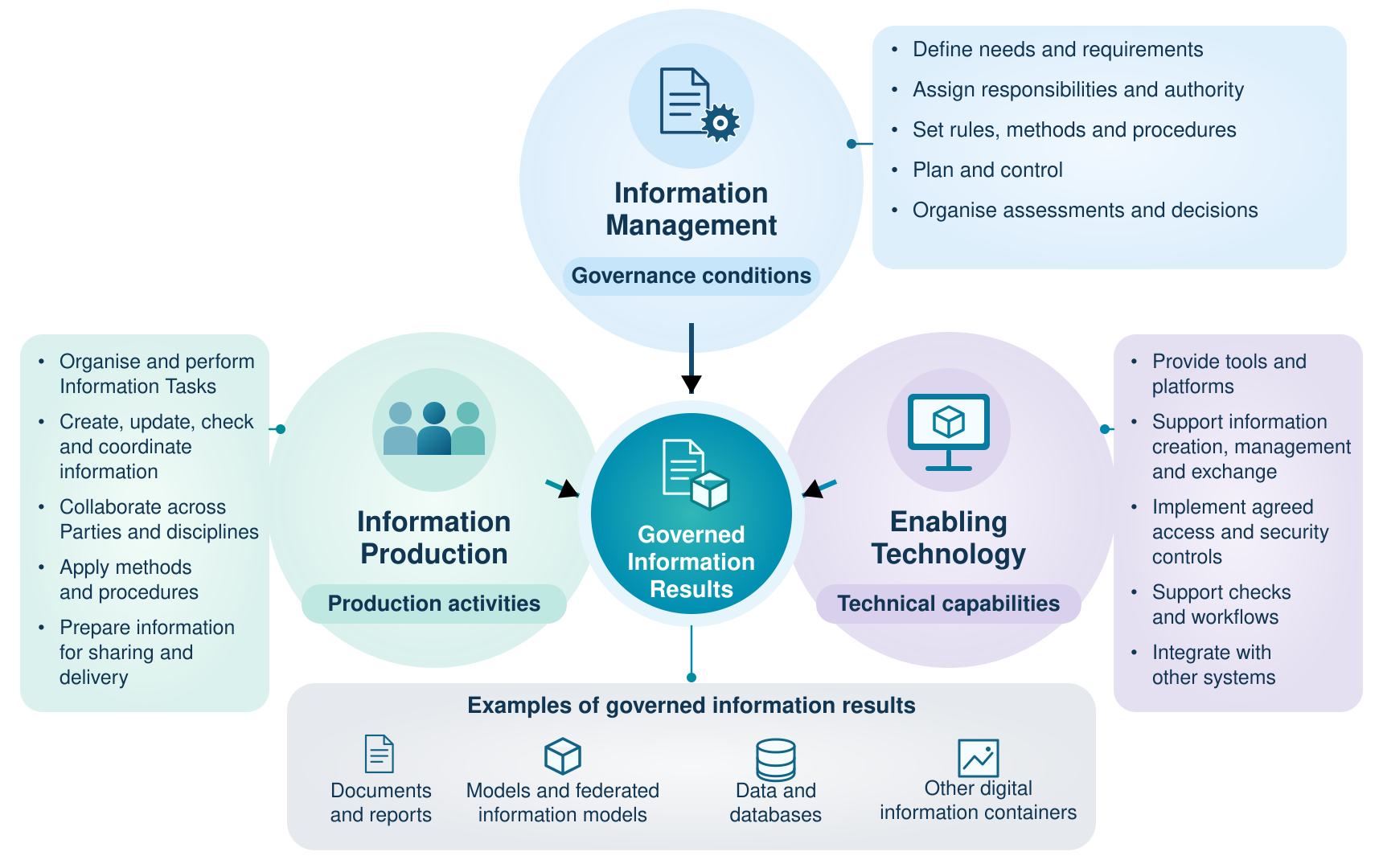
The relationships in Figure 5.6 should not be interpreted as an organisational hierarchy or a prescribed workflow. Information Management establishes the governance conditions, Information Production creates and develops the required information, and Enabling Technology supports the agreed activities through appropriate digital capabilities. Each domain contributes something necessary, but none can substitute for the others.
Information Management as a Distributed Function#
Information management is not confined to the activities of a professional holding the title of Information Manager. Every manager whose responsibilities depend on information must understand and address the information needs of the Management Activities they perform. This does not require every manager to become an information-management specialist, but it does mean that responsibility for managing an activity cannot be separated from responsibility for the information on which that activity depends.
An asset manager, for example, must understand what information is needed to maintain equipment, assess its condition and evaluate its performance. A project manager relies on information to control costs, monitor progress and assess proposed changes. A design manager must ensure that information developed by different engineering disciplines can be coordinated and used for its intended purposes. Although their professional responsibilities differ, all three perform information-management functions within their respective management contexts.
These managers need not personally formulate every Information Requirement, organise every information exchange or administer the CDE. They may rely on qualified specialists for such activities. Nevertheless, delegating information-management work does not automatically transfer the underlying management responsibility. The managers remain responsible for ensuring that the information required by their activities is appropriately identified, obtained and used.
Collaborative information production also creates coordination needs that extend beyond the responsibilities of individual managers. Information Requirements must be connected with production arrangements, responsibilities must be established across Parties, the common Information Production Standard and Procedures must be applied, and information exchanges and assessments must be organised under agreed conditions. These activities require specialised professional knowledge and coordination across organisational boundaries.
Information Managers provide this professional support. They help connect the information-management activities performed by different participants into a coherent Information Management Cycle. Several Information Managers may operate within the same Cycle, supporting different Parties, organisational functions or Appointment contexts.
Their role is therefore to coordinate and support the performance of information-management functions, not to replace the managers and authorised representatives responsible for the underlying Management Activities. Information management remains distributed across the participating Parties and their organisational structures, even where dedicated specialists provide substantial professional support.
Information Managers — Responsibilities, Competence and Authority#
An Information Manager is a professional responsible for organising, coordinating or supporting defined information-management activities within an organisation or an Appointment. The scope of this function depends on the Information Management Cycle, the responsibilities of the participating Party and the complexity of the information-management arrangements involved.
Information Managers provide professional support for the organisation and coordination of information management. Their principal functions may include:
Organising IMC Processes: preparing, planning and coordinating information-management activities in relation to the relevant stages of the asset lifecycle.
Coordinating responsibilities and tasks: supporting the definition, documentation and allocation of information-management responsibilities and activities among participating Parties and teams.
Monitoring the Information Management Cycle: following the progress of agreed activities, identifying coordination problems and supporting corrective action where necessary.
Facilitating communication: coordinating communication within and between Information Production Teams, Parties and other relevant participants.
Supporting management oversight: providing management with information about the production, condition, delivery and use of the Information Model.
These functions are primarily organisational and coordinating in nature. An Information Manager does not necessarily produce technical information, perform every assessment or make the management decisions associated with the work being coordinated. Supporting the organisation of information management is not equivalent to assuming the responsibilities and Authorities of the participating Parties.
Effective performance of these functions depends on three closely related conditions: Competence, Resources and Capacity, and Authority. Table 5.5 summarises their meaning and practical implications.
Condition | Meaning | Practical implication |
|---|---|---|
Competence | Relevant knowledge, experience and professional capabilities | The specialist must understand the IMC methods and processes appropriate to the assigned scope |
Resources and Capacity | Sufficient time, personnel support, information, tools and access to the organisational resources required for the assigned functions | The specialist must have the practical means to coordinate and monitor the work |
Authority | Formally established rights to perform particular management actions and decisions | Delegated powers must be clearly defined and limited to the appropriate governance context |
Competence includes understanding the relevant Information Requirements, collaborative production arrangements, Information Production Standards, Methods, CDE Processes and the relationship between information management and the organisation’s wider Management Activities. The competence required for a relatively simple production arrangement may differ substantially from that needed to coordinate information management across a complex programme involving several Parties and Information Production Teams.
Resources and Capacity concern the practical ability to perform the assigned functions. A specialist may possess the necessary professional knowledge but still be unable to coordinate information-management activities effectively if sufficient time, personnel support, access to information or organisational resources are unavailable. Professional competence alone does not guarantee the capacity to fulfil an assigned function.
Authority, as explained in § 5.4, concerns the formally established rights to perform particular management actions and make decisions. Holding the Information Manager role does not automatically confer every Authority associated with information management. For example, an Information Manager may organise the assessment of a submitted Information Model without being authorised to accept it on behalf of the Appointing Party. Professional responsibility for coordinating an activity must therefore be distinguished from Authority to make the corresponding governance decision.
These three conditions must be considered together. Competence without sufficient resources may be ineffective, while competence and resources without appropriate Authority may be insufficient to fulfil the assigned management functions. The required combination depends on the scope and complexity of the Information Management Cycle.
In a relatively simple arrangement, qualified existing employees may perform information-management functions alongside their other management duties. More complex projects, programmes or asset-management environments may require several specialists with complementary responsibilities. The essential requirement is not the existence of a dedicated position, but the availability of sufficient competence, resources and appropriately established Authority to perform the necessary functions.
The Particular Importance of Information Managers Supporting the Appointing Party#
Information Managers supporting the Appointing Party play a particularly important role during the preparation of an Information Management Cycle. At this stage, the Appointing Party must establish the conditions under which subsequent information production, assessment, acceptance and use will take place. The effectiveness of later production depends substantially on decisions and arrangements made before that production begins.
The Appointing Party must determine what information is needed and why, establish the applicable Information Requirements, define the governing arrangements and ensure that participating Parties have access to the resources and CDE capabilities necessary to fulfil their responsibilities. These activities require contributions from different organisational functions rather than the work of a single specialist.
Managers identify Information Needs arising from the Management Activities and Decisions for which they are responsible. Engineering and other professional specialists help determine the required information content and appropriate production conditions. Information Managers coordinate these contributions, helping to translate organisational information demand into a coherent set of arrangements for collaborative production.
The quality of this preparation strongly influences the resulting Information Model. Poorly defined Requirements, inconsistent Procedures or inadequate Supporting Information may cause difficulties that are expensive to resolve once production is underway. Even highly competent Information Production Teams cannot reliably compensate for missing requirements or unsuitable conditions established at the outset.
In practical terms, Information Managers help the Appointing Party organise the preparation of three interrelated groups of resources:
Information Documents: Information Requirements, Information Production Standards, Methods, Procedures and other governance provisions establishing what information must be produced and under which conditions.
Supporting Information: Reference Information and Shared Resources needed by participating Parties to produce coordinated and reliable information.
Common Data Environment: the agreed CDE Process, the necessary technical capabilities and, where applicable, arrangements for integrating different Information Systems.
These resources must be considered together. An Information Requirement may clearly describe the expected result, but production may still be ineffective if necessary reference information is unavailable or the CDE arrangements cannot support the required exchanges. Similarly, suitable technical capabilities cannot compensate for inconsistent governing Procedures or unclear responsibilities.
The Information Managers’ function is to organise and coordinate the preparation of these resources, not necessarily to produce every Information Document, prepare all Supporting Information or configure the technical environment themselves. The required work may involve managers, professional specialists, CDE Specialists and external providers, each contributing within an appropriately established scope.
The Appointing Party must ensure that sufficient competence, resources and Authority are available for this work. It may rely on qualified internal employees or engage external professional assistance. Where external specialists participate, their responsibilities and delegated Authorities should be clearly defined. Particular attention is needed when prospective information suppliers contribute to establishing the conditions under which their own future information results will be assessed, since this may create a conflict of interest.
Responsibility for the overall information-management arrangements remains with the Appointing Party. Information Managers provide professional coordination and support, while the relevant managers and authorised representatives retain their governance responsibilities. Delegating preparation activities does not automatically transfer responsibility for the conditions under which the Information Management Cycle operates.
The detailed development of Information Documents, Supporting Information and CDE arrangements is examined in Chapter 6. Here, the essential point is that preparing the Information Management Cycle is itself a substantial information-management activity, and the quality of that preparation directly influences the effectiveness of subsequent information production and use.
Information Production in Everyday Engineering Practice#
The relationship between information management and professional information production becomes particularly clear when compared with established engineering practice. The need to organise, coordinate and control information production did not emerge with digital technologies. Many of the underlying management principles were already familiar to engineering organisations working with traditional technical documentation.
Consider a design organisation preparing documentation for an industrial facility. A structural designer could not work entirely independently: reference drawings and technical information had to be obtained from other departments and checked for suitability before the corresponding calculations and drawings could be prepared. The designer followed established drafting standards, while department managers assigned work, monitored progress, organised checking and coordinated the release of completed documentation.
When another department required a drawing, an authorised representative permitted its release for the appropriate purpose. Information from different disciplines was repeatedly exchanged and coordinated until the relevant documentation could be assembled and delivered to the client for review. Although these activities relied on different technologies, their underlying management logic was recognisable:
obtain suitable reference information → produce the required result → check and coordinate it → authorise its release → submit it for the intended purpose.
Table 5.6 compares familiar activities from traditional engineering practice with their counterparts in contemporary digital information production.
Traditional engineering practice | Digital information production |
|---|---|
Obtaining and using reference drawings and technical documentation | Accessing Reference Information and Shared Resources |
Preparing drawings and other technical documents | Creating or updating Information Containers |
Following established drafting standards | Applying the Information Production Standard and agreed production Methods |
Checking drawings before releasing them to other departments | Checking Information Containers under agreed CDE Procedures |
Exchanging approved working documents between departments | Controlled sharing of Information Containers |
Coordinating drawings and specifications from different disciplines | Coordinating Information Containers within a federated Information Model |
Authorising the release of technical documentation | Authorisation for issue in accordance with the governing Procedures |
Delivering coordinated documentation for the client’s review | Submission, assessment and an Acceptance Decision by the Appointing Party |
The comparison illustrates continuity between traditional engineering management and contemporary IMC. In both cases, reliable results depend on common rules, appropriate professional methods, controlled exchanges, coordination and authorised decisions. The technologies and forms of information may change, while many of the organisational problems remain recognisable.
The transition to digital information production is therefore not merely the replacement of paper drawings with electronic files. Digital environments provide new capabilities for managing Information Containers, coordinating federated Information Models and supporting controlled information exchanges. At the same time, IMC makes the governing relationships and conditions more explicit, allowing information to remain manageable and usable across participants, systems and lifecycle stages.
Traditional coordination problems also remain relevant. When one Task Group does not provide information when another needs it, work may be delayed or duplicated. Inconsistent checking criteria may allow conflicting information to enter a coordinated Information Model. If multidisciplinary coordination is postponed until separate production activities are complete, resolving inconsistencies can become substantially more difficult and costly.
Effective collaborative information production therefore requires more than capable specialists and software. It depends on a common Information Production Standard, suitable production Methods, documented responsibilities and Procedures, and a CDE environment supporting governed exchanges. It also requires Information Managers, information-producing specialists and CDE Specialists to perform their complementary functions in a coordinated manner.
CDE Specialists — Technical Support for Information Management#
The third functional domain, Enabling Technology, concerns the technical capabilities that support information management and production. These capabilities must enable participants to perform their activities under the agreed Information Management Procedures, while accommodating the different Information Systems and technologies through which information may be produced, maintained and exchanged.
A CDE Specialist is a technical professional responsible for implementing, configuring, maintaining or supporting the CDE solutions and related Information Systems used within an Information Management Cycle. Depending on the organisational context, these functions may be performed by existing IT personnel, dedicated CDE professionals or external technical service providers.
The principal technical functions may include:
Configuring the CDE environment: implementing the necessary technical settings for Information Containers, metadata, states and controlled information exchanges.
Supporting Access and security controls: configuring permissions and security mechanisms in accordance with the established governance arrangements.
Integrating Information Systems: supporting the technical connections and information exchanges required between different applications or repositories.
Providing operational support: assisting users, maintaining system availability and resolving technical problems affecting information-management activities.
Supporting AIM maintenance: providing the technical capabilities needed for information integrity, controlled updating, archiving and continuity of access to Asset Information Model information.
These activities require CDE Specialists to understand the information-management conditions that the technical environment must support. However, the ability to configure or administer a system does not establish Authority to determine the governance rules implemented through that system.

Consider the authorisation of an Information Container for issue. The applicable Information Management Procedures establish who may make the decision, which conditions must be satisfied and what evidence must be recorded. The CDE Specialist implements the corresponding permissions and technical controls. The specialist’s technical ability to configure or execute an operation does not, by itself, confer Authority to make the underlying management decision.
This distinction also applies when technical services are provided by an external organisation. The Appointing Party remains responsible for ensuring that suitable information-management arrangements are established, while technical providers undertake their agreed support functions. Conversely, Information Managers and authorised representatives must understand the capabilities and limitations of the technical environment when developing arrangements that it must support.
The governing principle is that technical capabilities implement information-management arrangements; they do not replace the organisational responsibilities and Authorities through which those arrangements are established.
Supporting the Asset Information Model#
The need for information management and technical support does not end when a Project Information Model has been delivered. Where an Asset Information Model (AIM) is maintained to support asset-management activities, the relevant functions continue throughout the period in which that information is required.
An AIM may comprise information distributed across several Information Systems, including engineering-model repositories, document-management platforms, asset databases and operational systems. Maintaining the AIM therefore involves more than keeping the individual systems operational. It requires arrangements that preserve the integrity, accessibility, security and controlled updating of the information needed for asset-management purposes.
CDE Specialists and other technical professionals may support information storage, access, version control, archiving, system integration, recovery and the mechanisms through which the AIM is updated. These activities must be performed in accordance with the applicable organisational policies and Information Management Procedures. Technical convenience alone must not determine how asset information is governed or maintained.
Maintaining an AIM is a combined management, information-production and technical activity. Managers responsible for asset-related Management Activities identify the information they need and the conditions under which it must remain suitable for use. Information Managers help coordinate the relevant Information Requirements and governance arrangements. Information-producing specialists create, check or update information as required, while CDE Specialists provide the technical capabilities needed to manage it.
The degree of synchronisation required between a physical asset and its AIM illustrates this relationship. Information supporting time-critical operational decisions may need frequent updates, while other information can remain fit for its intended purpose over much longer periods. There is no universally appropriate updating frequency for all asset information.
Determining the required frequency is primarily a management decision, informed by the intended use of information, operational risks, costs and available resources. Asset-management specialists and Information Managers help establish the corresponding requirements. Information-producing specialists perform the necessary updates, while CDE Specialists assess and support their technical implementation.
The essential distinction is between deciding what information must remain current and why, performing the work needed to update it, and providing the technical means for maintaining and accessing it. These functions are complementary, and their coordination remains necessary throughout the operational life of the AIM.
The broader principles of AIM maintenance, information use during asset operation and the relationship between Information Models and Digital Twins are examined in Part II.
Coordinating the Three Functions#
Information Management, Information Production and Enabling Technology are distinct but interdependent functional domains. Their coordination is necessary throughout an Information Management Cycle, from establishing Information Requirements and preparing the conditions for collaborative production to managing information exchanges, supporting decisions and maintaining information for subsequent use.
Consider a requirement for updated structural information in our industrial reconstruction project. The responsible manager identifies the need for information to support a particular Management Activity. Information-management functions establish and coordinate the corresponding Requirement, responsibilities, production arrangements and conditions for exchange and assessment. Information-producing specialists develop, check and coordinate the required Information Containers. CDE Specialists ensure that the agreed technical environment can support their controlled sharing, delivery and subsequent management.
These activities are closely connected, but they should not be confused. Defining what information is needed is different from producing it; producing information is different from providing the technical environment in which it is managed; and supporting an information exchange is different from making the associated governance decision.
The same distinction applies to the individuals performing these functions. An Information Manager may coordinate the arrangements for an exchange without producing the technical content or having Authority to accept it. An engineering specialist may be responsible for preparing an Information Container without determining the requirements governing its acceptance. A CDE Specialist may configure the technical controls for an exchange without having Authority to approve the information being exchanged.
In smaller organisations, one individual may perform functions belonging to more than one domain. In larger programmes, these functions may be distributed among several teams, organisations and service providers. The effectiveness of the arrangement depends not on the number of specialist positions, but on whether the required functions, responsibilities and Authorities are clearly established and coordinated.
The organisational structures considered in this chapter provide the context for that coordination. Appointments establish relationships and obligations between Parties. Responsibilities, Authorities, Assignments and Access arrangements determine how participating individuals and groups may act. Information Production Teams and Task Groups organise collaborative production. Information Managers and CDE Specialists provide the professional and technical support necessary for these arrangements to function effectively.
Together, these elements establish an important foundation for the Information Management Cycle: information production must be organised as a governed collaborative activity, with identifiable responsibilities, appropriate professional competence and suitable technical support.
Information Management, Information Production and Enabling Technology are complementary functions within a single Information Management Cycle. Their effective coordination requires clearly established responsibilities and Authorities, competent participants and technical capabilities that support — rather than replace — the agreed information-management arrangements.
Chapter 6 examines the common conditions that enable these organisational arrangements to operate in practice. It considers the Information Documents, Supporting Information and Common Data Environment arrangements through which participating Parties establish a consistent basis for collaborative information production.