The Information Model
In this chapter 2.1–2.5
2.1. From Information to an Information Model#

An asset manager preparing to assess the condition of a bridge may already have a large amount of information available: previous inspection reports, structural drawings, photographs, maintenance records and monitoring data. The difficulty is often not obtaining another document or dataset, but understanding whether the existing information can be used together. Which bridge components does it concern? Is it still current? How was it produced? How does one resource relate to another, and is the combined information sufficient for the assessment that must now be performed?
This is a common information-management problem. Organisations rarely work with one self-contained source. Drawings, models, calculations, schedules, reports, measurements, records and structured data may all be meaningful individually while remaining fragmented as a management resource. The challenge is to understand them as parts of one coherent context.
Recorded values or observations become useful information when their context gives them meaning. But even meaningful information remains difficult to manage if its relationships, applicability and purpose are unclear.
The management challenge is therefore broader than interpreting individual information resources. Relevant information must be organised so that people can understand what it concerns, how different resources relate to one another, whether they remain applicable and how they can support a Management Activity.
An Information Model provides this coherent management context. It is not defined by one representation or one software environment, but by the purposeful and governed composition of information needed to support relevant Management Activities and uses.
The word model can easily create the wrong impression. In construction, it is often associated with a three-dimensional geometric or BIM representation. Such a representation may be an important part of an Information Model, but it is only one possible form of information. Specifications, schedules, calculations, inspection results, registers, photographs, maintenance records, performance data and structured datasets may all contribute where they support the relevant management purpose.
The same applies during project delivery. A multidisciplinary design review may depend on architectural and engineering models, drawings, specifications, calculations, programme information and cost data. No single resource necessarily provides the complete basis for the review. What matters is whether these resources can be understood together as parts of one Information Model and whether their relationships are sufficiently clear to support the Management Activity or Decision concerned.
Information resource | Information Model |
|---|---|
Represents a particular aspect of an asset, project or activity | Organises relevant information within a coherent management context |
Can be meaningful and useful on its own | Establishes relationships that allow multiple resources to be understood together |
May use any suitable technical representation | May bring together different forms of information |
May exist within a particular technical environment | Is defined by its governed information context rather than by a particular representation |
The composition of an Information Model should follow the management purpose established in Chapter 1. Technical representation still matters: formats, schemas, applications and exchange mechanisms affect how information can be produced, exchanged and used. But they do not determine what information belongs in the Model. That question follows from the Management Activities, Information Needs and Requirements the Model is intended to support.
For an information resource to contribute meaningfully to an Information Model, the organisation should be able to understand, where relevant:
- what the information concerns;
- why it exists and which Management Activity or use it supports;
- how it relates to other relevant information;
- whether it remains current and applicable;
- the conditions under which it may be used.
Together, these considerations establish the purpose, relationships and governance that allow separate information resources to operate as one coherent Information Model.
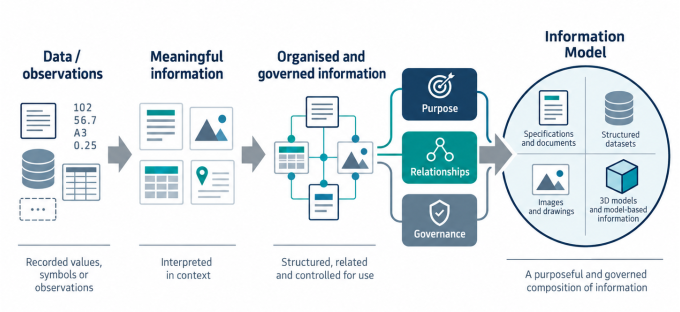
An Information Model may therefore contain technically different forms of information while remaining one coherent management context.
This raises a practical management question: what is the identifiable unit through which the information within that Model is governed as it changes, is exchanged and is used?
In IMC, that unit is the Information Container.
2.2. Information Containers: More Than Files#
In everyday work, the obvious managed unit is often assumed to be the file. A design model may be stored as a file, a report as a document, a schedule as a spreadsheet and inspection information in a database or structured dataset. Files remain important technical representations, but file-based thinking becomes unreliable when information must remain identifiable while it changes, moves between systems and is used by different participants.
Consider a structural model that develops over several months. Its filename may change, copies may be created for coordination or review, and different versions may appear in different technical environments. If management depends mainly on filenames and folders, apparently simple questions soon become difficult. Are two files different versions of the same managed information resource, or do they represent different resources? Which version was used for a particular review? Which one is currently applicable? How does it relate to other design information?
The problem is not the file itself, but the need to preserve the identity of the managed information even when its technical representation, location or content changes.
This is the purpose of the Information Container.
An Information Container is an identifiable set of information with a persistent identity, managed as a unit within one Information Model and retrievable through a file, system or application. It does not have to correspond to a single file. A Container may be represented by a document, model, dataset, database record, defined part of a file or another persistently retrievable set of information.
What makes it a Container is therefore not a particular file extension or software product, but the fact that the information is deliberately managed as one identifiable resource whose identity can be preserved as its content changes.
Persistent Identity as Information Changes#
The distinction becomes especially important when the information develops over time. Suppose the structural model moves from early coordination through design development and detailed engineering. Geometry is refined, attributes are added, errors are corrected and design decisions are incorporated. The information changes substantially, yet from a management perspective it may remain the same structural-model Container.
The organisation therefore needs to distinguish between the continuing identity of the managed resource and the governed information instances through which its content develops.
Container identity persists; the information represented through its Revisions may change.
A Container Revision is a governed instance of an Information Container representing its content and applicable governed metadata at a defined point in its development or use. One Container may therefore have a sequence of Revisions while remaining the same Container. Working Versions may also exist as information develops within a Revision. Part II examines the relationship between Working Versions, Revisions and the CDE Process. The essential distinction here is simple: changing information does not automatically create a new Container identity.
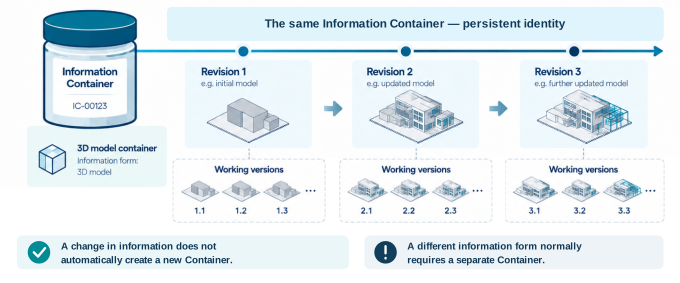
The same logic applies well beyond design models. An asset operator may maintain inspection information associated with a particular asset or managed scope over many years. New inspections add observations, conditions change and earlier findings may be superseded, but later users still need to recognise the continuing history of the same managed information resource rather than an unrelated series of records.
Persistent identity provides that continuity. It allows later users to determine which managed resource is being referenced, how its information has developed and which Revision was applicable at a particular point in time.
Content alone, however, is not enough. Depending on the management context, a Container also requires sufficient metadata and governed relationships to allow people and systems to identify and interpret it. These may indicate:
- what the Container concerns;
- how it is classified;
- which Revision is applicable;
- what other Containers it relates to;
- under what conditions its information may be used.
These mechanisms help preserve management meaning as information changes, responsibility passes between participants or the Container is accessed through different technical environments.
One Information Container belongs to exactly one Information Model.
This does not prevent information from being reused in another management context. Content may be reused, but the same Container identity does not thereby become part of another Information Model. Where information is required in a different Model, its content may be incorporated into a Container governed within that new context. This distinction becomes particularly important when project information contributes to asset management.
The contrast between file-based thinking and Container-based management can now be summarised as follows.
File thinking | Information Container thinking |
|---|---|
Identity is often inferred from filename and location | The Container has a persistent managed identity |
A changed file may appear to be a new information resource | Changing information can be represented through a new Revision of the same Container |
Relationships are often implicit or reconstructed manually | Relationships to other Containers can be explicitly governed |
Context depends heavily on folder structure or local conventions | Management context is associated with the governed Container rather than inferred from storage structure |
Technical representation tends to define the managed object | Container identity remains distinct from its technical representation |
Files remain important as practical means of creating, storing and exchanging information. The distinction is that, in IMC, the identity of the managed information should not depend on filename, storage location, software environment or technical representation.
Once an Information Model is understood as a composition of identifiable Containers, those Containers can remain separately governed while still being deliberately related and coordinated. A structural model, specification, programme and cost record can retain their own identities and still contribute to one coherent Information Model.
The next question is therefore how separately governed Containers can operate together without losing their identity and boundaries.
That is the purpose of federation.
2.3. Federation and the Federated Information Model#
A transport interchange being developed by several design teams may depend on architectural, structural, civil, building-services and specialist systems information. Different teams produce different Containers because they have different scopes, responsibilities and technical expertise. Yet design review, interface coordination and many project decisions require those Containers to be understood together.
The challenge is not simply to collect or combine the information. Each Container must remain identifiable: its scope, applicable Revision and relationships to other Containers still need to be understood while the wider composition operates coherently.
This is the management problem addressed by federation.
Aggregation, Consolidation and Federation#
Information resources can be organised together in different ways, and the distinctions matter because they serve different management purposes (Figure 2.3).
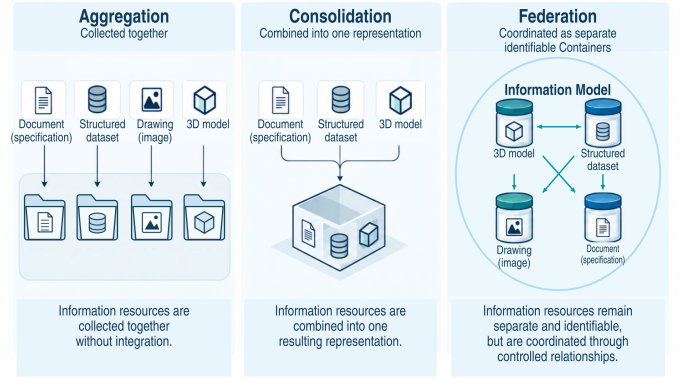
Aggregation brings resources together without necessarily establishing managed relationships between them. A shared folder containing drawings, reports, schedules and models is a simple example. Aggregation may make relevant information available in one context, but proximity alone does not create a coherent Information Model.
Consolidation combines information from several sources into a resulting representation. Several schedules may be incorporated into one consolidated programme, for example, or information from several records may be combined into one report. Here, the combined representation is itself required for the Management Activity.
Federation coordinates identifiable Information Containers so that they can be understood and used together while retaining their individual identities and management boundaries. Each Container remains separately identifiable while participating in a coherent composition through managed relationships.
These are not successive levels of maturity. None is inherently more advanced than another; each serves a different management purpose.
In the transport-interchange example, federation allows architectural, structural, civil and systems Containers to remain separately governed while contributing to the same design review and interface-management activities. A change to one Container can be understood in relation to the others without obscuring its identity, scope or relationships.

The value of federation therefore lies in coordinated composition rather than physical combination. The organisation needs to understand which Containers belong together, what scope each covers, where their interfaces lie and how changes in one may affect the others. The coherence of the resulting Information Model comes from these managed relationships, not from removing the boundaries between its parts.
This allows the concept of an Information Model to be stated more precisely:
An Information Model is a managed federated composition of interrelated Information Containers representing information about a built asset, project or related management context.
This federation is logical rather than necessarily physical. Its coherence depends on identifiable Containers and their governed relationships within a common management context, even when those Containers are held in different technical locations.
Planning the Federation#
Federation is not only a way of coordinating information after it has been produced. The intended composition of the Information Model also influences how information production is structured.
If Container boundaries arise only from authoring-software structures, folder conventions or established team habits, they may be technically convenient while poorly suited to responsibility, coordination or later use. The structure of the Model should therefore be considered deliberately.
Container boundaries are management and production decisions, not merely technical consequences of software, file structures or established team practices.
A Federation Strategy establishes the planned approach to structuring the Information Model as a coordinated composition of Containers. Relevant considerations may include production responsibilities, information scopes and interfaces, asset or system breakdown, and coordination needs. The appropriate structure depends on the management purpose and production context rather than on one universal hierarchy.
Where that planned structure needs to be made explicit, an Information Container Breakdown Structure represents how the Information Model is divided into planned Containers for production, coordination and management (Figure 2.4).
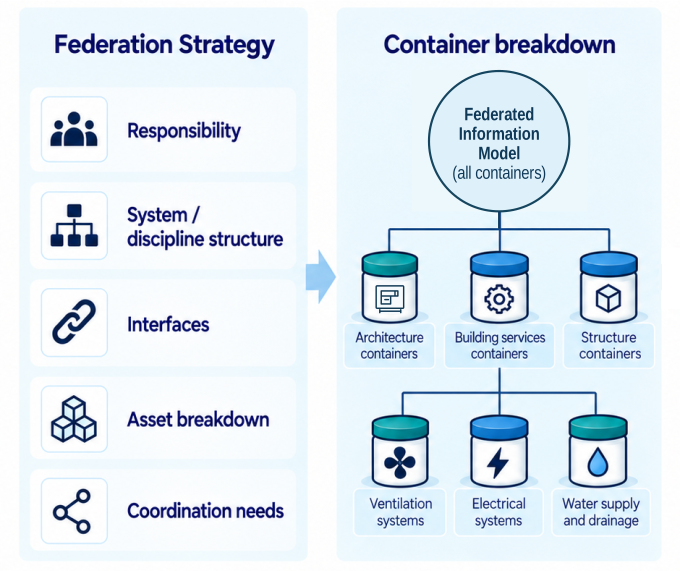
A well-designed federation therefore balances independence and coherence. Teams can work on identifiable parts of the Information Model with clear production scopes and responsibilities, while managed relationships between those parts allow the wider Model to support activities that depend on coordinated information.
The same logic applies during asset use. Containers and responsible participants may differ, but the Information Model still requires purposeful boundaries that support maintenance, inspection, performance assessment and other Management Activities without turning all information about the asset into one undifferentiated resource.
The logical composition of the Information Model is distinct from the technical locations of its Containers; this distributed aspect is examined in § 2.5.
A different issue arises when the management context itself changes. Information needed to design and deliver a project is not necessarily the same information needed to operate, maintain and assess the resulting asset.
This is the basis for distinguishing the Project Information Model (PIM) from the Asset Information Model (AIM).
2.4. Project Information Model and Asset Information Model#
Consider the delivery of a new hospital. During the project, information may be required for multidisciplinary coordination, procurement, construction planning, commissioning and project control. Much of it exists because particular project Management Activities require it.
The future operator, however, needs information for a different set of Management Activities: operating equipment, planning maintenance, assessing condition, managing compliance and supporting future interventions. Some of that information must be prepared during the project, but its continuing value depends on the asset-management context in which it will later be used.
The same built asset is involved, but the management purposes differ. Consequently, the required information, its organisation and its governing conditions may also differ.
Same built asset → different Management Activities → different Information Model contexts.
The distinction between the Project Information Model (PIM) and the Asset Information Model (AIM) reflects these different management contexts.
Different Management Contexts, Not Lifecycle Stages#
The PIM supports Management Activities associated with the project, such as design development, procurement, coordination, construction planning, commissioning and project control. The AIM supports the continuing management of the asset, including operation, maintenance, condition assessment, compliance, performance management and future interventions.
Project and asset-management activities may overlap in time. Information needed for future asset use can influence project production from an early stage, while some project information may remain relevant after physical work has been completed. The distinction between the two Models is therefore not primarily chronological.
PIM and AIM are defined by their management contexts, not simply by whether information exists before or after project handover.
Their respective scopes follow the Management Activities, Information Needs and intended uses they must support. The associated Requirement contexts also differ: Project Information Requirements (PIR) shape the information needed in the PIM, while Asset Information Requirements (AIR) shape the information needed in the AIM. The detailed structure and relationships of these Requirements are addressed in Chapters 3 and 4.
Neither the PIM nor the AIM is therefore a generic store of everything that could potentially be collected about the asset.
Project Information Model | Asset Information Model | |
|---|---|---|
Primary management context | Project management | Asset management |
Requirement context | Primarily shaped by PIR | Primarily shaped by AIR |
Typical Management Activities | Design development, procurement, coordination, construction planning, commissioning, project control | Operation, maintenance, condition assessment, compliance, performance management, adaptation |
Time perspective | Supports the changing project context | Supports continuing management of the asset |
Relationship to the other Model | May contain information with continuing value for future asset management | May incorporate relevant project information where it supports continuing asset-management Needs |
Project-to-Asset Continuity Is Selective#
The relationship between the two Models should not be understood as a rigid lifecycle transition. Asset-management Needs can influence project information production long before the project is complete, while much project information may have little or no continuing value for asset management. Not all information in the PIM therefore belongs in the AIM.
Information should contribute to the asset-management context where it supports continuing Management Activities and relevant AIR. Other project information may remain part of the historical project record. The AIM then continues to develop through operation, inspection, maintenance, modification and other asset-management activities.
This continuity is therefore selective rather than comprehensive. Information may remain technically valid while its management context changes. For example, commissioning information about an installed air-handling unit may later support maintenance, but it must then be understood within the operator’s asset-management context rather than simply treated as unchanged project information.
Because one Information Container belongs to exactly one Information Model, the same Container identity does not simply pass from the PIM into the AIM. Information with continuing value may instead be incorporated into an appropriate asset-context Container while its provenance remains traceable to the relevant project information.
PIM information → assess continuing value → preserve provenance → re-contextualise for asset management → AIM.
This is re-contextualisation rather than simple handover: information is carried forward into the management context in which it will subsequently be used (Figure 2.5).
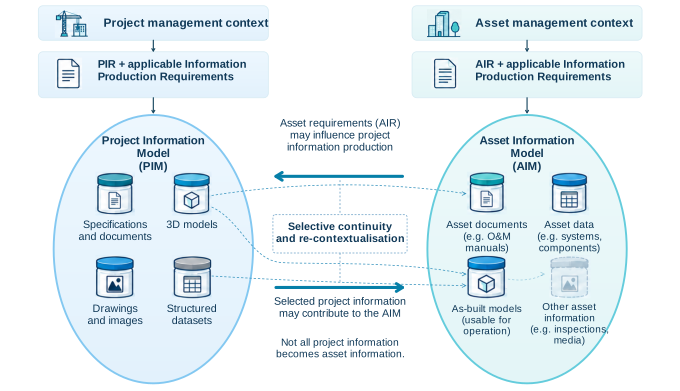
The distinction between PIM and AIM reinforces a broader point: the coherence of an Information Model comes from its management context rather than from continuity of files, storage locations or technical platforms. Its Containers may therefore remain distributed across different systems and environments while still forming one coherent governed context, provided that their meaning, relationships and governance remain understandable.
2.5. Information Model as Shared and Distributed Management Context#
One Information Model does not have to exist within one software application, database or repository.
Suppose a facilities team is investigating repeated failure of a pump in an operating building. Relevant information may be distributed across an asset-management system, maintenance application, document repository, monitoring platform and model or GIS environment.
No single system is necessarily intended to contain the complete management context. The practical requirement is to recognise that the information concerns the same equipment, determine what is current and applicable, understand the relationships between the relevant Containers and use the information under the appropriate management conditions.
The Information Model must therefore be distinguished from the technical environments in which its information resides.
Information Model Is Not an Information System#
An Information System is a technical environment that stores, processes, presents or exchanges information. It may provide authoring, database, document-control, workflow, visualisation, monitoring, analytics or other technical capabilities.
An Information Model serves a different function. It provides the governed context within which relevant Information Containers, their relationships and their applicability can be understood in relation to Management Activities and intended uses.
Information Model boundaries therefore do not have to coincide with Information System boundaries. One system may support only part of an Information Model, while several systems may contribute to the same Model. Technical environments may also be replaced over time without changing the management need to preserve the identity, meaning and relationships of the information they support.
Information Model | Information System |
|---|---|
A governed information context | A technical environment |
Organises identifiable information around management purpose and relationships | Stores, processes, presents or exchanges information |
Depends on identity, applicability, relationships and governance | Depends on technical functionality and configuration |
May extend across several Information Systems | May support part of one Information Model or parts of several Models |
The distinction has an important consequence: IMC must preserve a management context that is more durable than technical location. As systems, applications and participants change, it must remain possible to identify the relevant Container and applicable Revision, understand what the information concerns and how it relates to other information, and determine the governing conditions under which it can be used.
A technical system may help expose, maintain or enforce these relationships, but their management meaning does not arise merely because the information is stored there.
Execution location is not governance context.
Information may be produced, accessed, assessed and used through different technical environments over time. Those environments are replaceable; the governed identity, relationships and meaning of the information require greater continuity.
“Shared” and “Distributed” Describe Different Things#
This separation between Model and system also helps clarify what it means for an Information Model to be shared.
A shared Information Model does not require every participant to receive every Container, hold identical copies or work in the same application. Sharing concerns participation in a common governed information context, with each authorised participant able to identify and interpret the information relevant to its Management Activities under applicable rules and conditions.
By contrast, describing an Information Model as distributed refers to its technical arrangement: its Containers may reside in several systems, applications or technical locations while still belonging to one governed Model.
Shared therefore describes the governance context, while distributed describes technical location. The two characteristics are compatible: an Information Model may be technically distributed and still be shared if its Containers, relationships, applicability and governance remain coherent. Conversely, centralising information in one repository does not by itself create a shared Information Model.
Consider two contrasting situations. Thousands of files may be held in one central repository while their identities, relationships and applicability remain unclear. The information is technically centralised, but its management context is weak.
Conversely, Containers may remain across specialist authoring environments, enterprise systems, document services and operational platforms while their identities, relationships and applicability remain governed. The information is technically distributed, yet it may form a coherent Information Model.
Centralisation is therefore a technical architecture choice, whereas coherence is an Information Management outcome.
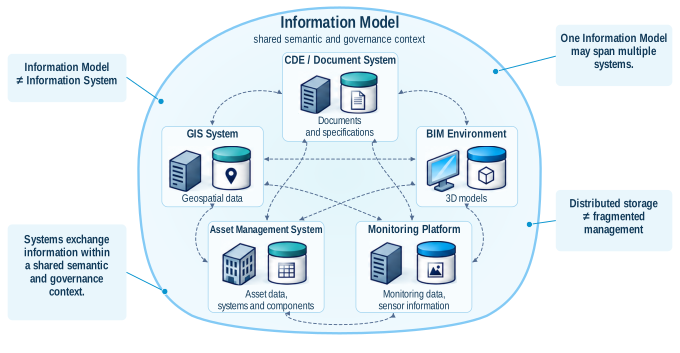
The boundary of an Information Model is therefore determined by its governed information context, not automatically by the boundary of a software product or repository.
This becomes even more important when information crosses not only technical boundaries but organisational ones.
Interoperability Is More Than Technical Exchange#
Construction and asset management operate across changing organisational and technical boundaries. Information produced in one environment may later need to be understood and used by another Party working through different systems, data structures and working methods.
Technical interoperability is therefore necessary but insufficient. Files may transfer successfully, APIs may connect and data fields may remain readable while the receiving organisation still lacks the context needed to understand what the information represents, which Revision is applicable or how it may be used.
In IMC, interoperability is the ability to exchange, interpret and use information across different systems and organisations while preserving its meaning and management context.
This requires both technical compatibility and semantic continuity. Technical compatibility enables information to cross system boundaries, while semantic continuity ensures that enough of its meaning and governance context remains understandable for the information to remain usable.
Information does not derive its management value from content alone. When it crosses a technical or organisational boundary, enough context must remain available to preserve its identity, applicability, relationships, provenance and conditions of use.

That context does not have to travel inside one file or one data structure. It may be maintained through linked systems, identifiers, governed records or other mechanisms. What matters is that the information remains interpretable within the wider managed environment.
The objective is therefore continuity of meaning, not technical uniformity. IMC complements rather than replaces technical interoperability standards, common formats, APIs and integration technologies.
- Technical compatibility → information can move.
- Semantic continuity → information remains understandable and usable.
A robust information environment depends on both. Semantic continuity may be less visible than successful transfer, but it is essential to the long-term value of information: a resource that has lost its identity, provenance or applicability may remain technically available while becoming managerially unreliable.
Part II examines the CDE mechanisms that preserve this continuity. At this stage, the governing idea is sufficient: an Information Model remains coherent because its purpose, Container identities, relationships and governance remain understandable even when technical environments change.
Taken together, these ideas show why the Information Model is much broader than a BIM model, a collection of files or the contents of one CDE or software platform. Its coherence depends on purpose, identifiable Containers, governed relationships and management context rather than on physical centralisation.
Yet a more fundamental question remains: how does an organisation determine what information should exist in the first place, why it is needed and what conditions it must satisfy?
That question leads from the Information Model to Information Needs and Information Requirements.