Information Needs and Information Requirements
In this chapter 3.1–3.7
3.1. Need Is Not Requirement#
The existence of an Information Model does not answer a more basic management question: what information should exist in the first place, and why?
In practice, organisations often begin with something that already sounds like a Requirement. A manager asks for a model, a spreadsheet, a report or a list of attributes. A procurement document specifies a format. An asset-management team asks for all available information about certain equipment. Such requests may eventually become valid Information Requirements, but they can also conceal the management demand that should justify them.
Consider a facilities manager deciding whether an ageing chiller should be replaced before the next cooling season. The immediate management problem is not to obtain a BIM object, a maintenance spreadsheet or a prescribed set of parameters. The manager needs sufficient information to understand the chiller’s condition, performance, remaining useful life and the consequences of retaining or replacing it. That management demand is the Information Need; its Intended Purpose is to support the replacement decision.

The Need must then be translated into one or more Information Requirements that specify what information is to be provided. These may address condition, performance, maintenance history and other information necessary to support the decision.
The distinction is therefore functional: the Information Need expresses the management demand, while the Information Requirement makes that demand sufficiently explicit for production and assessment. Moving directly to technical specification risks disconnecting information production from the management problem that justified it.
When this distinction is ignored, familiar problems follow:
- Requirements are copied from earlier projects without a current management purpose;
- specifications are shaped by what available technology can produce rather than by what is actually needed;
- unnecessary or duplicate information is requested and produced;
- essential information is missed because the underlying management question was never made explicit;
- information is produced, assessed and even accepted without subsequently being used.
The governing causal relationship is:
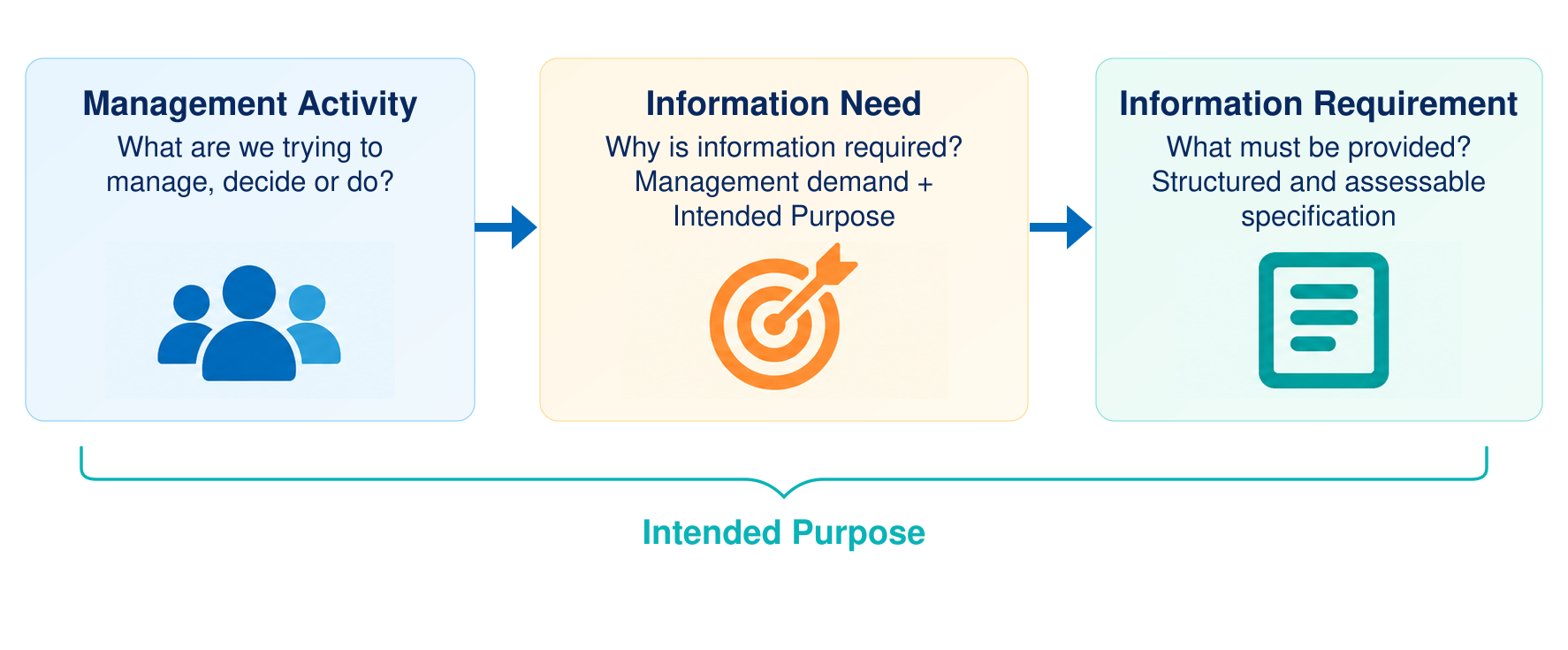
Management Activity → Information Need → Information Requirement.
The Management Activity creates the demand for information. The Information Need expresses that demand and preserves its Intended Purpose. The Information Requirement makes the expected information sufficiently explicit for production and later assessment.
Need explains why information is required. Requirement specifies what must be provided.
Figure 3.1 summarises this movement from a Management Activity, through an explicit demand for information, to a specification that can guide information production. The Intended Purpose remains visible across the sequence because increasing specificity should not sever the Requirement from the management purpose that justified it.
The relationship between Need and Requirement is not necessarily one-to-one. One Information Need may generate several Requirements when different pieces of information are needed to support the same Management Activity. Conversely, the same Requirement may later be applicable in more than one management context. In both cases, traceability to the originating Need preserves the reason why the Requirement exists.
This traceability is different from Requirement refinement. The first explains why a Requirement exists; the second explains how it becomes more specific. Section 3.6 develops this distinction through Requirement Cascade and provenance.
Starting from the Information Need also protects Requirement development from becoming technology-led. The governing question is not What can our software produce? but What information does this Management Activity actually require? Technical choices — file formats, data structures, authoring methods and software environments — should follow that demand rather than define it.
Once the distinction between Need and Requirement is clear, the next step is to examine the structure of the Need itself and the management information it must preserve before specification begins.
3.2. The Structure of an Information Need#
An Information Need must be specific enough to guide the development of Requirements without prematurely prescribing how the information will be produced. Too little structure leaves the management demand ambiguous; too much technical prescription risks turning an assumed solution into the starting point.
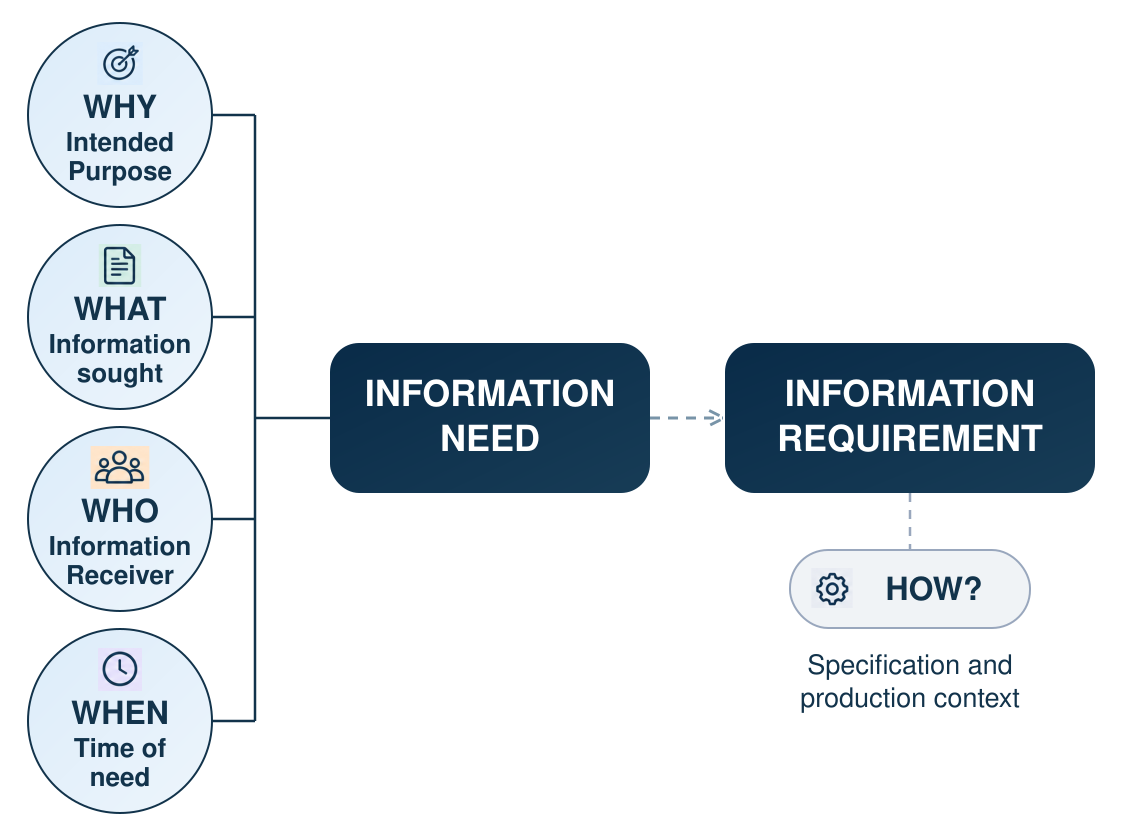
Four questions provide the necessary management structure:
- Why? — Intended Purpose
- What? — Information sought
- Who? — Information Receiver
- When? — Time of need
Together, they define the demand while leaving the production solution open for subsequent specification.
Consider a property manager assessing whether part of an existing building can be reorganised for a new operational use. Before specifying a survey, model, drawing package or data structure, the organisation needs to establish why information is required, what must be understood, who needs the result and when it must be available. In this case, the facilities function needs information about the existing layout and physical constraints to assess feasibility before the next investment Decision.
Why — Intended Purpose
The first question establishes why the information is needed: the Management Activity, Decision, assessment or action it is expected to support. In the refurbishment example, the purpose is not simply to obtain information about the building, but to determine whether the proposed operational change is feasible before an investment Decision is made.
The same principle applies across other contexts. Information may be needed to assess condition or performance, plan work or investment, control project progress, demonstrate compliance, manage risk or support operational action. The specific purpose varies, but it should always make clear the management outcome that the information is expected to support.
Intended Purpose is therefore not contextual decoration added to a request after the fact. It provides the reference point for determining what information is relevant, how much is sufficient and whether the resulting information is suitable for the Management Activity that justified it.
What — Information sought
The second question establishes what the Receiver needs to know, expressed in management rather than production terms. In the refurbishment example, this may include the existing layout, dimensions, access constraints and other physical conditions relevant to determining whether the space can support the proposed use.
At this stage, the Need should normally remain neutral about the technical means of satisfying it. An authoring tool, file format, survey method, data structure or modelling technique should be prescribed only where it is itself necessary to the Intended Purpose.
The sequence is therefore deliberate: first establish what information is needed; then determine how that information should be produced and represented.
Who — Information Receiver
The third question identifies who needs the information for the Management Activity concerned. The Information Receiver may be a person, role, team or organisational function. In the refurbishment example, this may be the facilities or property-management function responsible for assessing the proposed change.
The Provider may not yet be known when the Information Need is first identified. This is important because the Need should initially be defined from the perspective of the Management Activity it must support, not from the capabilities of a particular supplier.
The causal direction should remain:
Management Activity → Information Need → Information Receiver,
not:
known Provider → available capability → information to be requested.
When — Time of need
The fourth question establishes when the information must be available in order to support the Management Activity. This is not necessarily the same as the eventual delivery date.
The relevant time may be defined by a fixed date, a project or asset-management milestone, a Decision point, a Trigger Event, a recurring interval or an operational event. In the refurbishment example, the information is needed before the next investment Decision, because that is when it must be sufficiently complete and reliable for use.
Production and delivery planning may therefore need to work backwards from the time of need. Information may have to be produced, checked, coordinated and made available before the Management Activity can proceed.
The distinction is:
- time of need → when the information has management value;
- delivery timing → when the required information must be provided to make that use possible.
Taken together, the four questions define a structured Information Need without prematurely determining the production solution. Figure 3.2 shows this boundary: Why, What, Who and When define the management demand, while How belongs to the subsequent specification and production context.
In the refurbishment example, the organisation may ultimately decide that the information should be obtained through a measured survey, an existing-condition model, selected drawings or another suitable method. Those choices may be necessary, but they follow from the Information Need rather than define it.
Intended Purpose and Actual Use#
Intended Purpose explains why information is expected to be needed; Actual Use records how that information is ultimately used in practice. The two must remain distinct. Information may satisfy the applicable Requirements and become available to the Receiver, yet later circumstances may change: the planned Decision may no longer be required, the information may support another Management Activity, or it may not be used at all.
Distinguishing Intended Purpose from Actual Use allows the organisation to ask a different question after production: did the information actually contribute to the Management Activity that justified it?
With the Information Need defined, the next step is to translate that management demand into an Information Requirement that is sufficiently explicit for production and assessment.
3.3. The Structure of an Effective Information Requirement#
An Information Need can be clear from a management perspective and still be insufficient for information production. Before information can be planned, produced and assessed, the Need must be translated into one or more Information Requirements that make the expected result sufficiently explicit.
Consider a healthcare organisation preparing to install new clinical equipment in several existing rooms. The estates team needs to determine whether the rooms can accommodate that equipment safely and operationally. The Information Need may already be clear, but a statement such as provide room data is not yet an effective Information Requirement. It does not establish who the information is for, which purpose it must support, what information would be sufficient, what conditions the result must satisfy, which governed inputs may be used or when the information must be available.

The required degree of technical detail will vary. A Requirement established at organisational or management level may remain relatively high-level, while one applied within a specialist production context may require considerable technical precision. The difference is one of specificity, not of whether the Requirement should be structured.
All Information Requirements should be structured. What changes is the degree of specificity, not the need for structure itself.
Six aspects provide a practical completeness check for an effective Information Requirement and its applicable production context. Some may form part of the Requirement itself; others may be applied or referenced through the context in which it is to be fulfilled. What matters is that the relevant management, production and assessment conditions remain explicit and traceable.
Aspect | Core question |
|---|---|
Intended Purpose | Which Management Activity, Decision or use does does the information support? |
Information Receiver | Who is the information for? |
Level of Information Need | What information is sufficient for that purpose? |
Acceptance Criteria | What conditions must the result satisfy? |
Reference Information and Shared Resources | What governed inputs and reusable resources support production? |
Required Delivery Timing | When must the information be provided so that it is available when needed? |
Management Context and Purpose#
An effective Requirement must preserve the management context established by the Information Need. The Information Receiver identifies who needs the result for the relevant Management Activity; the Intended Purpose explains why that information is required. Neither should disappear as the Requirement becomes more technically specific.
In the healthcare example, the estates team remains the Receiver because it must determine whether the rooms can accommodate the proposed equipment. The Requirement should therefore be developed around the information needed for that assessment, not around what happens to be easy to produce or routinely requested.
Intended Purpose provides the reference point for deciding what information is relevant, what degree of precision is justified and which characteristics will matter when the result is assessed. A Requirement can be technically detailed and still be ineffective if that connection to management purpose has been lost.
Sufficiency and Assessability#
Once the Receiver and Intended Purpose are clear, the next question is not how much information can be produced? but what information is sufficient for this purpose?
For the proposed clinical equipment, the organisation may need room dimensions, access routes, clearances, load-bearing characteristics and servicing constraints. It may not need fabrication-level information about every element in the room. Too little information may undermine the assessment; unnecessary detail increases production and management effort without corresponding value.
Level of Information Need provides the framework for expressing this principle of sufficiency more precisely. Its detailed structure is examined in § 3.7. At this stage, the governing point is simple: sufficiency is determined by Intended Purpose, not by the maximum amount of information that can be produced.
A Requirement must also be assessable. Acceptance Criteria establish in advance the conditions that the resulting information is expected to satisfy, reducing the risk that Receiver and Provider interpret the expected result differently only after delivery. Depending on the Requirement, those criteria may address completeness, accuracy, required attributes, conformity with an agreed structure, tolerances or other purpose-specific conditions.
In the healthcare example, the criteria might establish which room dimensions must be provided, the accuracy required for critical clearances and the conditions under which existing structural information is considered reliable enough for the planned assessment.
Acceptance Criteria establish the basis for later judgement; they do not perform that judgement. The distinction remains:
- Acceptance Criteria → basis for assessment.
- Assessment → judgement of the produced information.
- Acceptance Decision → authorised management decision.
The full relationship is developed in § 3.7.
Production Context and Timing#
Even a clear and assessable Requirement depends on a production context. The Provider may need governed existing information as an input and reusable resources that support consistent production.
Reference Information is governed information used as an input or context for new production. In the healthcare example, it may include existing drawings, survey information, technical records or an earlier Information Model. Shared Resources are reusable means that support production, such as templates, object libraries, schemas or classification resources.
The distinction is:
- Reference Information → governed inputs to production.
- Shared Resources → reusable means that support production.
These conditions do not have to be repeated within every atomic Requirement. They may be applied or referenced through the relevant production context, provided that the Provider can determine what applies.
Timing introduces a related but different condition. The Information Need establishes when the information must be available to support the Management Activity; Required Delivery Timing establishes when it must be provided so that this use remains possible.
In the healthcare example, the room information may be needed before an investment or installation Decision. The delivery timing must therefore allow sufficient time for production, checking and any necessary coordination before that point. The Provider must also be able to assess whether the proposed timing is feasible; if not, scope, priorities or production arrangements should be reconciled before delivery becomes the point of conflict.
Taken together, these aspects turn a general request for room data into an effective Requirement: one that connects a defined Receiver and Intended Purpose with sufficient information, an assessment basis, relevant production conditions and appropriate timing.
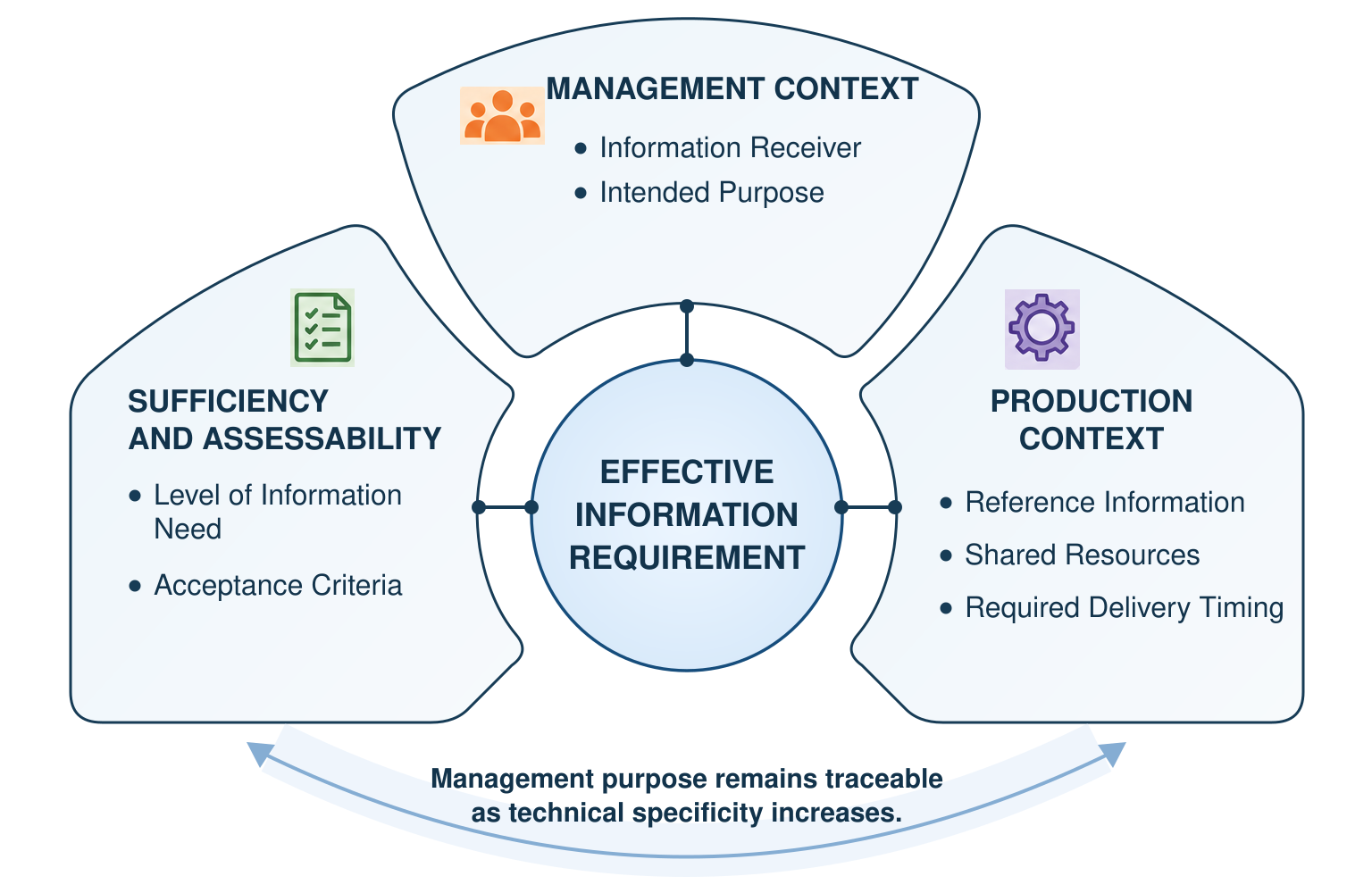
Figure 3.3 groups these elements into three complementary dimensions: Management Context, Sufficiency and Assessability, and Production Context. Table 3.1 provides the corresponding completeness check; the figure shows how the dimensions work together within one Requirement context.
The same logic applies at different levels of specificity. A higher-level Requirement may contain less technical detail, but it should still remain explicit, structured and traceable. As a Requirement develops towards production, greater specificity can be introduced without losing the management purpose that justified it.
This creates a different management problem. Requirements are rarely maintained as isolated statements: they appear in specifications, schedules, procurement records and other controlled representations. As those representations change, the Requirement itself must remain identifiable. The next question is therefore one of continuity: how can the same Requirement remain controlled across different representations and over time?
3.4. From Requirement to Documented and Managed Specification#
In practice, Information Requirements are recorded or referenced in briefs, specifications, schedules, procurement documents, standards, spreadsheets and other controlled records.
This document-centred practice is not a problem in itself. Readable artefacts remain necessary for review, issue, approval, reference and contractual or management use. The difficulty arises when the document becomes the only means of identifying and controlling the Requirements it contains.
Consider a Requirement concerning asset information for mechanical equipment. The same Requirement may appear in several controlled contexts:
Brief or specification — Provide manufacturer, model, serial number and maintenance information for air-handling units.
Structured Requirement schedule — REQ-118 — Provide manufacturer, model, serial number and maintenance information for air-handling units.
Scope or Appointment record — REQ-118 applies to the relevant mechanical information scope.
Production planning record — planned information work is linked to REQ-118.
Assessment record — produced information is assessed against the conditions associated with REQ-118.
The management problem is continuity. If wording changes, a document is revised or the Requirement is referenced elsewhere, participants still need to know whether they are dealing with the same Requirement, whether its definition has changed, which version applied at a particular time, where it originated and where it applies.
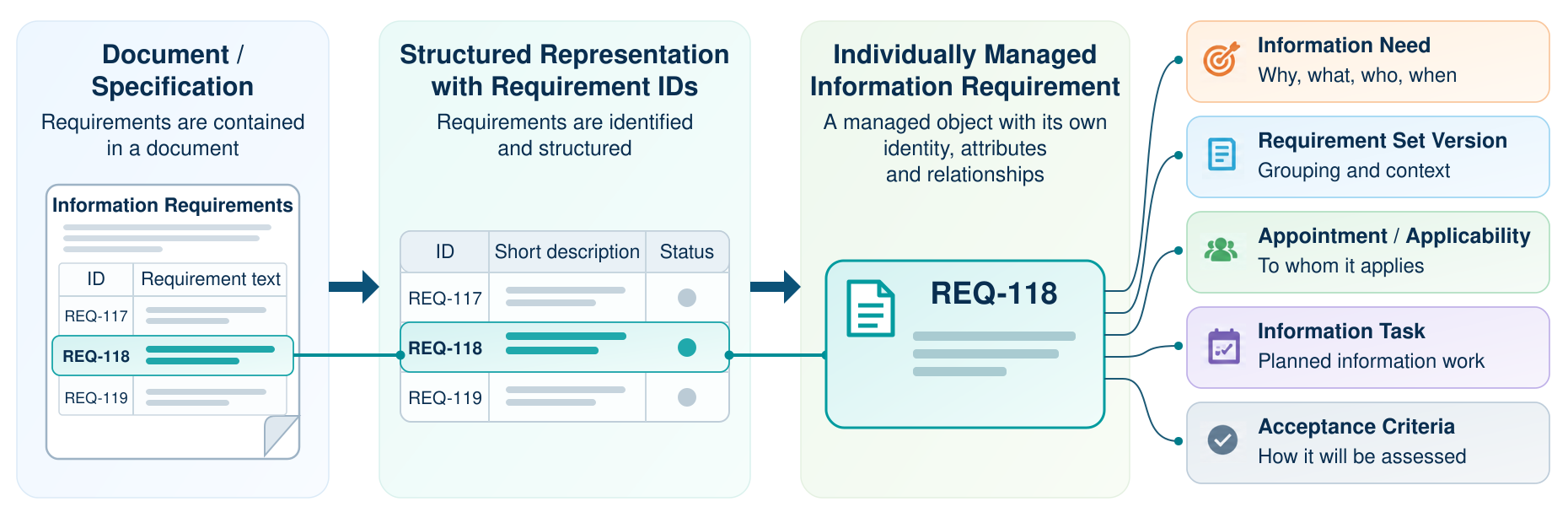
The document carries Requirements; it is not identical to them.
A single document may contain many Requirements, while the same Requirement may be referenced from several documents or management records without becoming several different Requirements.
The consequence is that Requirement identity should not depend entirely on the document in which a statement happens to appear. A Requirement can retain a persistent identity across different representations, supported by a stable identifier such as REQ-118.
The identifier makes that identity explicit and referenceable, but it is not the identity itself. The Requirement remains the managed object whose definition, history, applicability and relationships can evolve under controlled conditions.
The progression is therefore:
Implicit identity within documents → explicit and managed Requirement identity.
Figure 3.4 illustrates this shift from representation to persistent management identity.
Identity, History and Relationships#
Once Requirements are managed individually, three questions become important: is this still the same Requirement; has its definition changed; and how is it related to other controlled elements? Table 3.2 separates these questions.
Management question | What must be controlled |
|---|---|
Is this still the same Requirement? | Identity |
Has the Requirement changed? | Version and history |
How is it connected to other controlled elements? | Relationships |
Persistent identity answers the first question. Suppose REQ-118 initially requires the manufacturer, model and serial number of each air-handling unit. Later, asset-management experience shows that maintenance interval and warranty expiry are also required. The definition has changed, but REQ-118 may remain the same managed Requirement rather than becoming an unrelated one.
Version history records that controlled development. Successive issued versions may change the required information content, Acceptance Criteria, timing, applicability or referenced supporting information while preserving the continuing identity of the Requirement.
The distinction becomes critical once information production has begun. If a Provider works against one issued version and the Requirement is subsequently revised, the historical record must preserve which version governed that production and assessment.
A later version must not rewrite the conditions under which earlier information was produced and assessed.
An issued version may also supersede an earlier one without creating a new Requirement identity. The relationship is therefore:
One persistent Requirement identity → successive controlled versions → preserved historical applicability.
The third question concerns relationships. Once Requirement identity is explicit, the connections that give the Requirement its management context can also be made explicit and traceable.
A Requirement may, for example:
- originate from an Information Need;
- refine or develop another Requirement;
- apply within a defined scope or management context;
- be applied through a particular Appointment;
- be linked to production planning;
- define or reference Acceptance Criteria used to assess the resulting information.
These relationships are not created by digital technology. They already exist whenever a Requirement is developed, applied, planned for or used as the basis for assessment. Making them explicit allows the Requirement to remain connected to its origin, applicability and subsequent use as it moves through different management records and contexts.
This distinction matters because digitalisation is sometimes understood too narrowly as transferring information from documents into a database or another software environment. A specification may become technically structured without improving the management logic through which its Requirements are identified, related and controlled.
The more important progression is:
Implicit context within documents → explicit Requirement identity, history, applicability and relationships.
Technology may store, display or exchange this information, but the management value lies in making those relationships persistent and traceable.
A structured schedule may already provide much of this benefit. If each Requirement has a persistent identity supported by a stable identifier, other records can reference it for planning, applicability or assessment without recreating the Requirement itself. The original management demand can then remain traceable even as the Requirement appears across different representations and management contexts.
Persistent identity solves the problem of continuity, but not the problem of scale. Organisations do not manage Requirements one at a time; they manage many Requirements associated with different objectives, assets, projects and production contexts.
The next management problem is therefore one of organisation: how can Requirements be grouped for different contexts without losing their individual identity, history and traceability?
3.5. Requirement Sets Across the Organisation and Lifecycle#
At organisational scale, Requirements arise from different objectives, assets, projects and production contexts. The challenge is no longer individual identity alone, but how those identifiable Requirements should be organised for different management purposes.
Consider a healthcare organisation operating several hospitals. Its Requirements may support portfolio reporting, operation and maintenance of a particular hospital, plant replacement, a refurbishment project or information production within a specific appointment context. These are different management contexts, even where some of the underlying Requirements overlap.
A Requirement Set groups individually identifiable Requirements for a defined management context or purpose. The Set does not merge them into one larger Requirement: each Requirement retains its own identity, history and relationships while being managed as part of that context.
The composition of a Requirement Set may change over time. New Requirements may be added, existing Requirements revised and different versions made applicable. Controlled management therefore requires more than identifying the Set itself: it must also be possible to determine which issued composition applied at a particular point in time.
A Requirement Set Version records that controlled composition by establishing which Requirements, and which versions of those Requirements, were included when the Set was issued.
Requirement Sets organise individually identifiable Requirements by context. Context is not sequence.
Four types of Requirement Set Version are especially important in IMC:
OIR — Organisational Information Requirements — organisation-level context;
AIR — Asset Information Requirements — asset-management context;
PIR — Project Information Requirements — project-management context;
IPR — Information Production Requirements (formerly Exchange Information Requirements, EIR) — particular Appointment and production context.
Table 3.3 summarises their different management purposes.
Requirement Set Version | Management context | Primary focus |
|---|---|---|
OIR — Organisational Information Requirements | Organisation | Organisational objectives, Management Activities, governance and performance |
AIR — Asset Information Requirements | Asset management and use | Operation, maintenance, performance and asset-management decisions |
PIR — Project Information Requirements | Project management | Project planning, control and project decisions |
IPR — Information Production Requirements | Particular Appointment | Applicable Requirements and production, delivery and assessment conditions |
OIR, AIR and PIR: Different Management Contexts#
OIR, AIR and PIR organise Information Requirements around different management contexts. OIR provide an organisation-level context, AIR an asset-management context, and PIR a project-management context. The Requirements within them remain individually identifiable and may be relevant to more than one context where the underlying Management Activities interact.
For example, an organisation-level objective may influence Requirements associated with both asset management and a project; information needed for future asset use may affect production during a project; and project information may later remain valuable for asset-management activities. These relationships reflect interaction between management contexts, not a fixed progression between Requirement Sets.
An Information Need may arise directly from an organisational, asset-management, project, regulatory or other legitimate management context. A Requirement therefore does not have to pass through a prescribed sequence such as OIR → AIR → PIR before becoming applicable elsewhere.
A Requirement Set must also be distinguished from Requirement Cascade. A Requirement Set groups Requirements because they belong to a common management context; Requirement Cascade describes how one Requirement is developed into one or more specific Requirements.
The distinction can be expressed simply:
- Requirement Set → grouping by context.
- Requirement Cascade → development through increasing specificity.
Two Requirements may therefore belong to the same PIR without either having been developed from the other. Conversely, a Requirement developed through cascade may later be organised within a different Requirement Set context.
A Requirement Set is also different from an Information Model. Requirement Sets organise what is required; Information Models organise governed information that has been produced and maintained for defined purposes. AIR may shape what is required within an AIM, and PIR may shape what is required within a PIM, but the Requirement Set and the Information Model remain distinct management concepts.
IPR and the Appointment Context#
The IPR have a distinct function. They constitute an appointment-specific Requirement Set Version that applies and organises relevant Information Requirements for a particular Appointer–Appointee relationship and establishes the conditions under which the required information is to be produced, delivered and assessed.
An IPR may define or reference:
- applicable Information Requirements;
- Level of Information Need and Acceptance Criteria;
- Reference Information and Shared Resources;
- required delivery timing or frequency;
- other applicable production and delivery conditions.
Where necessary, Requirements within that context may also be refined to provide the specificity required for production. They nevertheless remain individually identifiable Requirements with their own identity, history and traceability; the IPR do not combine them into one large atomic Requirement.
Different Appointments may therefore require different IPR even where the resulting information contributes to the same project or asset Information Model. The IPR are defined by their particular Appointment and production context, not by their position at the end of a mandatory sequence such as OIR → AIR → PIR → IPR.
Figure 3.5 brings these management contexts together without treating them as a hierarchy. OIR, AIR, PIR and IPR organise individually identifiable Requirements within different management or Appointment contexts; none represents a mandatory stage through which every Requirement must pass.
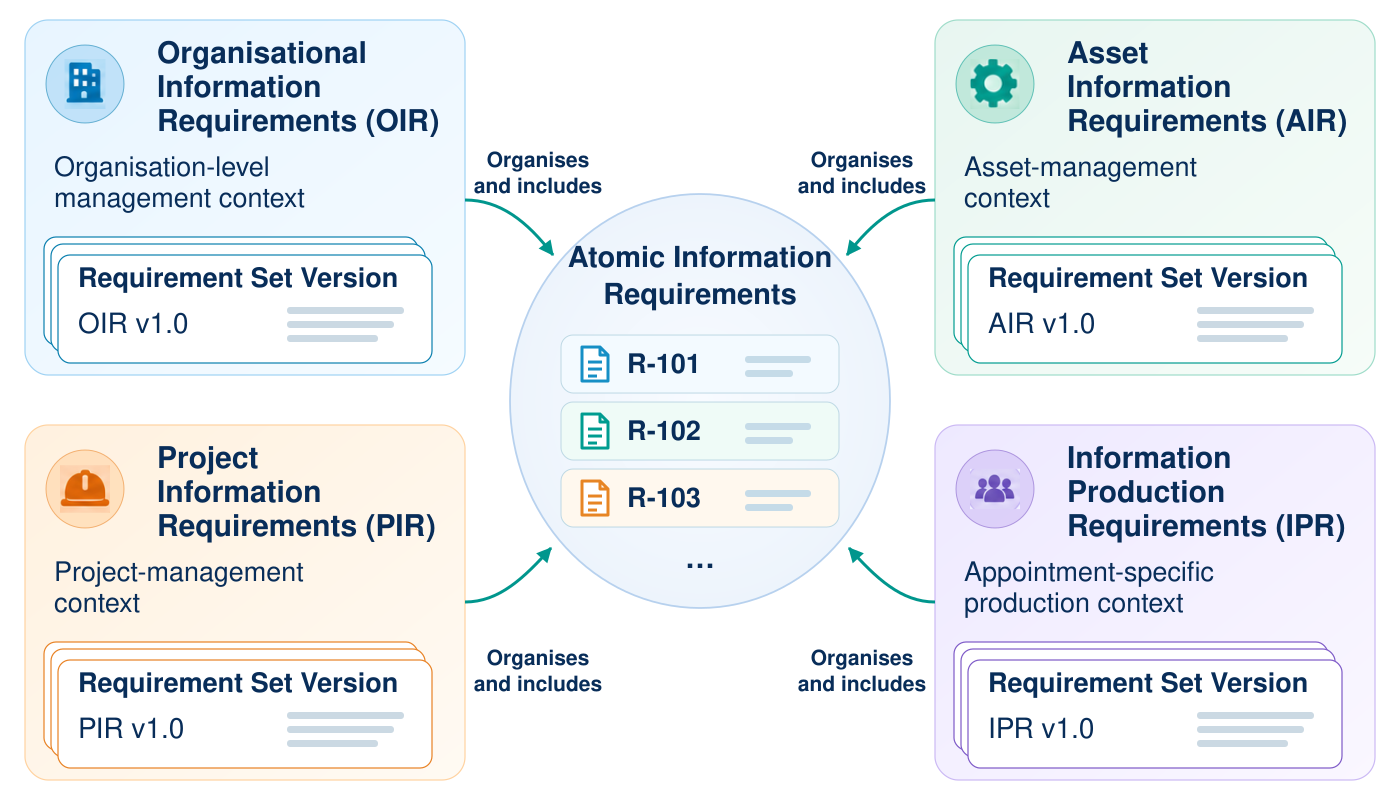
Requirement Sets answer the question of context: where and for what management purpose Requirements are organised together. They do not explain how a Requirement itself becomes more specific as scope, responsibility and production conditions develop.
That is the role of Requirement Cascade. The next section therefore turns from grouping by context to the controlled development of Requirements while preserving their origin and management meaning.
3.6. Requirement Cascade and Provenance#
An Information Requirement may be valid at management level and still require further development before a particular Provider can act on it. As scope, responsibility and technical context become clearer, the Requirement may need to be refined, decomposed, adapted or supplemented with greater specificity.
Consider an organisation planning to change the use of part of an existing office building and install heavier equipment on one of its floors. A management-level Requirement might state:
Provide sufficient information to determine whether the existing floor structure can safely support the proposed loading.
This is already a legitimate structured Requirement. It expresses a real information demand and remains traceable to the Management Activity and Information Need from which it originated. The fact that a structural specialist later requires greater technical specificity does not make the original Requirement incomplete or inadequate for its management context.
For the structural assessment, more specific Requirements may address:
- geometry and arrangement of structural elements;
- material and section properties;
- known defects or deterioration;
- previous modifications;
- capacity under the proposed loading condition.
The management-level Requirement and the specialist Requirements operate at different levels of specificity. The more specific Requirements develop the original management demand into specifications that can be acted upon within a defined technical scope. This controlled development is Requirement Cascade.
Cascade is controlled transformation, not copying. One Requirement may develop into several more specific Requirements, while several upstream Requirements may sometimes need to be considered together when defining a downstream scope. The objective is not to preserve identical wording, but to preserve the management meaning of the original demand while increasing the specificity needed for production.
Requirement Cascade may cross organisational, management and production contexts as Requirements become applicable to more specific scopes and Providers. A downstream Provider does not need every Requirement that exists elsewhere in the project or asset context; it needs the Requirements applicable to its own scope, expressed with sufficient specificity for the responsibility concerned.
As Requirements become more specific, their technical content may become substantially more detailed. This creates a corresponding risk: dimensions, tolerances, survey methods and data structures may be specified precisely while the original management reason for the Requirement becomes increasingly difficult to see.
Cascade increases specificity; provenance preserves meaning.
From Cascade to Provenance#
Provenance provides the traceability needed to understand both why a Requirement exists and how it developed. Two forms are especially important: origin provenance and cascade provenance.
Type of provenance | Question answered | Typical relationship |
|---|---|---|
Origin provenance | Why does this Requirement exist? | Management Activity → Information Need → Information Requirement |
Cascade provenance | How did this Requirement become more specific? | Requirement A → Requirement B → Requirement C |
Origin provenance explains why a Requirement exists. It connects the Requirement to the Management Activity and Information Need that justified it and, where relevant, to the Intended Purpose, Receiver and other contextual information needed to understand its origin.
Cascade provenance explains how a Requirement developed. It records relationships through which a Requirement was refined, decomposed, adapted or otherwise developed into more specific Requirements for a particular scope or production responsibility. A downstream Requirement can therefore be understood as part of a controlled line of development rather than as an isolated specification.
The two forms of provenance are related but not interchangeable. Knowing that Requirement C developed from Requirement B does not explain why Requirement B existed in the first place. Conversely, knowing the originating Information Need does not reveal the intermediate refinements through which the current Requirement developed.
Together, they can establish a continuous trace such as:
Management Activity → Information Need → Requirement A → Requirement B → Requirement C.
Figure 3.6 brings these two forms of provenance together. Requirements may become progressively more specific through cascade while remaining traceable to the management purpose from which they originated.
The Appointment context and IPR sit alongside this cascade rather than forming another level within it. They apply and organise relevant Requirements for a particular production relationship without becoming another Requirement at the end of the chain.
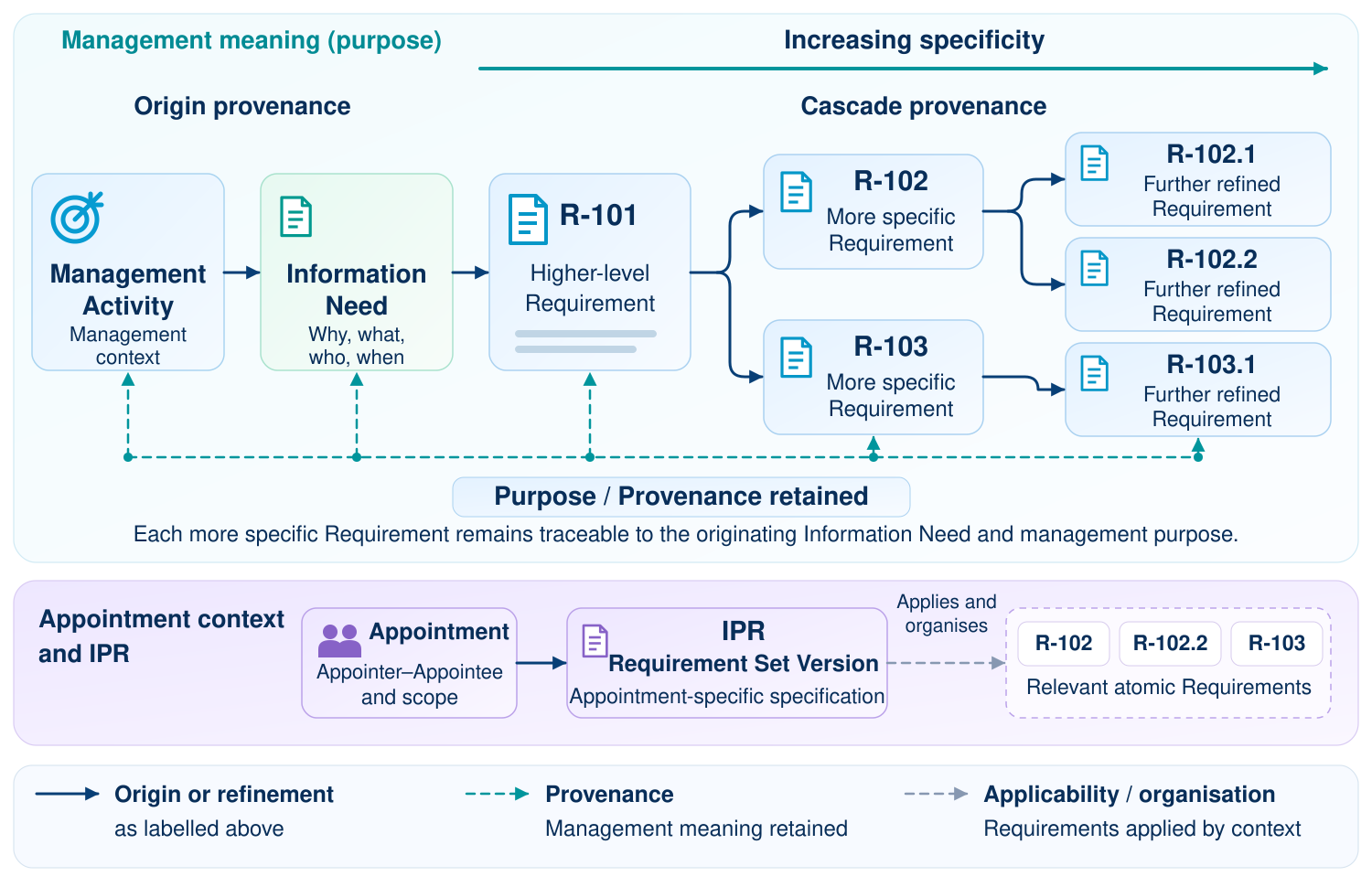
Preserving provenance does not require every contextual detail to be repeated in every downstream Requirement. What matters is that the relationships needed to understand the Requirement remain traceable. Depending on the context, these may include the originating Information Need, Intended Purpose, Receiver, parent Requirement, applicable timing or the context in which the Requirement applies.
The structural example illustrates the risk. A specialist may receive a highly precise Requirement for geometrical information about existing structural connections, including dimensions, tolerances and survey conditions. If the link to the original capacity assessment has been lost, however, Provider and Receiver may no longer be able to determine whether the requested information remains necessary or whether the specification is still aligned with its purpose.
The opposite failure is equally important. A Requirement may preserve its management purpose yet remain too general for a specialist to determine what information must actually be produced. Effective cascade must therefore preserve both management meaning and sufficient technical specificity.
Requirement Cascade must also be distinguished from applicability. Cascade explains how a Requirement develops; applicability explains where, when and to whom a particular version of that Requirement applies.
A Requirement may therefore be refined without becoming applicable to every scope in which related Requirements exist. Conversely, an existing Requirement may be made applicable within a particular Appointment, scope or period without being further refined.
The distinction is:
- Requirement Cascade → development of the Requirement.
- Applicability → assignment of that Requirement to a defined context.
By this point, Information Requirements can be structured, individually identified, organised by context and developed through controlled cascade while preserving their origin. One question still remains: how should the sufficiency of the required information be defined, and how should the resulting information be assessed?
3.7. Level of Information Need and Acceptance#
A Requirement may be well structured, traceable to its management purpose and sufficiently specific for a particular Provider, yet still leave one critical question unanswered: what information, in what form and with what characteristics, is sufficient for the Intended Purpose?
More information is not automatically better information. Too little may prevent the Receiver from making a Decision, performing an assessment or carrying out the intended Management Activity. Too much may create unnecessary production, checking, coordination and maintenance effort while making the information that actually matters harder to identify and use.
Consider an asset manager deciding whether an air-handling unit should be replaced. The decision does not necessarily require every dimension, property, drawing, photograph, calculation and maintenance record that could be produced about the unit. It requires the information characteristics sufficient to support that specific decision.
The right information is not the maximum that can be produced. It is the information sufficient for the Intended Purpose.
The practical challenge is to turn sufficient into a specification that a Provider can understand, produce against and that the resulting information can later be assessed against. This is the problem addressed by the Level of Information Need.
From Detail to Information Sufficiency#
Construction and BIM practice has long used methods for expressing how developed information should be at a particular point. LOD-, LOG- and LOI-type approaches emerged partly to make expectations more explicit and to avoid ambiguous requests such as provide a sufficiently detailed model.
These approaches address a genuine production problem, but a single scale of increasing detail has an important limitation: different forms of information do not develop in the same way or to the same degree. One component may require highly accurate geometry but only a small number of structured properties; another may require simple geometry but extensive operational data; a third may depend mainly on inspection records, photographs or other documentary evidence.
There is therefore no universal axis from less information to more information that can adequately express every Information Need. The relevant question is not simply how detailed should the model be? but what information, in what form and with what characteristics, is sufficient for the Intended Purpose?
Level of Information Need is not another model-detail scale. It provides a management framework for specifying the characteristics of information required for a defined purpose. LOD-, LOG- and LOI-type methods may still be useful within particular production contexts, but they do not replace that broader question of information sufficiency.
The Level of Information Need Framework#
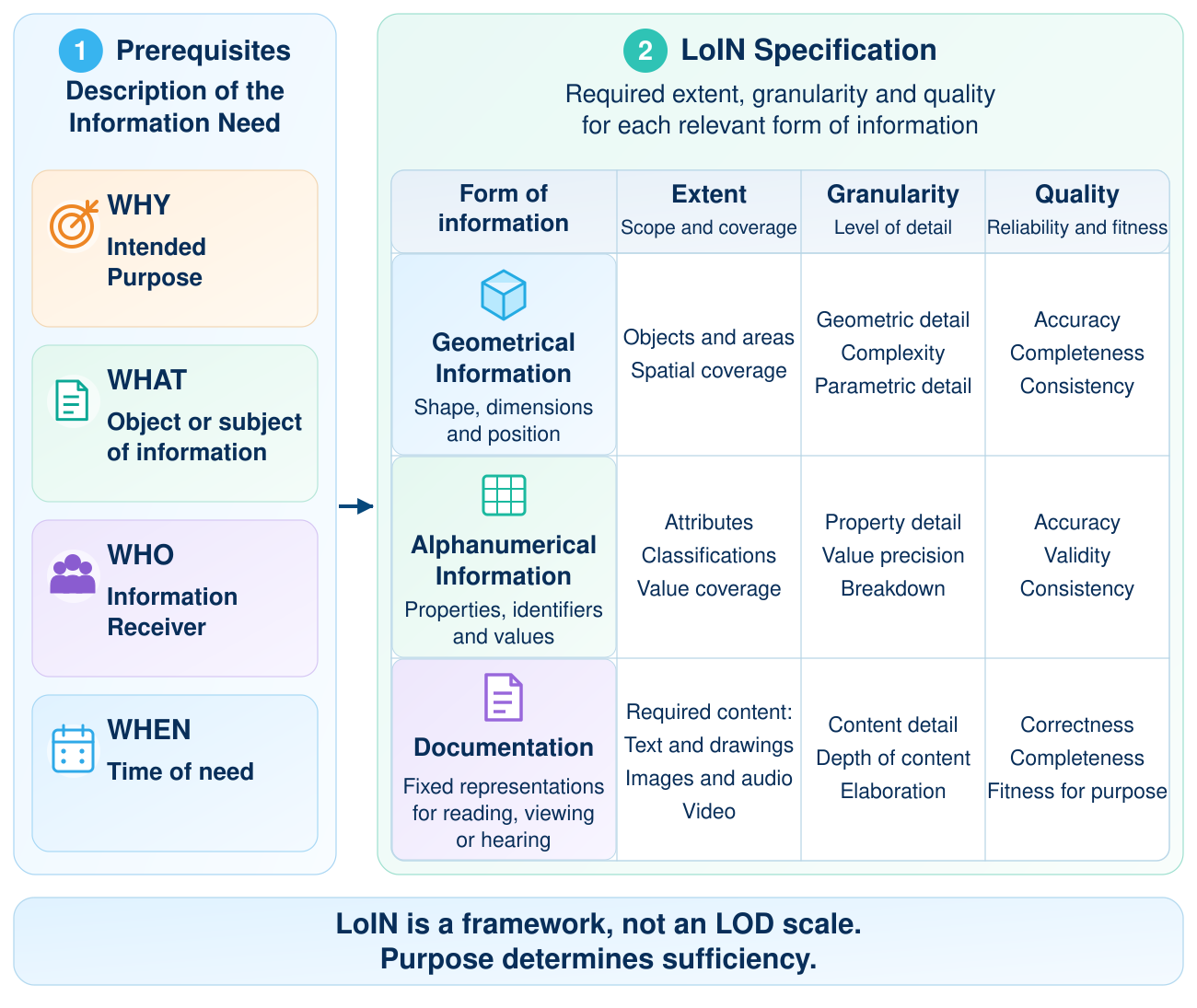
The Level of Information Need (LoIN) provides a framework for specifying the extent, granularity and quality of information required to satisfy a defined Information Need. It does not begin by selecting a predefined “level”; it begins with the management context and Intended Purpose for which the information is required.
We use the four questions that describe an Information Need as the starting point for specifying LoIN.
- Why? — the Intended Purpose;
- What? — the object or subject about which information is needed;
- Who? — who needs the information;
- When? — the time, event or Information Delivery Milestone at which the information is needed.
ISO 7817-1:2024 identifies the purpose, delivery milestones, participants and objects concerned as prerequisites for specifying LoIN. At the Information Need stage, Who? identifies the Receiver. When specifying LoIN, the relevant Providers are also considered once they are known. These prerequisites inform the LoIN Specification, which describes the required characteristics of three forms of information:
- Geometrical Information;
- Alphanumerical Information;
- Documentation.
These are not successive stages of development or positions on a common scale. They describe different forms in which information may be required for a particular purpose.
Geometrical Information describes spatial characteristics such as shape, dimensions, position and other geometrical aspects of an object or space. The required geometry may be simple or highly developed depending on the Intended Purpose.
Alphanumerical Information expresses structured properties, identifiers, classifications, values and other characteristics using symbols, numbers and text. It may include anything from manufacturer and installation date to performance, condition, capacity or classification information.
Documentation is recorded information presented in a fixed representation for reading, viewing or hearing. It may include text, drawings and diagrams, photographs, scanned material, audio, video and similar forms. Documentation may be unstructured or partly structured, but it should not be defined solely by file format or degree of machine readability.
These categories describe the role and character of information rather than mutually exclusive file types. The same technological format may support different information purposes, and a single Information Container may contain more than one form of information. What matters is what information is represented and how it supports the Intended Purpose, not the file extension through which it is delivered.
Documentation is especially important where evidence, explanation, instruction or a fixed record is required. An inspection report, a photograph showing a defect, a maintenance instruction, a signed certificate or a video record of an inspection may all contribute information needed for a Management Activity.
Merely naming a document type, however, is rarely sufficient. Its required content and characteristics must still be specified clearly enough for production and assessment. Templates, examples, instructions or references to statutory and technical requirements may be used where greater precision is needed.
Across these forms of information, the LoIN Specification uses characteristics such as Extent, Granularity and Quality. Together, they describe how much information is required, how finely it needs to be differentiated and what qualities it must possess to satisfy the Intended Purpose.
These characteristics are applied to the relevant forms of information rather than collapsed into one overall “level”. Precise Geometrical Information does not automatically require extensive Alphanumerical Information; rich structured data does not imply detailed geometry; and Documentation may be essential for one Management Activity while unnecessary for another.
Figure 3.7 brings the two parts of the framework together: the Prerequisites establish the management context and purpose, while the LoIN Specification defines the characteristics of the information considered sufficient for that context.
Consider again an asset-management team preparing an annual replacement programme for air-handling units. The team needs to determine which units are approaching the end of useful life, which replacements are most urgent and how future capital expenditure should be prioritised.
For that purpose, the LoIN Specification might require:
Geometrical Information — overall dimensions, location and access zones sufficient to determine whether replacement is physically feasible, without fabrication-level geometry;
Alphanumerical Information — manufacturer, model, capacity, installation date, operating condition and expected remaining life;
Documentation — a recent inspection report, photographs showing current condition and access constraints, and relevant maintenance or manufacturer instructions.
The three forms of information do not have to reach the same “level”. Geometry may remain relatively simple while the Alphanumerical Information is comparatively rich and selected Documentation provides evidence that neither geometry nor structured attributes can express adequately. A photograph may therefore satisfy part of the Information Need just as legitimately as a structured property or geometrical representation when it is the appropriate form for the Intended Purpose.
Purpose determines sufficiency. There is no meaningful “correct level of information” independently of purpose, Receiver, timing and context. Information that is excessive for one Management Activity may be insufficient for another.
Level of Information Need within the IPR#
Level of Information Need answers a specific question within the wider production specification: what characteristics of the required information are sufficient for the defined purpose? It does not replace either the Information Requirement or the IPR.
Within a particular Appointment, the relevant LoIN may be defined within the IPR or referenced by it alongside:
- applicable Information Requirements;
- Acceptance Criteria;
- Reference Information;
- Shared Resources;
- required delivery timing or frequency;
- other applicable production and delivery conditions.
The distinction is therefore:
- Information Requirement → what information is required.
- LoIN → what characteristics make that information sufficient for the Intended Purpose.
- IPR → the appointment-specific Requirement Set Version that applies and organises the relevant Requirements and production conditions.
LoIN is therefore part of the wider IPR production specification, whether defined within it or referenced by it; it is not a substitute for the IPR.
Defining sufficient information solves only one part of the production problem. The Provider must know what is required and with what characteristics, but the Receiver must also be able to determine whether the resulting information satisfies the applicable Requirement.
This leads from sufficiency to assessability.
From Specification to Assessment#
Before production begins, the applicable Requirement should make it possible to answer a simple question:
How will we know whether the required information has been provided satisfactorily?
This is the role of Acceptance Criteria. They establish in advance the conditions against which the produced information can later be assessed.
Depending on the Requirement, Acceptance Criteria may address:
- completeness;
- accuracy;
- presence of required attributes;
- conformity with an agreed schema or structure;
- specified tolerances;
- classification;
- consistency with Reference Information;
- required documentary evidence;
- other characteristics relevant to the Intended Purpose.
Without sufficiently explicit criteria, assessment remains open to interpretation. The Provider may consider the Requirement satisfied while the Receiver considers the resulting information incomplete or unsuitable. Acceptance Criteria reduce that ambiguity by establishing the expected conditions before production is complete.
They do not, however, perform the assessment or make the subsequent management Decision.
Criteria ≠ Assessment ≠ Decision.
The distinction can be illustrated with the air-handling-unit example.
Information Verification asks whether the produced information conforms to the applicable technical, structural and information-management requirements. It may confirm, for example, that required data fields are present, identifiers and units conform to the agreed structure, mandatory attachments have been supplied and applicable technical rules have been satisfied.
Information Validation asks a different question: whether the information is suitable for the Intended Purpose. Information may pass technical checks and still fail to provide sufficient evidence for the asset manager to determine whether the unit should be replaced.
Neither form of assessment constitutes formal Acceptance. An authorised participant must make the relevant Acceptance Decision within the applicable governance arrangements.
The conceptual relationship is:
correctly supplied → fit for purpose → formally accepted.
This expresses a distinction between types of judgement, not a requirement that every assessment process follow one identical procedural sequence.
Acceptance Criteria define what the result is expected to satisfy. Information Verification and Information Validation assess the information that has actually been produced from different perspectives. Acceptance is a separate management Decision made by the appropriate Authority.
Figure 3.8 summarises the relationship between Requirement definition, assessment and Acceptance while preserving the distinction between them.
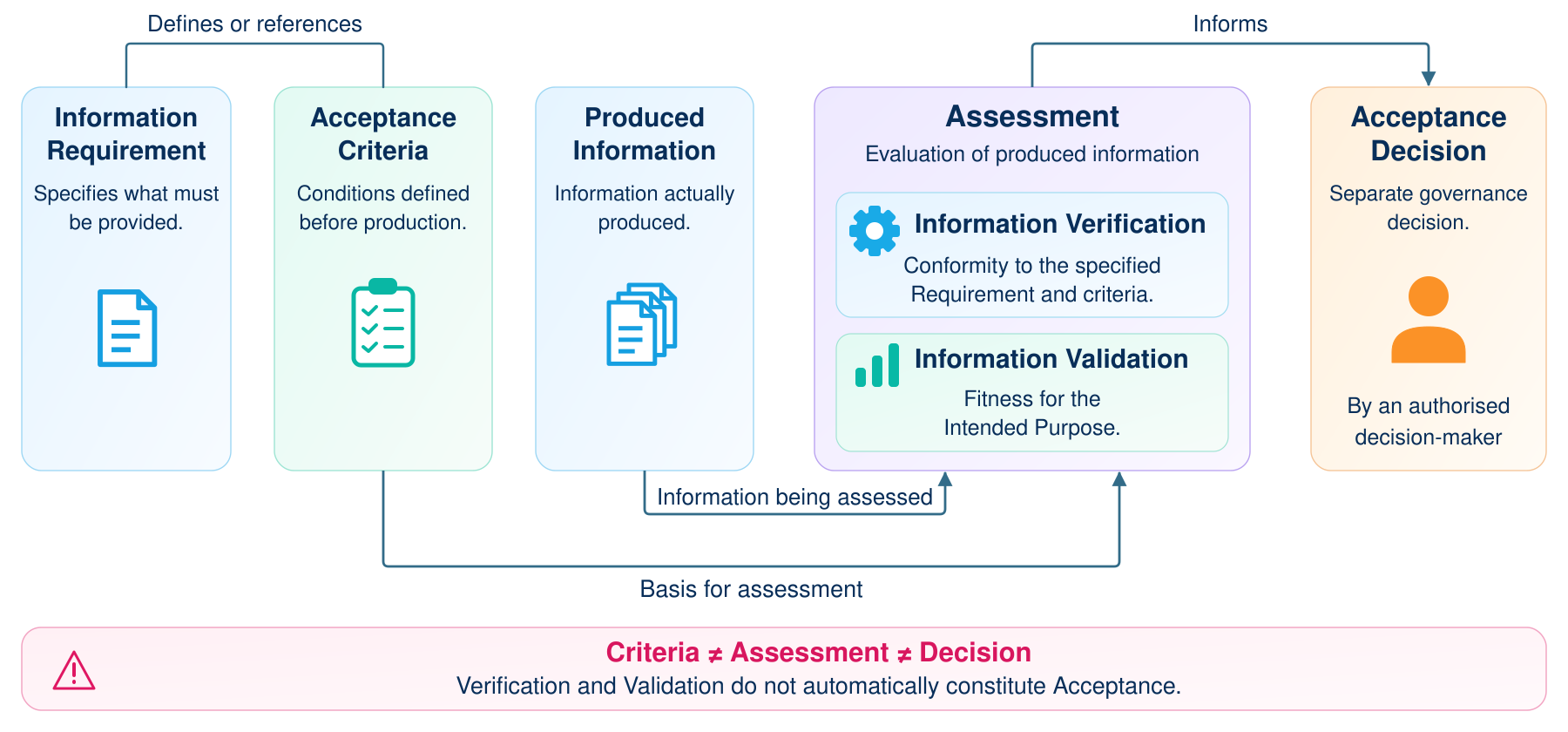
The distinction is an important safeguard. Information may satisfy technical checks without being suitable for its Intended Purpose, and it may be judged fit for purpose without that judgement itself constituting formal Acceptance.
Part II examines the procedures for Verification, Validation and Acceptance. At this stage, the governing point is that the basis for judgement belongs to Requirement definition: the conditions against which a result will be assessed should be established before production, not negotiated after delivery.
The chapter has followed the development of a management demand into a controlled Information Requirement. A Management Activity creates an Information Need; that Need is translated into individually identifiable Requirements that can be structured, versioned, organised by context, developed through cascade and kept traceable to their origin.
As the production context becomes clearer, those Requirements can be applied within an IPR, specified for sufficiency through Level of Information Need and made assessable through explicit Acceptance Criteria. What emerges is not merely a more detailed technical specification, but a controlled connection between management purpose, required information and the basis on which the resulting information will be judged.
A Requirement becomes operational when the Receiver can understand why the information is needed, the Provider can understand what must be produced and with what characteristics, and both can understand how the resulting information will be assessed.
The remaining challenge is one of scale and coordination. Requirements do not exist only as isolated specifications; they arise across organisational objectives, asset-management activities, projects and production relationships. Managing those contexts without losing consistency, provenance or purpose requires a broader organisational view of information demand.