Establishing the Conditions for Collaborative Information Production
In this chapter 6.1–6.6
6.1. Why Collaborative Information Production Requires Common Management Conditions#
The preceding chapters established how Information Requirements define what must be produced and how Appointments, Information Production Teams and Task Groups organise the responsibilities and work needed to fulfil them. Yet even when these arrangements are clear, effective collaboration is not guaranteed. Independently produced information must also remain identifiable, compatible and governable across organisational and technical boundaries.
Consider the reconstruction of an industrial facility involving several engineering disciplines. Each team may employ competent specialists, established production methods and suitable applications, yet their contributions may be difficult to coordinate if they use incompatible identification conventions, interpret revisions differently or disagree about when information may be shared. Resolving such inconsistencies after production has begun can lead to additional checking, repeated clarification and costly rework.

Reliable collaboration therefore requires common management conditions without imposing identical working practices on every participant. These conditions must establish common information rules, suitable production arrangements and governed ways of coordinating, assessing, exchanging and using information.
The essential distinction is that defined responsibilities do not, by themselves, ensure governed collaboration. Common management conditions connect the organisational arrangements established through Appointments with the coordinated production of information. Establishing these conditions is an essential part of preparing an Information Management Cycle.
Establishing Common Conditions for Information Production#
Information Management operates within the wider Organisational Management System. The conditions for collaborative information production must therefore reflect the organisation’s management purposes, Information Requirements, responsibilities and governance arrangements. They are not established by introducing a separate management system or selecting a particular software platform.
Several related arrangements are needed, each serving a distinct purpose:
Information Production Standard establishes common rules for identifying, structuring, classifying, representing and governing information.
Information Production Methods and Procedures establish suitable approaches to production and governed ways of performing activities.
Reference Information and Shared Resources provide existing information inputs and reusable means of production.
The first two arrangements establish rules and ways of working; the third provides resources needed to perform that work. They serve different purposes and should not be treated as components of a single category. The availability, applicability and permitted use of supporting resources must themselves be governed.
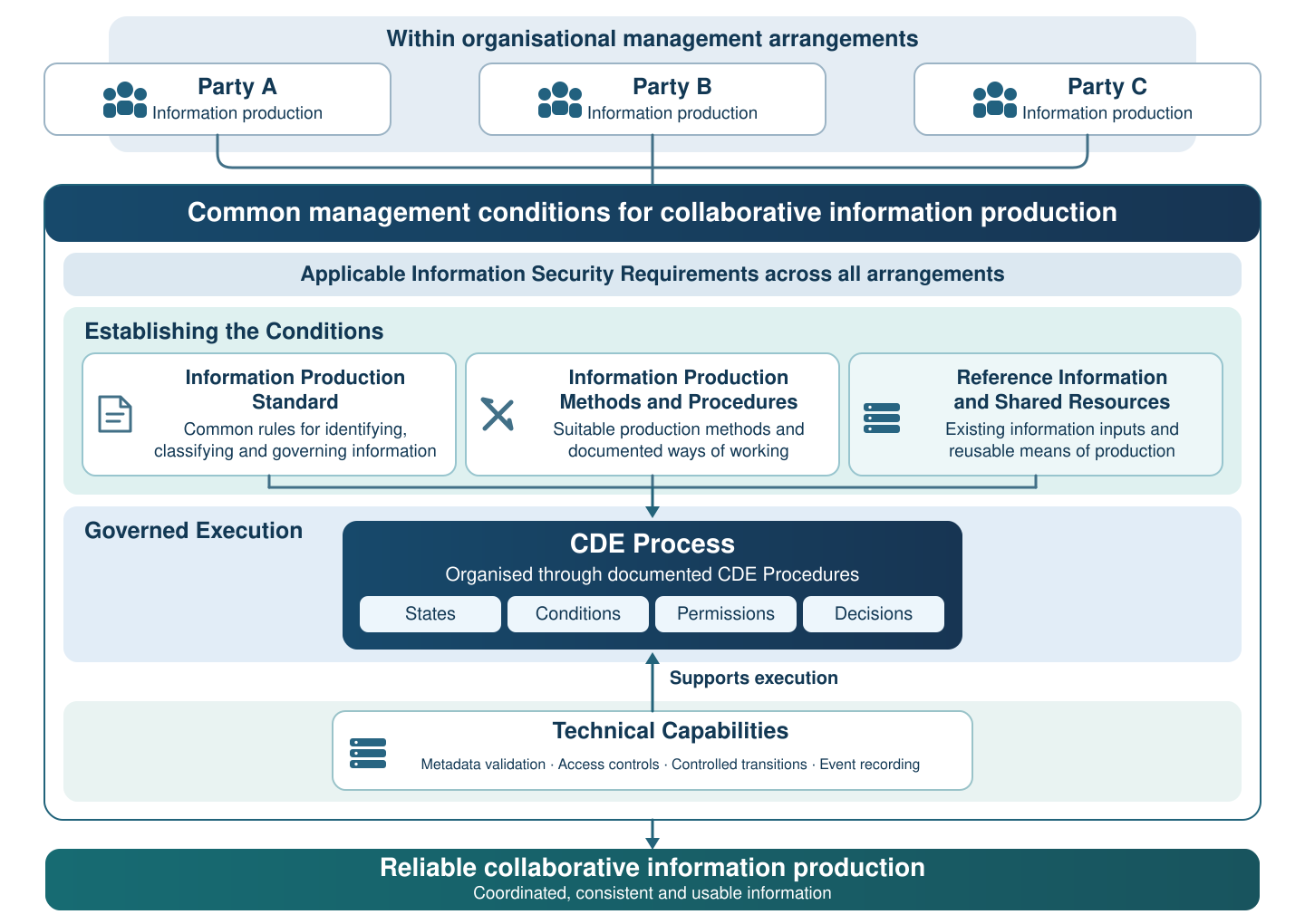
The CDE Process coordinates the governed production, sharing, assessment, authorisation and use of Information Containers. It is organised through documented CDE Procedures, which form a specialised part of the wider Information Management Procedures, together with applicable responsibilities, permissions, conditions and management Decisions. The process is therefore distinct from both its procedural basis and the technical systems supporting its execution.
Information Security requirements influence these arrangements from the outset. They may affect information identification, classification, production, exchange, access and permitted use. Security is thus a cross-cutting governance consideration, not a separate production stage. Security-Minded Information Management is examined in Part II.
Figure 6.1 brings these relationships together, distinguishing common rules and production arrangements, supporting resources, governed execution through the CDE Process, and technical enablement. Reliable collaboration depends on their consistency: common rules must be applicable, resources suitable and accessible, Procedures executable, and relevant responsibilities and Authorities clearly established.
Common Conditions and Professional Flexibility#
Common management conditions do not require participating organisations to adopt identical internal working practices. Construction and asset management depend on different disciplines, specialist technologies and professional methods. These differences are often a source of expertise rather than an obstacle to collaboration. What must be consistent is the way information is identified, interpreted, governed and made available across organisational boundaries.
The distinction is between common obligations necessary for collaboration and professional discretion in fulfilling them. Information identification, required metadata, revision conventions, exchange conditions and authorisation arrangements may need to be coordinated, while participants retain appropriate freedom to organise their internal work and select suitable production methods.
Table 6.1 summarises this distinction.
What must be coordinated | What may remain flexible |
|---|---|
Information identification, classification and required metadata | Internal organisation of modelling and documentation work |
Required information representations and exchange conditions | Selection of authoring applications and specialist production tools |
Revision conventions, information readiness and permitted use | Internal development sequences consistent with agreed Requirements |
Required assessment and authorisation arrangements | Additional internal checking practices and specialist production Methods |
Information Security, access and governance requirements | Local technical implementations that satisfy the agreed controls |
The boundary between common obligations and professional discretion is not absolute. A particular production Method may need to be prescribed where it affects safety, interoperability or the ability to verify the resulting information. Conversely, internal Procedures may vary where they remain consistent with applicable Requirements and agreed governance conditions.
Common management conditions must establish what is necessary for collaboration without unnecessarily prescribing how competent Providers perform their work.
This approach is scalable. A relatively simple engineering assignment may operate through a limited set of agreed rules and Procedures supported by existing information systems. A large programme involving many organisations may require more extensive coordination, formalised responsibilities and integrated technical capabilities. The scale of implementation changes, but the underlying management requirement remains the same.
The distinction between governance and technical implementation is equally important. The availability of CDE functions for identification, metadata management, access control and information exchange does not establish which rules should apply or who has Authority to make particular Decisions. Those conditions must be established through the relevant management arrangements. Technical systems provide the means to implement them.
The Appointing Party is responsible for ensuring that suitable common conditions are established for the Information Management Cycle. Information Managers may coordinate their preparation, while CDE Specialists and other technical professionals implement the necessary capabilities. Their contributions are complementary, but technical administration does not itself confer management Authority.
The resulting progression can be expressed as:
Agreed Governance Conditions → Functional Requirements → Technical Configuration → Tested Operational Readiness.
Operational readiness must be demonstrated, not assumed. A system may be installed and accessible without supporting the required CDE Procedures, access conditions or information exchanges. Its suitability depends on whether the agreed activities can be performed under the actual governance conditions of the Information Management Cycle.
The distinction between common obligations and professional flexibility ultimately depends on what must remain consistent across independently produced information. Participants may retain different production Methods and technologies, but their contributions must follow shared rules for identification, structure, representation and governance. Common information rules provide the foundation for this consistency, allowing professional diversity without sacrificing the coherence of the Information Model.
6.2. The Information Production Standard#
Collaborative information production requires more than technically correct contributions. Information created by different Parties must remain identifiable, interpretable and compatible within a common Information Model, even when participants use different professional conventions and technical applications. Establishing this consistency is the purpose of the Information Production Standard.
Establishing Common Rules for Information#
The Information Production Standard establishes common rules for identifying, classifying, structuring, representing and governing information. Its purpose is to establish the conventions that produced information must follow, rather than to prescribe every professional activity involved in its production. Different engineering organisations may therefore use their own authoring applications and production Methods while creating information that can be reliably coordinated, exchanged and used by others.
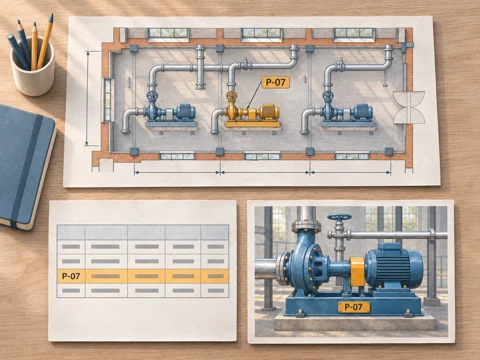
The Standard may incorporate or reference existing organisational, industry and technical standards. However, simply collecting references is not sufficient. The applicable provisions must form a consistent set of rules that participants can understand and implement within the relevant Information Management Cycle.
Table 6.2 summarises the principal categories of these rules and their management purposes.
Rule category | Management purpose |
|---|---|
Identification and naming | Establish consistent identification and referencing of Information Containers |
Classification and metadata | Define common categories, attributes and descriptive conventions for interpreting and governing information |
Information structure and representation | Specify applicable data structures, schemas, formats and presentation conventions |
Spatial reference and measurement conventions | Establish common coordinate references, units and relevant tolerances where spatial coordination is required |
Revision and Status Code conventions | Establish rules for identifying revisions and expressing applicable information-use purposes and conditions |
Conventions for specifying Level of Information Need | Provide common methods or referenced frameworks for describing the required extent and detail of information |
Validation rules | Establish checks for conformity with applicable information and governance rules |
The required level of standardisation depends on the complexity of collaboration and the consequences of inconsistent information. A relatively simple engineering assignment may need only essential identification, classification and revision conventions, while a major infrastructure programme may require detailed metadata structures, spatial references, exchange specifications and automated validation rules. The objective is sufficient consistency, not standardisation for its own sake.
Common rules must also reflect applicable organisational policies and Information Security Requirements. Such requirements may influence information classification, identification, representation and exchange. They should be incorporated into the governing arrangements from the outset rather than treated as technical restrictions introduced after production begins.
The practical importance of the Standard is evident in the reconstruction of an industrial facility. Structural and process engineers, equipment suppliers and building-services specialists may produce information in different systems, yet use agreed identifiers, classification references, metadata and spatial conventions. Their contributions become easier to coordinate because they follow common rules at the information interfaces, not because their internal production environments are identical.
The relationship can be expressed as:
Different Providers and Methods → Common Information Rules → Consistent Interpretation and Coordination.
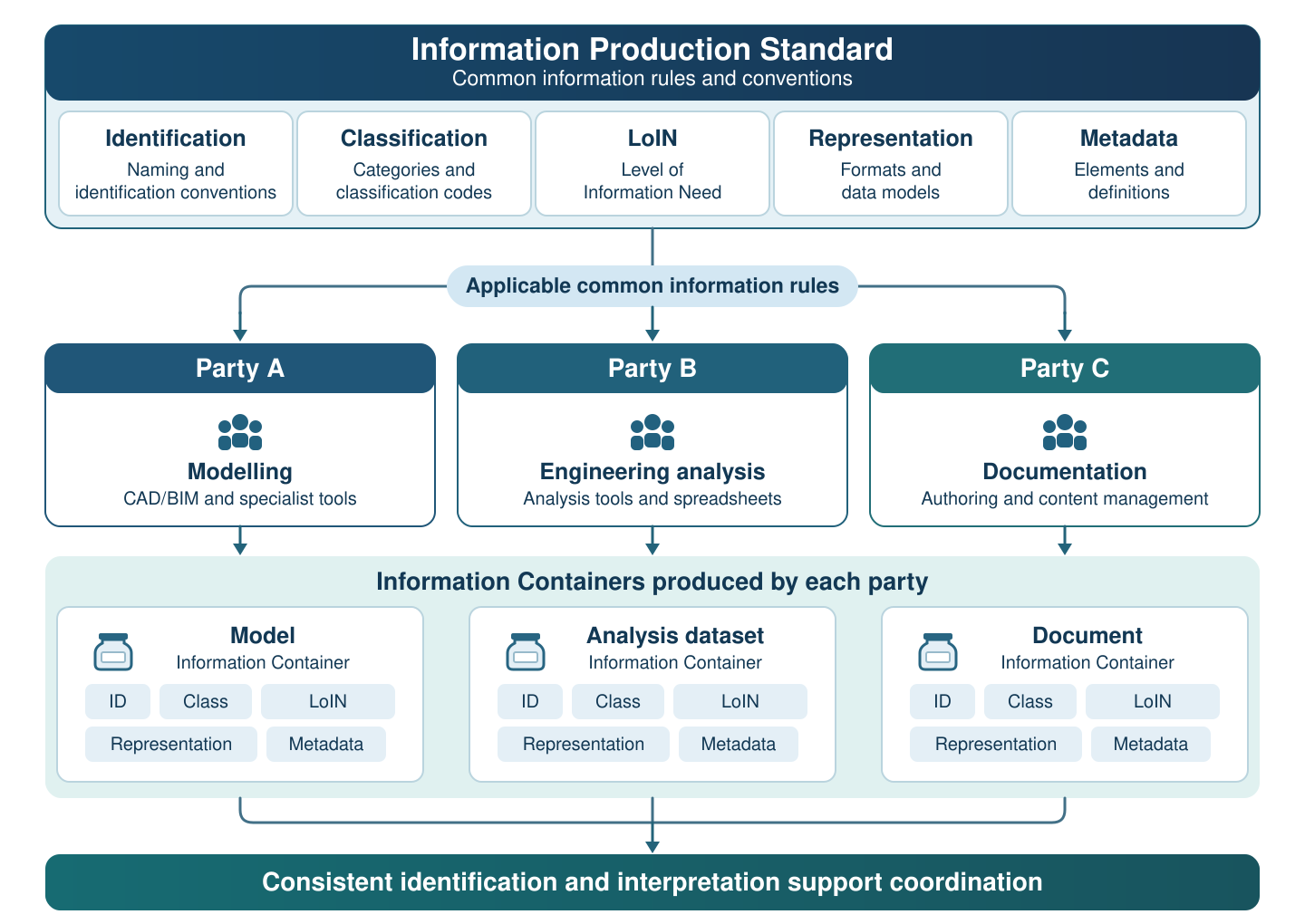
Figure 6.2 illustrates how the Information Production Standard establishes a common information interface across different Parties and technical systems, supporting reliable identification, interpretation, coordination and subsequent use of their contributions.
How Common Rules Improve Information Management Efficiency#
The Information Production Standard does more than establish conformity with agreed rules. Its practical value lies in reducing the effort needed to find, understand, coordinate and reuse information. Consistent conventions allow information produced by different Parties to remain useful beyond the immediate activity for which it was created, provided that its suitability for subsequent purposes can be established.
Four mechanisms are particularly important:
Finding and retrieving information. Consistent identifiers, classifications and metadata allow participants and Information Systems to locate relevant Information Containers without depending on personal knowledge of their storage locations or production history.
Reusing information. Common structures and representation conventions make existing information easier to interpret and apply to subsequent Management Activities, reducing unnecessary reproduction where the information remains suitable for its new Intended Purpose.
Coordinating information. Shared references, measurement conventions and classification schemes help relate contributions from different sources and identify inconsistencies between them.
Interpreting information reliably. Common terminology, symbols, units and presentation conventions reduce ambiguity, particularly when information is received by specialists who did not produce it.
These mechanisms reinforce one another. Information may be easy to retrieve but difficult to reuse if its meaning or applicability is unclear. Two geometric models may use compatible file formats yet fail to align because their coordinate references, orientations or measurement units differ. Likewise, a drawing may contain technically correct information but remain open to misinterpretation if its symbols or presentation conventions are unfamiliar to the Receiver. Technical compatibility alone does not ensure consistent interpretation.
The economic benefit becomes particularly important when information can support several Management Activities over time. Structural information developed during design may later support construction planning or modification of an existing facility. Equipment information originally provided for installation may remain relevant to maintenance and replacement decisions. Common rules make such information easier to understand and potentially reuse, reducing the need to produce equivalent information repeatedly.
However, standardisation supports reuse; it does not establish suitability for every new purpose. Existing information must still be assessed against the relevant Information Requirements, its currency and applicability. A consistently identified and structured Information Container may be reliable within its original context yet insufficient for a subsequent Decision requiring different information or greater detail.
The relationship can be summarised as:
Common Information Rules → Reliable Interpretation and Coordination → Greater Reuse Potential → Reduced Information Production Effort.
These benefits remain relevant when the Information Model spans several Information Systems. As explained in Chapter 2, information must retain sufficient identity, meaning and governance context to remain understandable across technical and organisational boundaries. The Information Production Standard contributes to this continuity by establishing common conventions that remain applicable regardless of where information is produced or managed.
Information Requirements and the Information Production Standard#
Information Requirements and the Information Production Standard govern different aspects of information production. An Information Requirement specifies what information is needed for a defined Intended Purpose, while the Standard establishes the common rules that produced information must follow. The former expresses a particular information demand; the latter establishes conventions applicable across many Requirements, Providers and Information Containers.
Consider an industrial facility where management needs to determine whether an existing floor can support new production equipment. The applicable Information Requirement specifies the necessary structural information and Acceptance Criteria. The Information Production Standard governs how the resulting Information Containers must be identified, classified, structured and represented. The Standard does not establish the need for the structural assessment; it establishes common rules for the information produced in response.
The same distinction applies to the Level of Information Need (LoIN). The Standard may establish common conventions for describing the required extent and detail of information, but the particular LoIN must be determined in relation to the Intended Purpose and applicable Information Requirements. A common specification method does not determine how much information a particular Management Activity needs.
The relationship can be expressed as:
- Information Requirement → Required Information and Acceptance Criteria.
- Information Production Standard → Common Rules for Information Representation and Governance.
- LoIN → Information Characteristics Sufficient for the Intended Purpose.
These distinctions have practical consequences. An Information Container may conform fully to the Standard while failing to provide the information required for a management Decision. Conversely, information may satisfy the substantive Requirement but fail to comply with common identification, metadata or representation rules, making its coordination and subsequent use less reliable.
An Information Requirement specifies what information must be provided. The Information Production Standard establishes the common rules that produced information must follow.
The Standard must also be applicable to the relevant production work. Providers need to know which provisions govern their Information Containers and which version of the Standard applies to their Appointment or production scope. Publishing a Standard is not sufficient; its applicability must be established and controlled. This becomes particularly important when common rules change during an Information Management Cycle.
Applicability and Controlled Change#
Information Production Standards must evolve as organisational needs, technologies and information-management practices change. Classification systems may be refined, metadata structures extended, new exchange formats adopted and validation rules improved. The challenge is to introduce better common rules without undermining the reliability of information produced under earlier versions.
This is particularly important across an asset lifecycle. Information created during the reconstruction of an industrial facility may later support operation, maintenance or further modification. Conversely, operational information may become Reference Information for a subsequent project. These activities may involve different Parties, applications and production arrangements, but previously governed information must remain identifiable, interpretable and potentially reusable.
The objective is therefore not to maintain an unchanged Standard indefinitely. It is to ensure controlled evolution with continuity of information meaning and governance. An issued Information Container Revision may remain relevant long after the Standard under which it was produced has been superseded. Its identity, metadata and historical context must remain understandable according to the rules that applied at the time.
When the Information Production Standard changes, five aspects require attention:
Applicability. Which version governs particular Parties, Appointments, production scopes and Information Containers.
Transition conditions. When the revised rules take effect and how ongoing production is affected.
Historical continuity. How information produced under earlier versions remains identifiable, interpretable and traceable.
Implementation consequences. Which Procedures, Shared Resources, validation arrangements and technical configurations require adjustment.
Responsibility for change. Who has Authority to approve the revised Standard and coordinate its implementation.
These aspects are interdependent. For example, introducing a new metadata structure may require changes to information-production instructions, validation rules and CDE configuration. Existing information may also need to be mapped or converted where this is justified by a new management purpose. Such changes must be deliberate and traceable; previously issued information must not silently acquire a different identity or meaning because the governing Standard has changed.
Changes to common information rules must not erase the meaning or governance context of information produced under earlier versions of those rules.
This principle applies whenever information is carried forward through successive projects, inspections, maintenance activities or changes in organisational and technical arrangements. The Standard may change, but the information governed by earlier rules must remain understandable within its original context.
The Information Production Standard thus provides a stable basis for collaboration without preventing necessary improvement. Its value lies not only in creating consistency at a particular moment, but also in preserving continuity as information and its management conditions evolve.
Yet common rules alone cannot ensure effective information production. Even when all participants follow the same identification, classification and representation conventions, they must still determine how the required information will be produced, checked and coordinated, and which activities require agreed Procedures. Consistency of information must therefore be supported by suitable Methods and governed ways of working.
6.3. Information Production Methods and Procedures#
Common information rules establish consistency, but they do not determine how the required information should be produced. The same Information Requirement may be fulfilled through different professional techniques, technologies and working arrangements. Managing information production therefore involves not only defining the expected result, but also establishing suitable and governable ways of achieving it.
Consider the reconstruction of an industrial facility where engineers need information about existing structural geometry before installing new equipment. The Information Requirement establishes what must be provided, and an Information Task defines the work needed to obtain it. However, the Task does not determine whether the information should be produced through conventional measurement, laser scanning, photogrammetry or a combination of techniques. These alternatives may all be technically suitable, but differ in cost, duration, required competence and implications for subsequent work.
This example reveals an important distinction: defining the work is not the same as selecting a way to perform it. Nor does selecting a suitable technique establish all the conditions under which that work must be coordinated and governed.
Information Task, Method, Procedure and Process#
Four related concepts describe different dimensions of information-production work and its management: Information Task, Method, Procedure and Process. They are complementary, but they do not represent successive stages of a prescribed workflow.
An Information Task is a planned unit of work directed towards a defined information-related result. It provides a basis for organising, assigning and coordinating the activities needed to fulfil applicable Information Requirements.
A Method describes an available approach or means of performing that work. It may involve professional techniques, equipment, software and specialist competence. Several Methods may be suitable for the same Information Task, depending on the required result and the conditions under which it must be achieved.
A Procedure establishes a defined, repeatable and governed way of performing an activity. It specifies relevant actions, responsibilities, relationships and conditions, particularly where consistency, traceability or controlled interaction between participants is required.
A Process is a wider managed arrangement through which related activities are coordinated to achieve an intended outcome. It may involve several Procedures, Information Tasks, participants, assessments and management Decisions. A Process is therefore neither an individual Procedure nor merely a technical workflow implemented in software.
Table 6.3 summarises these distinctions through the management questions answered by each concept.
Concept | Principal question | Management meaning |
|---|---|---|
Information Task | What work must be performed? | A planned unit of work directed towards a defined information-related result |
Method | How may the work be performed? | An available approach or means, subject to assessment and selection |
Procedure | How must an activity be carried out under agreed conditions? | A governed arrangement defining actions, responsibilities and conditions |
Process | How are related activities coordinated to achieve an outcome? | A wider managed arrangement connecting activities, participants and results |
Consider the preparation of a drawing from a 3D model. The Information Task defines the required work and result. The Method may involve generating views and annotations using suitable authoring software. Procedures govern activities such as checking, registration, review and authorisation, while the wider Process coordinates the related activities and participants within the applicable information-management arrangements.
These relationships are not one-to-one. A Method may be used for many Information Tasks; a Procedure may govern activities repeated in different production contexts; and a Process may coordinate multiple Tasks and Procedures. Keeping these concepts distinct allows management to separate the work to be performed, the means of performing it and the arrangements governing its execution.
Choosing Effective Information Production Methods#
Most Information Tasks can be performed through more than one Method. Choosing among suitable alternatives is therefore an important management decision, particularly when the available approaches differ in cost, duration, required competence or consequences for subsequent activities.
No Information Production Method is inherently effective or ineffective. A technologically advanced approach may offer substantial advantages in one situation while introducing unnecessary expense or complexity in another. Conversely, a conventional technique may be entirely appropriate when the task is straightforward. Effectiveness depends on the required result and the actual conditions of application, not on the sophistication of the technology itself.
Two questions should guide Method selection. First, is the Method suitable? Can it produce information that satisfies the applicable Information Requirements and mandatory conditions? Second, is it effective? Among the suitable alternatives, which offers the most appropriate balance of performance, resources and consequences?
A practical assessment should consider four interrelated factors:
Time — the duration of the activity and its implications for the wider information-production schedule.
Costs — the resources required to introduce and apply the Method, including equipment, software, training and changes to existing working arrangements.
Risks and other considerations — potential limitations, errors, dependencies, benefits and consequences for related activities.
Competence — the professional knowledge, skills and organisational capabilities necessary for reliable application.
These factors must be considered together. A Method that accelerates a critical activity may justify additional expenditure, while a less expensive approach may create substantial downstream processing work. A technically suitable Method may also be impractical if the necessary competence is unavailable within the required time.
Consider the review of engineering information. Depending on the purpose and form of the information, several Methods may be appropriate. Immersive virtual-reality review can help specialists examine complex spatial relationships within a three-dimensional model. Electronic review using conventional digital applications may provide a more economical way to examine information and record comments within the governed environment. Paper-based review may remain suitable for certain site activities or straightforward documents, although printing, transferring and subsequently digitising comments can introduce additional work and opportunities for error.
The selection should therefore consider the effectiveness of the complete activity, not merely the apparent efficiency of one operation. A review Method that appears inexpensive in isolation may become costly when its results must be incorporated into subsequent coordination and information-management activities.
The selection logic can be expressed as:
Applicable Requirements → Suitable Alternative Methods → Effectiveness Evaluation → Justified Method Selection.
Assessing effectiveness is part of information management, but it requires the participation of competent production specialists. Information Managers may help establish evaluation criteria and coordinate the comparison of alternatives, while engineers, surveyors and other specialists assess their technical feasibility and practical consequences. The resulting Method must be selected and authorised within the applicable organisational responsibilities and decision-making Authorities.
This distinction is particularly relevant to collaborative production. The Appointing Party may establish initial Methods and Procedures, while prospective or appointed Providers may possess specialist knowledge that enables them to propose better approaches. Such proposals can be considered during procurement, Appointment preparation or production planning, with the agreed governance arrangements determining how the selected Methods become applicable.
The objective is not to select the most sophisticated technology or impose uniform working practices. It is to establish production arrangements capable of delivering the required information with an appropriate use of resources.
The effectiveness of an Information Production Method is determined by the required result, available resources and conditions of application, not by the technology or technique considered in isolation.
Procedures and the Wider Management Process#
Selecting an effective Method does not establish all the conditions necessary for reliable collaboration. Participants must also understand who performs the required actions, under which conditions and with what responsibilities. Where consistency and control are necessary, these arrangements are established through documented Procedures.
Consider the preparation of a drawing from a 3D model. The Method determines how the drawing is generated, while the applicable Procedure may establish who checks it, which criteria are applied, how comments are recorded and what authorisation is required before the drawing is released for a particular purpose. The Procedure need not prescribe every operation within the authoring application. Its purpose is to make the relevant activity predictable, repeatable and governable.
A Procedure must be more than a written description of intended actions. Its responsibilities and conditions must be communicated, supported during execution and accompanied by suitable evidence that the required activities have been performed. Documenting a Procedure is not the same as ensuring that it can be followed in practice.
The degree of formalisation should reflect the activity being governed. A straightforward Procedure may require only a short description of actions, responsibilities and conditions. More complex arrangements involving several Parties, alternative outcomes or authorised Decisions may require process diagrams, responsibility matrices and structured supporting documentation. The objective is reliable and governable execution, not documentation for its own sake.
Information Management Procedures extend beyond the production and handling of individual Information Containers. They may govern the development of Information Requirements, production planning, coordination between Parties, information assessment and other activities within the Information Management Cycle.
CDE Procedures form a specialised part of these wider procedural arrangements. They establish governed ways of performing activities associated with the production, controlled progression, sharing and exchange of information. Together with the applicable responsibilities, conditions, permissions and management Decisions, documented CDE Procedures provide the procedural basis for the CDE Process.
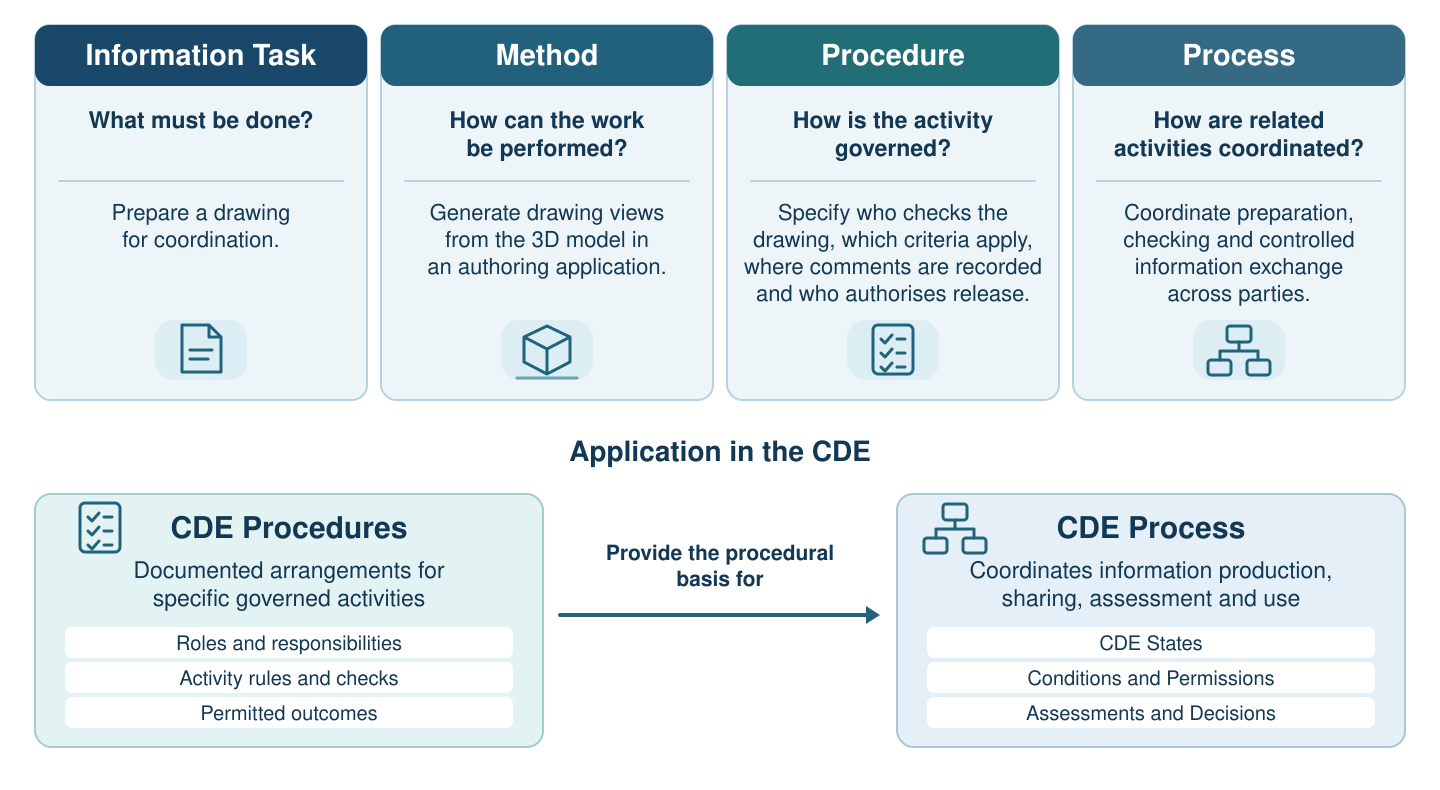
Figure 6.3 brings together the distinctions between Information Tasks, Methods, Procedures and Processes. In particular, it illustrates how Methods provide alternative ways of performing work, while Procedures establish governed arrangements for activities coordinated within wider Processes. CDE Procedures are shown as a specialised part of the procedural arrangements supporting the CDE Process.
In practice, the execution of CDE Procedures may be supported by configured workflows, automated checks, access controls and transaction records, potentially involving several Connected Information Systems. These capabilities can improve reliability and reduce repetitive work, but technical execution must remain consistent with established responsibilities and management Authority. A system’s ability to perform an operation does not, by itself, authorise that operation.
A further distinction is necessary because Procedures interact with governance conditions and Decisions without being equivalent to them:
Procedure ≠ CDE State ≠ Decision ≠ State Transition.
A Procedure establishes how an activity must be performed. A CDE State describes the applicable governance condition of a particular information instance. A Decision records an authorised determination, while a State Transition changes the applicable condition. These concepts describe different aspects of governed information management and must not be treated as interchangeable.
Once established, Methods and Procedures should be managed as reusable organisational resources. They may be documented, maintained and improved across successive Information Management Cycles, provided their applicability, governing versions and conditions of use remain clear. Some may also contain valuable organisational know-how requiring appropriate controls over access, disclosure and reuse.
Effective Methods and governed Procedures make information-production activities more consistent and reliable. Their successful application, however, also depends on the information and supporting resources available to the participants. Even a well-defined Procedure and a suitable production Method cannot compensate for missing or unreliable inputs, nor can they eliminate unnecessary work caused by the absence of reusable production resources.
6.4. Reference Information and Shared Resources#
Even when participants follow common Standards and apply suitable Methods and Procedures, the quality of their work may depend on information and resources that already exist. Outdated drawings, incomplete surveys or unavailable production materials can compromise otherwise competent information production. Reliable collaboration therefore requires not only common rules and ways of working, but also suitable inputs and reusable supporting resources.
Two categories serve different functions. Reference Information provides existing information needed to support new work, while Shared Resources provide reusable materials that help participants produce information consistently and efficiently. The distinction concerns the role these resources perform, rather than their file formats, storage locations or ownership.
Reference Information as a Production Input#
Reference Information is existing information made available to support the planning, production, assessment or use of new information. It may describe an asset, its surroundings, previous decisions or other conditions relevant to the work.
Consider the reconstruction of an industrial facility. An engineering Provider receives structural drawings prepared twenty years earlier, but the facility has undergone modifications that are not fully reflected in those documents. Records of underground services are also incomplete. Before producing reliable engineering information, the Provider must determine which existing information can be used and what additional investigation may be necessary.

Reference Information for such work may include:
Existing asset documentation — drawings, specifications, equipment records and other information describing the facility.
Survey and investigation results — measurements, condition assessments and investigations of the site or existing structures.
Previous Information Models — information produced during earlier project or asset-management activities.
External information sources — geospatial datasets, records of neighbouring infrastructure and relevant regulatory or technical information.
These resources may be provided by the Appointing Party or obtained from asset operators, public authorities, infrastructure owners and other organisations. They may exist in different formats and Information Systems. What makes them Reference Information is their function as an input to the intended work, not the way they are stored or represented.
However, available information is not necessarily reliable or suitable information. An existing drawing may describe an earlier asset configuration, a survey may cover only part of the required area, and a dataset may use classifications that no longer correspond to current operational records. Participants must therefore understand the source, currency, scope, completeness, reliability and known limitations of the information they intend to use.
Incomplete Reference Information may still be valuable when its limitations are understood and the associated uncertainty can be managed. The objective is not to assume that existing information is correct, but to establish how confidently it can support the required work.
The value of Reference Information depends not only on its availability, but also on the understanding of its reliability, completeness and limitations.
The consequences of inadequate Reference Information extend beyond technical production. In the industrial facility example, a prospective Provider may need additional surveys, more time to verify existing conditions or a contingency allowance for uncertainty. Different Providers may also make different assumptions, reducing the comparability of their proposals.
Incomplete Reference Information → Greater Production Uncertainty → Higher Cost and Risk.
This does not mean that every information gap must be resolved before procurement or Appointment. Obtaining missing information may itself form part of the appointed work. Nevertheless, the Appointing Party should ensure that relevant Reference Information is identified and made available at the appropriate stage, with known limitations and responsibilities for further investigation clearly established.
Making uncertainty visible and manageable is more important than creating an appearance of completeness. Well-prepared Reference Information can improve procurement, production planning and the reliability of the resulting information without requiring unnecessary duplication of earlier investigations.
Shared Resources for Consistent Production#
Reference Information provides existing information needed for particular activities. Shared Resources, by contrast, are reusable materials that support consistent and efficient information production across different Tasks and participants.
Such resources may include Information Container templates, standard document forms, object libraries, drawing styles, symbols, data dictionaries and reusable information structures. Their purpose is to reduce unnecessary repetition and help participants apply compatible conventions without requiring each Provider to develop the same supporting materials independently.
Consider three Providers working on different parts of an industrial facility. Each develops its own equipment-object library, using slightly different attributes and naming conventions. Although all three libraries may be technically adequate, integrating the resulting information requires additional mapping and correction. A suitable common library could reduce this work while improving consistency between the Providers’ information results.
The benefit of Shared Resources extends beyond saving production effort. By providing suitable reusable structures and components, they can reduce inconsistencies, simplify coordination and make established information rules easier to apply. Their value is therefore realised both during individual production activities and when independently produced information is brought together.
Shared Resources are closely related to the Information Production Standard, but the two perform different functions. The Standard establishes the rules; Shared Resources help participants apply them. For example, the Standard may require an equipment dataset to contain particular attributes, use an agreed classification scheme and follow specified representation conventions. A shared template may provide the required structure, while a common object library supplies reusable components. The Provider remains responsible for fulfilling the applicable Information Requirements, even when using these resources.
Table 6.4 summarises the functional distinction between Reference Information and Shared Resources.
Aspect | Reference Information | Shared Resources |
|---|---|---|
Primary purpose | Provide existing information needed to support new work | Support consistent and efficient production through reuse |
Typical examples | Surveys, previous Information Models, asset records, existing documentation | Templates, object libraries, styles, reusable data structures |
Main management concern | Reliability, completeness, applicability and provenance | Availability, standardisation, version control and permitted reuse |
Practical value | Reduce uncertainty and avoid unnecessary recreation of information | Reduce repetitive work and improve consistency across Providers |
The categories are not mutually exclusive. A previous Information Model may serve as Reference Information for a refurbishment project, while selected components derived from it may later be developed into Shared Resources. Their classification depends on the function they perform in a particular context, not on their technical format or original purpose.
Reuse also requires professional judgement. An outdated template may introduce incorrect attributes, while a standard object may be unsuitable for a particular asset or Level of Information Need. A resource is valuable only when it remains appropriate for the intended work. Its availability or previous successful use does not establish its suitability in every new situation.
The value of Shared Resources lies in avoiding repeated work while maintaining consistency — not in imposing identical production practices on every Provider.
Common production support should therefore reduce unnecessary duplication without constraining legitimate professional choices. Where a Shared Resource is suitable, its reuse can improve efficiency and consistency. Where it is not, the agreed arrangements should permit an appropriate alternative.
Managing Availability, Applicability and Rights#
The practical value of Reference Information and Shared Resources depends on how they are managed. Identifying useful materials is not sufficient if participants cannot obtain them when needed, determine whether they are appropriate for their work or understand the conditions under which they may be used.
Figure 6.4 illustrates Reference Information as an input to information-production activities and Shared Resources as reusable support for those activities. Both contribute to Information Tasks performed under the Information Production Standard and applicable Methods and Procedures. Their functions remain distinct, even when the resources are managed across several Information Systems.
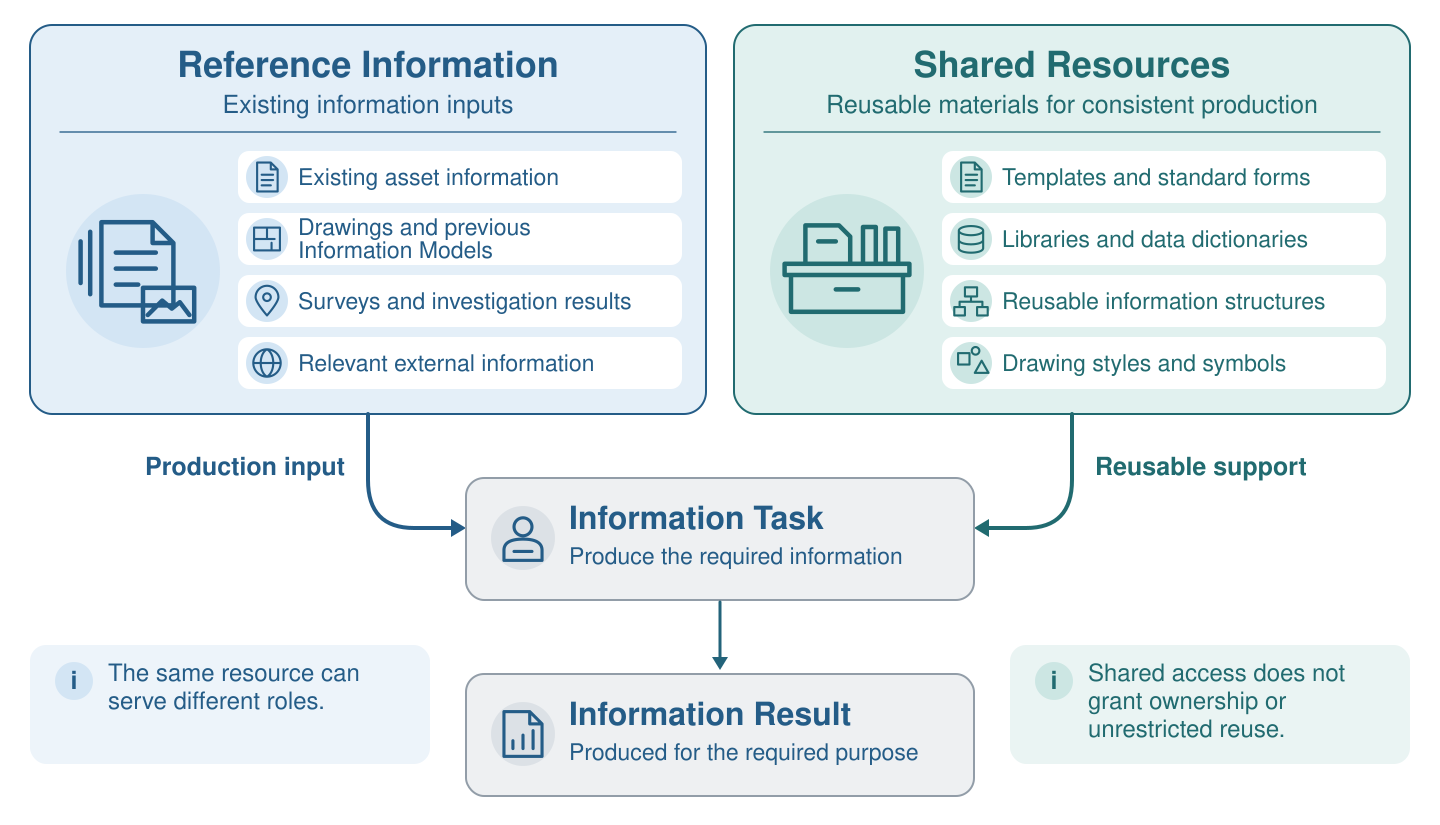
Four management conditions are particularly important:
Availability and timing. Resources must be accessible when the relevant activities require them. Reference Information may be needed during procurement, before a Provider is appointed, while Shared Resources should be available before the production Tasks they support begin. Delayed access can increase costs or disrupt work even when the required materials already exist.
Applicability and currency. Participants must know which resource or version is appropriate for their work, including its intended scope, known limitations and conditions of use. A resource may remain historically valid without being suitable for a new Information Task.
Responsibility and maintenance. The Parties responsible for preparing, providing, updating and governing resources must be identifiable. These functions may be distributed across organisations: an asset operator may maintain existing asset records, while a specialist Provider manages a technical object library.
Access and permitted use. Participants must understand not only how to obtain a resource, but also what they are authorised to do with it. Access does not automatically confer permission to modify, redistribute or reuse information beyond the agreed scope.
The last distinction has important commercial implications. A specialist Provider may have invested substantially in developing templates, object libraries or other reusable materials. Making these resources available within an Information Management Cycle does not necessarily transfer ownership or unrestricted reuse rights to the Appointing Party or other Providers. Applicable Appointments, information protocols or licensing arrangements may need to establish these conditions explicitly.
The same principle applies to Reference Information obtained from external organisations. A Party may be permitted to examine or use a dataset for a particular activity without being authorised to distribute it to others or employ it for unrelated purposes. Technical access and authorised use are different management conditions.
Resources also need not be copied into a single repository. They may remain in different Connected Information Systems, provided participants can identify them, obtain the appropriate access and understand their applicability and permitted use. Where resources are updated or superseded, the applicable arrangements should preserve the traceability of earlier versions and their use.
Reference Information and Shared Resources are therefore more than supplementary files. Reference Information helps participants understand the conditions in which work must be performed; Shared Resources help them carry out recurring work with less duplication and greater consistency. Both contribute to reliable information production when their availability, applicability and use are properly governed.
These arrangements establish the availability and appropriate use of supporting materials. They do not, however, determine when an Information Container may progress to another CDE State, which participants may receive it or what assessment and authorisation are required before it can be used for a particular purpose. Such matters depend on agreed Procedures, responsibilities, permissions and management Decisions, coordinated through the CDE Process.
6.5. The CDE Process#
The preceding sections have established the common rules, Methods, Procedures and supporting resources required for collaborative information production. Yet these arrangements alone do not determine how Information Containers are made available to different participants, how their progression is controlled or under what conditions they may be used.
Consider an engineering drawing prepared during the reconstruction of an industrial facility. A Task Group develops the drawing, checks its content and makes it available to other specialists for coordination. Following further assessment, the information may be authorised for a specified purpose. Although the drawing may remain technically accessible throughout these activities, its governance conditions are not the same. Information being developed is not equivalent to information available for coordination, and neither is necessarily authorised for construction or another intended use.
These distinctions cannot be managed reliably through file storage or informal communication alone. They require an agreed arrangement coordinating responsibilities, activities, assessments and authorised management Decisions across participating Parties. This is the purpose of the Common Data Environment (CDE) Process.
The CDE Process as a Management Arrangement#
The CDE Process is the governed arrangement through which Information Containers are produced, shared, assessed, authorised and made available for their intended use across participating Parties. It coordinates applicable CDE Procedures and related management activities in accordance with Information Requirements, the Information Production Standard and established responsibilities.
The CDE Process is not a software application, an information repository or a particular technical workflow. It establishes how information-related activities are organised and governed; technical systems provide capabilities that support their execution.
This distinction is particularly important because collaborative information production rarely takes place within a single organisation or technical environment. Engineers may use specialised authoring applications, contractors may operate their own information-management systems, and the Appointing Party may maintain a separate environment for reviewing and using information. The CDE Process must coordinate these activities without requiring all participants to adopt identical technologies.
Its purpose also extends beyond transferring files between participants. The CDE Process must preserve the management context necessary to understand which information is applicable, what activities have been completed and whether particular uses have been authorised.
The CDE Process governs the controlled progression and use of information across participating Parties. It is not a particular software application or technical workflow.
A useful conceptual starting point is the four-state CDE framework presented in ISO 19650-1.
The Four CDE States#
The four principal CDE States are In Work, Shared, Published and Archived. They distinguish information being developed, information available for defined collaborative purposes, information authorised for specified uses and information retained as part of the historical record.
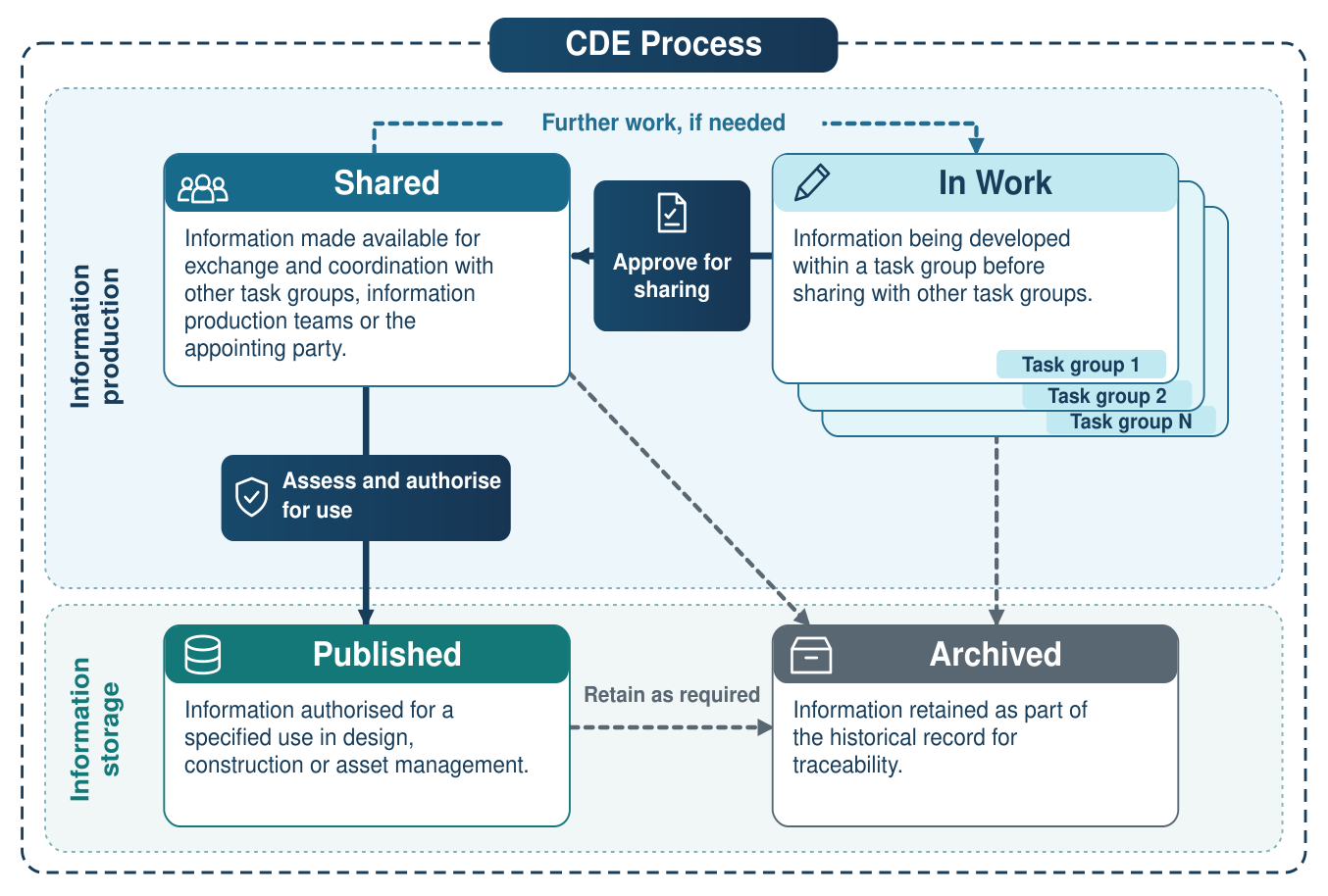
Figure 6.5 presents the conceptual four-state framework, adapted by the authors from ISO 19650-1. It illustrates information production, controlled sharing, authorised use and historical retention, together with representative checking, reviewing and authorisation activities.
Consider again the drawing prepared for the reconstruction of the industrial facility. While the Task Group is developing it, the drawing remains In Work. Successive working versions may be produced, internal checks performed and errors corrected under the applicable production arrangements.
After the necessary internal checking, the drawing may become Shared for coordination. Structural engineers, building-services specialists and equipment suppliers can examine it for defined purposes, identify conflicts and request changes. However, availability for coordination does not establish authorisation for construction.
Once the applicable assessments and authorisations have been completed, the relevant information may become Published for a specified purpose. Its permitted use depends on the governing requirements, Decisions and conditions of use, rather than merely on its visibility in an Information System.
Earlier information instances may need to be retained as Archived. These records preserve traceability and support later comparison, investigation and understanding of the information’s history. Archiving should not be confused with deleting information or removing its governance context.
The four-state framework provides a common conceptual structure, not an obligatory linear progression that every Information Container follows without exception. Information may require further production, repeated coordination or additional assessment before it is suitable for its intended use.
Figure 6.5 also distinguishes information production from information storage. This is a functional distinction, not a requirement for separate technical repositories. An Information Container retains its unique identity as applicable Revisions and governance conditions change. Progression between CDE States does not create a second Information Container with the same identity.
Where information must move between technical systems or storage locations, that movement must preserve the Container’s identity and the continuity of its management context. The movement itself must not be treated as the creation of another independently governed Container.
The conditions governing particular CDE States and their transitions are established through the applicable CDE Procedures and wider management arrangements.
Controlled Progression and Management Decisions#
The controlled progression of information through the CDE Process involves more than completing technical operations. Making information available does not, by itself, establish permission for its intended use. Its progression depends on the applicable governance conditions, required assessments and Decisions made by authorised participants.
Consider an engineering drawing that has been Shared for coordination. Another Task Group identifies interference between the proposed equipment-support structure and an existing service route. The drawing must be reconsidered, modified where necessary and checked again before the information can proceed towards its intended use. Its technical availability has not changed the need for further work or the conditions governing that progression.
To manage such situations, several related concepts must remain distinct. A CDE State describes an applicable governance condition of a particular information instance. A Status Code expresses its intended or permitted use according to established conventions. An Assessment establishes findings against applicable criteria, while a Decision records an authorised determination. A State Transition changes the applicable CDE State in accordance with the governing rules.
These concepts are related, but they perform different functions. In particular, a management Decision is not itself a State Transition. A Decision may provide the authority or justification for progression, while the transition is a separate governed event. Likewise, an Assessment establishes findings but does not automatically confer authorisation for the information’s intended use.
The distinction between technical permissions and management Authority is equally important. A participant who can access or modify an Information Container does not necessarily have the Authority to approve it for another Party’s intended use. Nor can changing a metadata value within a technical system substitute for the required assessment or authorisation. Technical capability does not establish management Authority.

Information-security requirements may impose additional restrictions on access, sharing and use. Their wider implications are considered in the discussion of Security-Minded Information Management in Part II.
The detailed relationships between Information Container Revisions, CDE States, Assessments, Decisions and State Transitions are examined in the discussion of the CDE Process in Part II. At this stage, the essential distinction is that the CDE Process coordinates these elements without treating them as interchangeable.
Documenting CDE Procedures and Configuring the Process#
The four-state framework in Figure 6.5 explains the general organisation of the CDE Process, but it does not specify how particular activities must be performed within an organisation or Information Management Cycle. It cannot determine, for example, who may authorise the sharing of an Information Container, which checking criteria apply, when an assessment must be repeated or what evidence must be retained. These conditions must be established through documented CDE Procedures.
As explained in § 6.3, a Procedure defines a governed way of performing an activity. CDE Procedures apply this principle to activities involving Information Containers. They provide the documented arrangements through which the CDE Process can be organised in accordance with the participating Parties, applicable Information Requirements and conditions of the work.
For a CDE Procedure to support consistent execution and, where appropriate, automation, its description should establish:
Activity and purpose — what is to be performed and which result is expected.
Conditions of execution — when the activity may begin and which requirements or preconditions must be satisfied.
Responsibilities and Authority — who performs the activity and who may make any associated management Decisions.
Required actions and assessments — what must be done, checked or reviewed during execution.
Expected outcomes and evidence — which results, records and subsequent actions are required.
The necessary detail depends on the complexity and consequences of the activity. A straightforward Procedure may require only a concise description of actions, responsibilities and conditions. More complex arrangements involving several Parties, alternative outcomes or authorised Decisions may require conditional rules, process diagrams, responsibility matrices and supporting documentation.
Documented CDE Procedures can then be coordinated into a CDE Process suited to the Information Management Cycle. Procedures for registering Containers, performing internal checks, sharing information, conducting reviews and implementing authorised progression may all contribute to this arrangement. Their coordination does not imply a fixed sequence of activities: Procedures may be repeated, applied under different conditions or connected with activities outside the immediate CDE environment.
Documented CDE Procedures → Coordinated CDE Process → Governed Execution.
The CDE Process is built upon documented and coordinated CDE Procedures. Their formalisation provides the basis for consistent execution and enables appropriate automation.
Graphical diagrams are useful for explaining the overall organisation of a Process. However, they may not provide sufficient detail about individual activities, their governing conditions or the information involved. A complementary approach is to describe CDE activities and transactions through structured tables, using consistent attributes for applicable conditions, responsibilities and expected outcomes.
Defined activity | Applicable conditions | Responsible participant | Expected result |
|---|---|---|---|
Create and register an Information Container | Applicable identification and metadata rules are established | Producing Task Group | Container registered in accordance with the applicable rules, in the In Work State |
Complete internal checking | Information is available and relevant checking criteria are defined | Authorised checking participant | Checking outcome and supporting evidence established |
Make information available for coordination | Required checking and sharing conditions are satisfied | Authorised participant | Defined Container Revision becomes available in the Shared State |
Review information for intended use | Relevant information and assessment criteria are available | Responsible reviewing participant | Assessment findings and any required Decision recorded |
Implement authorised progression | Applicable authorization and transition conditions are satisfied | Authorised participant or automated technical function operating under established permissions | Permitted State Transition executed and recorded |
Table 6.5 illustrates how selected CDE activities can be described in this form. It is an example of process specification, not a prescribed workflow. More detailed descriptions may include Information Container identifiers, Revision references, Status Codes, specific Authorities, Decision references and evidence requirements.
Each row defines an activity or intended transaction, not an event that has already occurred. Depending on the activity, the specification may also identify the precise information attributes involved, permissible outcomes and conditions under which relevant data may change.
Structured descriptions thus complement process diagrams by providing the detail needed for consistent interpretation and potential technical implementation. They help Information Managers and technical specialists translate agreed Procedures into functional requirements, configurable rules and executable operations.
Formalisation also creates opportunities for automation. Where activities, governing conditions and permissible outcomes are sufficiently defined, technical systems may support or automate appropriate operations, including checks, notifications, controlled transactions and the recording of relevant events. Such capabilities can reduce repetitive work and improve consistency.
Automation does not remove the need for professional judgement or authorised management Decisions. Some assessments require competent specialists, while particular Decisions must remain with participants holding the relevant Authority. Technical execution must reflect these responsibilities rather than replace them.
A further distinction concerns process definition and actual process execution. Documented Procedures establish how activities are intended to be performed. During execution, actions involving Information Containers, relevant Decisions and other significant events are recorded through the CDE Journal, providing evidence of what occurred and supporting the examination of whether the agreed arrangements were followed.
Process definition establishes what should happen; execution history records what did happen. The relationship may be expressed as:
Process Definition → Process Execution → CDE Journal → Traceability and Process Improvement.
These elements serve complementary purposes. Documented Procedures support consistent execution and appropriate automation, while the CDE Journal preserves evidence of significant activities and events, enabling accountability, traceability and subsequent improvement.
The detailed organisation of the Journal, Transaction History and their relationship to Information Model Snapshots is examined in the discussion of transaction history and snapshots in Part II.
One CDE Process Across Multiple Parties and Systems#
Collaborative information production commonly crosses organisational and technical boundaries. Task Groups may use specialised authoring applications, Lead Appointed Parties may operate their own information-management systems, and Appointing Parties may maintain separate environments for assessing and using information.
One CDE Process does not necessarily mean one CDE system. A common management process can operate across multiple organisations and technical environments, provided the arrangements governing information remain coherent and continuous. The essential requirement is not technological uniformity, but continuity of information governance across participating Parties and systems.
Consider the reconstruction of the industrial facility. A structural engineering team develops an Information Container in its own authoring environment. The information is subsequently made available for coordination through arrangements operated by the Lead Appointed Party and may later be submitted to the Appointing Party for assessment and an applicable Decision. Different technical systems can support these activities, but the participating Parties must still be able to determine which information was involved, what actions were performed, what outcomes were established and under whose Authority.
A distributed CDE arrangement must therefore preserve five essential conditions:
Information identity — the relevant Information Container and its exact Revision remain identifiable across participating systems, without creating duplicate independently governed Containers with the same identity.
Governance applicability — the applicable rules, Procedures and conditions governing information use remain identifiable and understandable.
Responsibilities and Authority — the Parties and participants responsible for particular activities and authorised management Decisions remain clear.
Process continuity — relationships between activities, assessments, Decisions and their outcomes are preserved across organisational and technical boundaries.
Execution evidence — significant actions, events and their results remain traceable across participating environments.
These conditions do not require all Information Containers to be stored in a central repository. They require a coherent CDE Process that preserves information identity, governance context and the relationships necessary for controlled collaboration, even when information and technical capabilities remain distributed.
This becomes particularly important when information passes between Parties. Each organisation may retain control over its internal systems and production arrangements, while the common CDE Process governs the interactions necessary for coordinated information production, assessment and authorised use. Organisational and technical independence must not result in fragmented information governance.
The CDE Process should therefore be defined according to the required management arrangements before decisions are made about its technical implementation. Management requirements must determine the capabilities expected from supporting Information Systems, rather than allowing the features or limitations of a particular application to define the management process.
This principle also establishes the relationship between information management and technology: the process defines what must be governed, while technical solutions are selected and configured to support its execution.
6.6. From the CDE Process to Technical Enablement#
Common information rules, suitable production Methods, documented Procedures and supporting resources establish the conditions for collaborative information production. The CDE Process brings the relevant activities together within a governed arrangement for the controlled progression and use of Information Containers. Yet defining how information must be governed is not the same as providing the technical means to carry out that governance.
Participants need applications, Information Systems and other technical capabilities that support the agreed Procedures, responsibilities and management Decisions. The challenge is to translate these management arrangements into functional requirements that can be satisfied through suitable technical solutions.
The starting point is the CDE Process, not the selection of software. Technical capabilities should be determined by what the agreed management arrangements require, rather than allowing the features of an available system to define how information is governed.
From Management Requirements to Functional Capabilities#
The development or selection of a CDE technical solution begins with understanding what participants must accomplish under the agreed CDE Process. Documented CDE Procedures establish the relevant activities, responsibilities, conditions of execution and expected outcomes. These arrangements provide the basis for specifying the functional capabilities that technical systems must support.
Consider an engineering drawing prepared during the reconstruction of an industrial facility. The applicable management arrangements require the drawing to undergo internal checking before it can be made available to other Task Groups for coordination.
This requirement must be translated into several related specifications. At the management level, checking before sharing is an obligatory condition. The documented CDE Procedure establishes how that condition is fulfilled: who performs the checking, which criteria apply, what outcomes must be recorded and under which circumstances the information may proceed.
The corresponding functional requirements specify what the technical environment must be capable of doing. It must identify the relevant Information Container Revision, support the recording of checking outcomes, apply the appropriate permissions and prevent progression when the required conditions have not been satisfied.
These capabilities may then be implemented through suitable technical arrangements, including metadata rules, access controls, checking and review functions, controlled State Transitions and event recording.
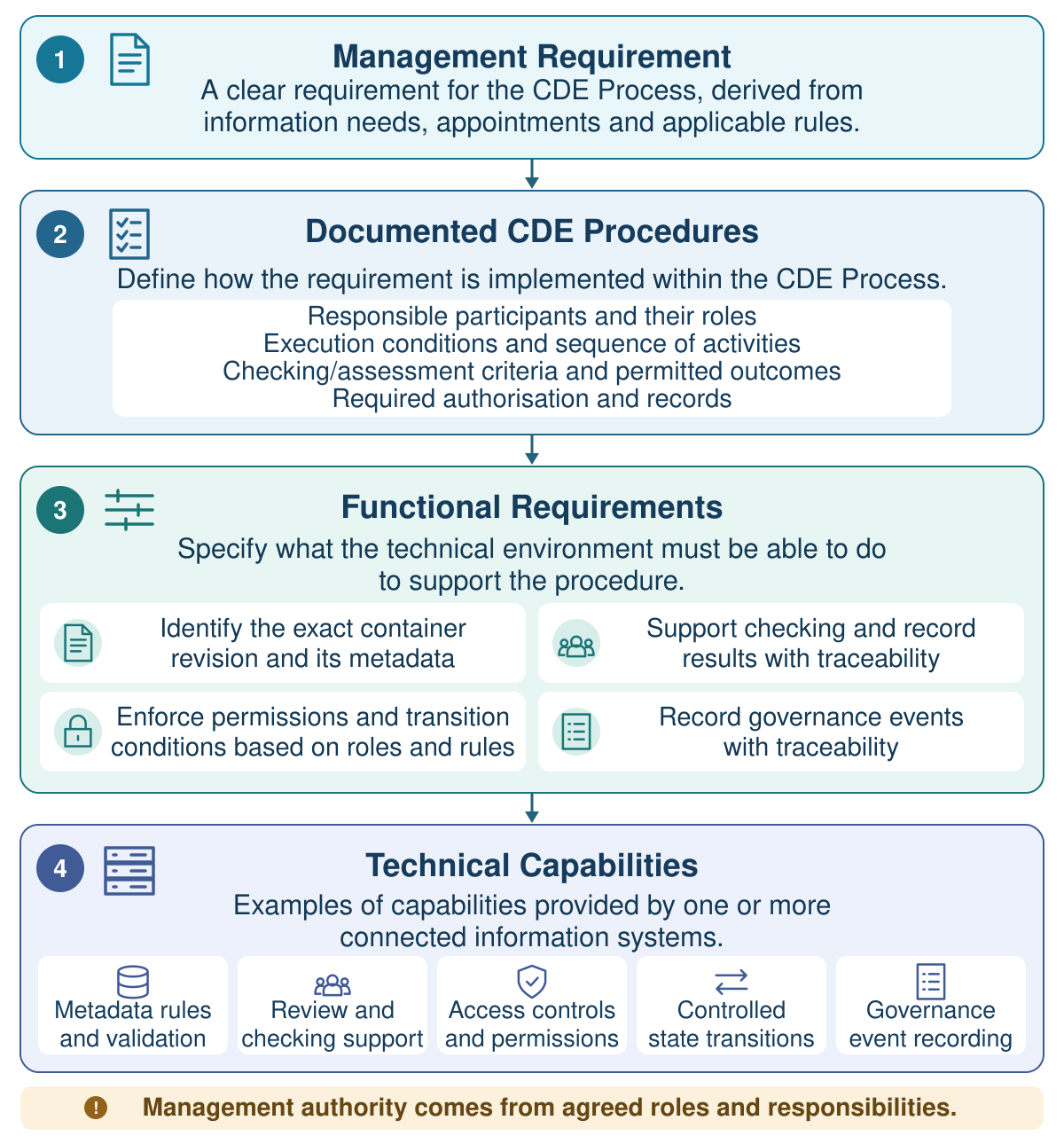
Figure 6.6 shows how a management requirement for the CDE Process is translated into functional requirements for the supporting technical environment. A documented CDE Procedure specifies who performs the relevant activities, under what conditions, and what outcomes and evidence must be recorded. These arrangements determine what the technical environment must support, such as identifying the relevant Information Container Revision, recording checking outcomes, applying permissions and controlling State Transitions. The required capabilities may be provided by one system or by several connected Information Systems.
The distinction between functional requirements and technical implementation is fundamental. A functional requirement establishes what the technical environment must be capable of doing; the technical solution determines how that capability is provided. For example, restricting sharing until checking has been completed does not necessarily require a particular workflow application. Different systems or combinations of capabilities may fulfil the same requirement, provided they support the applicable governance conditions.
This approach allows organisations to evaluate existing Information Systems, identify missing capabilities and select appropriate technical arrangements without surrendering the design of the CDE Process to the limitations of particular software products.
Technical capabilities must be derived from the requirements of the CDE Process, rather than allowing a particular software solution to determine how information is governed.
Not every activity can or should be automated. Professional assessments and authorised management Decisions may require the judgement of competent participants. Technical enablement must support these responsibilities while allowing suitable operations to be automated where their conditions and permissible outcomes are sufficiently well defined.
Core Capabilities of a CDE Technical Solution#
A technical solution supporting the CDE Process requires more than file storage and exchange functionality. It must enable participating Parties to identify, govern and use Information Containers in accordance with established rules, Procedures, responsibilities and management Decisions.
The specific capabilities depend on the scale and complexity of the Information Management Cycle. Nevertheless, several functional areas are common to most arrangements. Table 6.6 relates these capabilities to the management needs they are intended to support.
Management need | Required technical capability |
|---|---|
Govern Information Container identity | Enforce unique identification, preserve Revision references and prevent duplicate governed Container identities |
Apply the Information Production Standard | Assign, validate and update required Container metadata, including identifiers, classification, Revision references and Status Codes, in accordance with applicable rules, documented Procedures and authorised permissions |
Support CDE Procedures | Check execution conditions, support permitted actions and enforce applicable procedural restrictions |
Support Assessments and Decisions | Record assessment findings, identify authorised decision-makers and associate Decisions with the relevant information |
Control access and operations | Apply permissions according to participants, Parties, responsibilities and governance conditions |
Preserve execution history | Record significant events and maintain traceable references to affected Containers, Revisions and management actions |
Support distributed execution | Support controlled information exchange and access across participating systems while preserving Information Container identity, applicable metadata and management context |
These capabilities are interdependent. A technical solution may provide individual functions without preserving the relationships that give them their management meaning. Supporting a management operation is not the same as ensuring that it is performed under the applicable governance conditions.
Consider metadata management. A technical system must do more than recognise predefined fields or validate values against a list of conventions. It must support the assignment of required metadata, controlled modification of permitted attributes and verification against the applicable Information Production Standard.
Different metadata attributes are subject to different rules. An Information Container’s unique identity must remain stable, while changes to other attributes may be permitted under specified conditions. Revision references, Status Codes and other governed metadata must be managed according to the applicable rules, documented Procedures and authorised permissions. Significant changes must remain traceable without compromising the continuity of the Container’s identity and management history.
Similarly, supporting CDE States requires more than allowing a participant to change a metadata value. The technical environment must recognise the applicable conditions for progression, support the required Procedures and preserve the relationships between Assessments, management Decisions and resulting State Transitions. A technically permitted change is not necessarily an authorised management action.
Access controls must also reflect the distinction between technical permissions and management Authority. A participant may be authorised to view or modify information without holding the Authority to approve it for a particular purpose. Configured permissions should implement the agreed allocation of responsibilities and Decision rights, not substitute for it.
The same principle extends to execution history. Relevant actions and events must be recorded with sufficient context to identify the affected Information Containers and Revisions, the activities performed and the associated Decisions. This allows participants to establish what actually occurred and assess whether execution followed the governing Procedures. The detailed organisation of the CDE Journal and Transaction History is discussed in the discussion of the CDE Process in Part II.
A CDE technical solution must therefore support not only individual operations, but also the governed relationships between information, activities, responsibilities, Decisions and their results. These capabilities distinguish technical enablement of the CDE Process from ordinary information storage and exchange.
Enabling a Distributed CDE Environment#
Collaborative information production involves organisations with different technical infrastructures, operating arrangements and commercial interests. It may be neither practical nor desirable for every participating Party to work directly within an Information System controlled by the Appointing Party.
A specialist engineering organisation may need to retain control over its production environment, while a contractor may already operate a CDE system supporting several projects. Information-security requirements, contractual conditions and the protection of intellectual property may also restrict the use of another organisation’s technical infrastructure. A common CDE Process must therefore be capable of operating across distributed technical environments.
Two configurations are particularly relevant.
In the first, a Task Group uses a Local Data Environment to develop and check Information Containers with its own technical resources. The relevant information is subsequently made available through the wider CDE arrangements under agreed Procedures. Where further production is required, the applicable arrangements may provide for controlled continuation of work within the responsible team’s environment.
In the second, several organisations operate interconnected CDE systems. A Lead Appointed Party, specialist Providers and the Appointing Party may maintain separate technical environments while participating in the same governed CDE Process.
These configurations are not mutually exclusive. Individual Task Groups may use local production environments while their organisations participate through interconnected CDE systems. What matters is not the number of applications or repositories involved, but the ability to preserve one coherent CDE Process across independently operated technical environments.
Preserving Information Identity and Management Context#
Technical integration cannot be reduced to transferring files or establishing connectivity between applications. When information passes between systems, its content must remain associated with the attributes and management context necessary for its governed use: the Information Container’s unique identity, applicable Revision, relevant metadata, Status Code and other governing conditions.
The receiving environment must be able to interpret this information according to the applicable Information Production Standard. Otherwise, a transfer may succeed technically while leaving the receiving Party unable to determine which information has been received, what conditions apply to it or how it may be used.
The history of relevant activities must also remain traceable. Checking outcomes, Assessments, Decisions and other significant events may determine which subsequent activities are permitted. If these relationships are lost when information crosses an organisational or technical boundary, the continuity of the CDE Process is compromised even though the information itself remains accessible.
A particularly important requirement concerns Information Container identity. Within a single CDE Process, transferring information between technical locations must not create a second, independently governed Information Container with the same unique identity. Different systems may hold or provide access to the relevant information, but they must preserve the ability to recognise the same Container and identify its applicable Revisions.
This requires arrangements that maintain both identity and governance context across participating systems. The technical means may differ, but the management process must preserve the relationships between the information, its governing conditions and the activities performed on it.
The essential challenge of a distributed CDE environment is therefore not simply to exchange information, but to preserve its governed meaning across technical and organisational boundaries.
Intellectual Property and Contractual Conditions#
Technical interoperability is only one part of the challenge of distributed information management. Participating organisations may hold intellectual property rights in the information they produce, while other Parties need to access, assess, modify, distribute or reuse that information for agreed purposes. The technical ability to obtain information does not automatically establish the right to use it.
Consider a specialist engineering Provider developing a detailed equipment model. The Appointing Party may require this information for construction and subsequent asset operation, while other Providers may need to incorporate elements of the model into their own work. Making the model accessible through an interconnected CDE environment does not, however, establish unrestricted rights to modify, distribute or reuse it.
Three conditions must therefore remain distinct: technical access, management Authority and rights to information. Technical access determines whether a participant can obtain or operate on information through the available systems. Management Authority determines whether the participant is empowered to perform particular governed actions or make relevant Decisions. Intellectual property rights and contractual permissions establish the legally permitted uses of the information.
An action may be technically possible without being authorised under the management arrangements or permitted under the applicable contractual conditions. None of these conditions can substitute for the others.
Where an Appointment involves a contract between separate organisations, the necessary information-management rights and obligations must be addressed through appropriate contractual arrangements. An Information Protocol, incorporated into that contract, establishes the applicable conditions governing information production, exchange and use, including intellectual property and licensing provisions. Internal Appointments are instead governed by the organisation’s applicable internal regulations, procedures and other management documents. The purpose and contractual application of the Information Protocol are examined in Part II.
A distributed CDE environment must consequently support both the technical continuity of information management and the contractual conditions under which participating Parties collaborate. Software interoperability cannot compensate for unresolved rights to information or the absence of management Authority.
A technically distributed CDE environment must preserve the identity, governance context and controlled progression of information across participating systems.
Assessing the Suitability of Technical Solutions#
Once the necessary functional capabilities have been defined, the next question is whether available technical solutions can provide them. Technical suitability must be assessed against the requirements of the agreed CDE Process and its supporting Procedures, rather than the advertised features of particular software products.
A system may offer extensive document-management, collaboration and workflow functionality while remaining unable to support essential governance conditions. For example, it may allow users to define CDE States without enforcing the conditions governing transitions between them. Another system may provide configurable metadata fields but insufficient control over their assignment, modification or historical traceability.
Similar limitations may arise in distributed environments. Two systems may exchange Information Containers successfully while interpreting essential metadata differently or failing to preserve the context of earlier Assessments and Decisions. Successful technical exchange does not necessarily establish continuity of information governance.
These limitations do not automatically make a system unsuitable. Their significance depends on the role the system is expected to perform within the CDE Process and on whether the required capabilities can be provided through the wider technical arrangement. Suitability is contextual: a capability that is essential in one arrangement may be provided elsewhere, or may not be required, in another.
The assessment must therefore consider not only individual functions but also how they operate together under the applicable governance conditions. Particular attention is needed where activities cross organisational or technical boundaries, requiring continuity of Information Container identity, relevant metadata, authorised operations and execution history.
A suitable technical solution may consist of one application, several integrated applications or a wider ecosystem of independently operated Information Systems. The appropriate configuration depends on the required capabilities, the responsibilities of participating Parties and the circumstances of the Information Management Cycle.
The decisive criterion is the ability to support the intended management arrangements, not the number or sophistication of available software features.
Selecting a suitable solution is not the same as establishing an operational environment. Technical capabilities must subsequently be configured, integrated and supported, while participating organisations and individuals must be prepared to use them under the agreed Procedures. These implementation activities are considered in the discussion of organisational implementation in Part II.
———————
Common information rules, production Methods and Procedures, suitable Reference Information and Shared Resources, and a governed CDE Process establish the conditions for collaborative information production. Technical capabilities enable participating Parties to carry out the agreed activities across different organisations and Information Systems. The essential outcome is not a particular technical environment, but a coherent management foundation through which information can be produced, governed and used according to its intended purpose, applicable Information Requirements and established responsibilities.
These common conditions must be applied within a particular Information Management Cycle. The cycle connects the management needs that give rise to Information Requirements with the planning, production, delivery, assessment, acceptance and incorporation of information into a continuing Information Model, making it available for subsequent use. What has been established as a common management arrangement must become a coordinated sequence of activities and Decisions, adapted to the circumstances of the undertaking and the responsibilities of its participants.