Planning the Information Management Cycle
In this chapter 7.1–7.7
7.1. The Information Management Cycle#
Common information rules, production procedures and supporting technologies establish the conditions for collaborative information production. Yet these conditions alone do not explain how an organisation coordinates the work of different Parties and successive Appointments, or how their information contributions become part of a continuing Information Model.
An organisation may commission engineering studies, undertake construction projects, operate existing facilities and maintain technical records through different departments and external Providers. Each activity may involve its own responsibilities, production arrangements and information deliveries. The challenge is to connect these activities so that their results remain governed, coherent and usable rather than becoming disconnected collections of information.

This is the purpose of the Information Management Cycle (IMC Cycle). It provides a coordinated management structure through which common conditions are applied, Information Appointments are organised, information is produced and delivered, and accepted results contribute to the continuing federated Information Model.
An IMC Cycle may involve several Information Production Teams operating concurrently or successively under different Appointments. Their contributions are connected through common Information Management arrangements and the continuing Information Model, even when the teams use different production schedules or information systems.
The cyclical character of Information Management does not imply a fixed sequence repeated from beginning to end. Information Requirements may change, production arrangements may need adjustment, and submitted information may be returned for correction. New Information Needs may also lead to further Appointments and production activities. The IMC Cycle accommodates these developments through the controlled repetition and adjustment of relevant processes while maintaining continuity of the Information Model.
Establishing the IMC Cycle#
The IMC Cycle begins with an organisational decision to establish coordinated Information Management for a defined management context. This decision determines the scope of the cycle, the purposes that its Information Model is expected to support and the common conditions under which participating Parties will produce and manage information.
Establishing an IMC Cycle is not the same as identifying an individual Information Need. Information Needs arise from particular Management Activities and provide the basis for Information Requirements, as explained in Chapters 3 and 4. Preparing the cycle is a broader undertaking: it connects those requirements with the responsibilities, production arrangements and technical capabilities needed to fulfil them across multiple Appointments.
Consider an industrial enterprise establishing an Asset Information Model (AIM) for several production facilities. Maintenance departments require equipment records, engineering specialists need information for technical assessments, and investment managers rely on information when planning modernisation projects. Although these activities serve different purposes, their information requirements and resulting contributions must be coordinated within a continuing governed Information Model.
To establish the IMC Cycle, the enterprise must address three interconnected areas:
Information demand and delivery needs — establishing or confirming the applicable Organisational Information Requirements (OIR), Asset Information Requirements (AIR) and, where relevant, Project Information Requirements (PIR), together with Information Delivery Milestones and Trigger Events.
Management and production arrangements — ensuring that the Information Production Standard, Information Production Methods and Procedures, Reference Information, Shared Resources and Information Protocol Template are available and suitable for the intended cycle.
Technical and security arrangements — establishing the applicable CDE Process, identifying the supporting Information Systems and technical capabilities, and implementing proportionate Information Security measures.
These arrangements need not be created anew. Existing organisational standards, procedures, information resources and technical capabilities may be reviewed, adapted and coordinated for the intended cycle. What matters is that they form a consistent basis for information production across participating Parties.
This distinction becomes important when the enterprise commissions a structural assessment, an equipment inspection or a modernisation project. Each Appointment has its own scope, requirements and responsibilities, but it can operate under common Information Management conditions established for the cycle. Those conditions remain reusable and may be revised under appropriate management control as circumstances change.
The IMC Cycle establishes common conditions for information production across multiple Appointments. These Appointments contribute to the development of one continuing governed federated Information Model.
Processes and Party Functions#
The IMC Cycle comprises eight interconnected processes through which common Information Management conditions are established, individual Appointments are organised, information is produced and delivered, and accepted results are incorporated into a continuing Information Model. Each process has a distinct purpose, but their combined effect is to coordinate the contributions of participating Parties and Information Production Teams.
The principal processes and their purposes are summarised in Table 7.1.
Process | Principal purpose |
|---|---|
1. Preparing the IMC Cycle | Establish the relevant Information Requirements, assign Information Management functions and prepare the common management, production and technical arrangements required for the IMC Cycle. |
2. Preparing an Information Appointment | Define the scope, applicable Information Requirements and production and delivery conditions for a particular information supply relationship. |
3. Information Provider’s Proposal | Develop a proposed production approach and demonstrate the competence, capability and resources required to fulfil the anticipated Appointment. |
4. Appointment and Information Production Planning | Establish Appointments, allocate responsibilities, coordinate information-production planning and formalise the agreed arrangements through contracts or internal appointment agreements, as applicable. |
5. Mobilisation | Prepare and test the personnel, resources, technologies, Methods and Procedures required for information production. |
6. Collaborative Information Production | Create, verify, share, coordinate and review information according to applicable Requirements and Procedures. |
7. Information Delivery and Acceptance | Present information to the Receiver, undertake the required assessments and make the relevant Acceptance or Rejection Decision. |
8. Information Model Incorporation and Continuity | Incorporate accepted information results into the governed Information Model and establish arrangements for maintaining its continuity, including controlled updates and the preservation of relevant historical information. |
The eight processes form a coherent management structure, not a rigid sequence of isolated operations. Depending on the circumstances, processes may overlap, recur or require earlier activities to be revisited. Information Production Planning, for example, may begin before an Appointment is finalised and develop further as responsibilities and production dependencies become clearer. Several Information Production Teams may also work concurrently, with information produced under one Appointment becoming Reference Information for another.
The Party Functions introduced in Chapter 5 provide the organisational basis for coordinating these activities. Within the IMC Cycle, they operate through distinct but connected responsibilities:
The Appointing Party establishes the common Information Management conditions, organises the required Appointments and ensures that delivered information is subject to the appropriate assessments and authorised decisions.
The Lead Appointed Party plans and coordinates information production within its appointed scope, assigns the necessary Information Management functions and manages dependencies between participating Task Groups.
The Appointed Parties perform their assigned Information Tasks, coordinate their contributions with other participants and prepare information results for the required exchanges and deliveries.
These functions describe responsibilities within particular Appointment relationships rather than permanent organisational categories. A Party may undertake different functions in different relationships, while the same IMC Cycle may involve several Lead Appointed Parties and Information Production Teams.
Consider the expansion of a manufacturing facility. The enterprise acting as Appointing Party commissions an engineering consultancy to coordinate design information production and a construction contractor to organise information relating to construction execution. Their Appointments may overlap, although their responsibilities and production arrangements differ.
Within the engineering Information Production Team, process engineers, structural engineers and building-services specialists produce interdependent information. Equipment arrangements influence structural loads and spatial requirements; structural solutions affect equipment supports and installation; and building-services systems must be coordinated with both. Collaborative production therefore depends on governed exchanges between Task Groups, not simply on collecting their separate results at the end of an Appointment.
The Lead Appointed Party coordinates these dependencies and prepares the combined information for the required assessments and delivery. The Appointing Party arranges the receiving-side assessment and authorised decisions. Meanwhile, the construction Information Production Team may use selected design information as Reference Information and contribute installation records, inspection results, test records and commissioning information to the continuing Information Model.
The important connection is continuity across Appointments. Different teams may contribute at different times and under different responsibilities, but their information results remain connected through common management conditions and the governed Information Model.
Figure 7.1 illustrates this relationship between the processes of the IMC Cycle, the functions of participating Parties and the continuing Information Model.
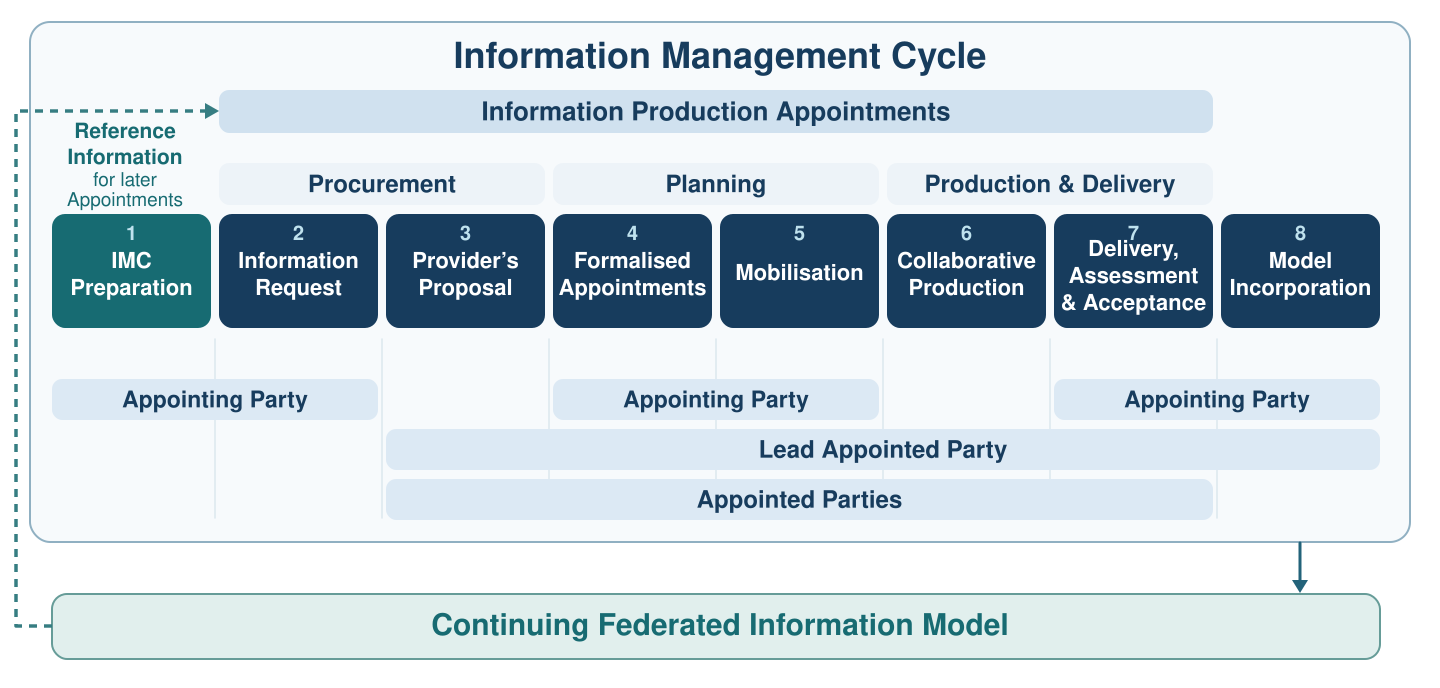
The figure distinguishes the preparation of common Information Management conditions from activities organised through individual Appointments. It also shows that the IMC Cycle is not a single production chain: several Information Production Teams may operate concurrently, successive deliveries may depend on earlier results, and particular processes may be revisited as the Information Model develops.
The Cyclical Nature of Information Management#
The cyclical character of Information Management becomes especially apparent when several Appointments contribute to the same Information Model over time. During a construction project, successive Information Delivery Milestones may require information for design, procurement, construction, installation and commissioning. Some Information Production Teams work concurrently, while others begin their activities after earlier results become available. The recurring progression from planned delivery → information production → incorporation into the Information Model allows the model to develop without requiring the entire IMC Cycle to be prepared anew for every delivery.
A similar pattern occurs during asset operation. An industrial enterprise may engage inspection, maintenance and specialist engineering Providers to maintain and update its Asset Information Model (AIM). Scheduled inspections generate recurring information deliveries, while unexpected equipment failures or changes in operating conditions may require additional assessments and updated information. The same governed Information Model supports both planned production and responses to changing circumstances.
Three recurring situations are particularly important:
Planned information deliveries — established Information Delivery Milestones or recurring obligations require further information production and delivery.
Trigger Events — changes in asset condition, operation or management context prompt a review of existing information and may require additional production.
Corrections and adjustments — assessment findings, changing Requirements or newly identified dependencies require information results or production arrangements to be reconsidered.
These situations do not necessarily require a new IMC Cycle or the repetition of all its processes. Existing Requirements, common production arrangements, Reference Information, Shared Resources and technical capabilities can be reused where they remain applicable. Changes are introduced under appropriate management control, while participating Parties undertake the processes relevant to the new circumstances.
The recurring activities of the IMC Cycle must, however, be distinguished from an IMC Use. An IMC Use concerns the application of information to support a particular Management Activity, decision or organisational purpose. It may rely entirely on information already available in the governed Information Model, without initiating additional information production.
For example, existing equipment information may support maintenance planning, cost forecasting and replacement decisions. If it remains suitable for these purposes, the organisation can reuse it without commissioning new information. If a particular decision requires additional evidence, Actual Use may initiate the sequence new Information Need → new or revised Information Requirements → further information production. This feedback connects information use with subsequent Information Management activities without making Actual Use part of the IMC Cycle itself.
The IMC Cycle governs the production, delivery and incorporation of information into a continuing Information Model. An IMC Use concerns the application of governed information to Management Activities. Actual Use may reveal new Information Needs, but it does not itself constitute another process of the IMC Cycle.
This distinction connects the eight processes with the broader management purposes they serve. The IMC Cycle maintains the governed availability and continuity of information across successive Appointments, while its practical value is realised through use. Part II examines that use, including the reuse of existing information and the circumstances in which new information production becomes necessary.
The following sections examine how the eight processes are organised and performed, beginning with the preparation of the common conditions for collaborative information production.
7.2. Preparing the IMC Cycle#
The first process of the Information Management Cycle establishes the organisational and management basis for collaborative information production. Before individual Information Appointments can be prepared, the Appointing Party must ensure that the relevant Information Requirements have been identified, Information Management functions assigned, and common production conditions and supporting capabilities established.
This preparation forms part of the organisation’s wider management system, rather than a separate BIM or technology initiative. It must therefore be aligned with the Management Activities, responsibilities and existing arrangements through which the organisation pursues its objectives. The organisational implementation of Information Management is examined further in Part II; here, the emphasis is on preparing a particular IMC Cycle.
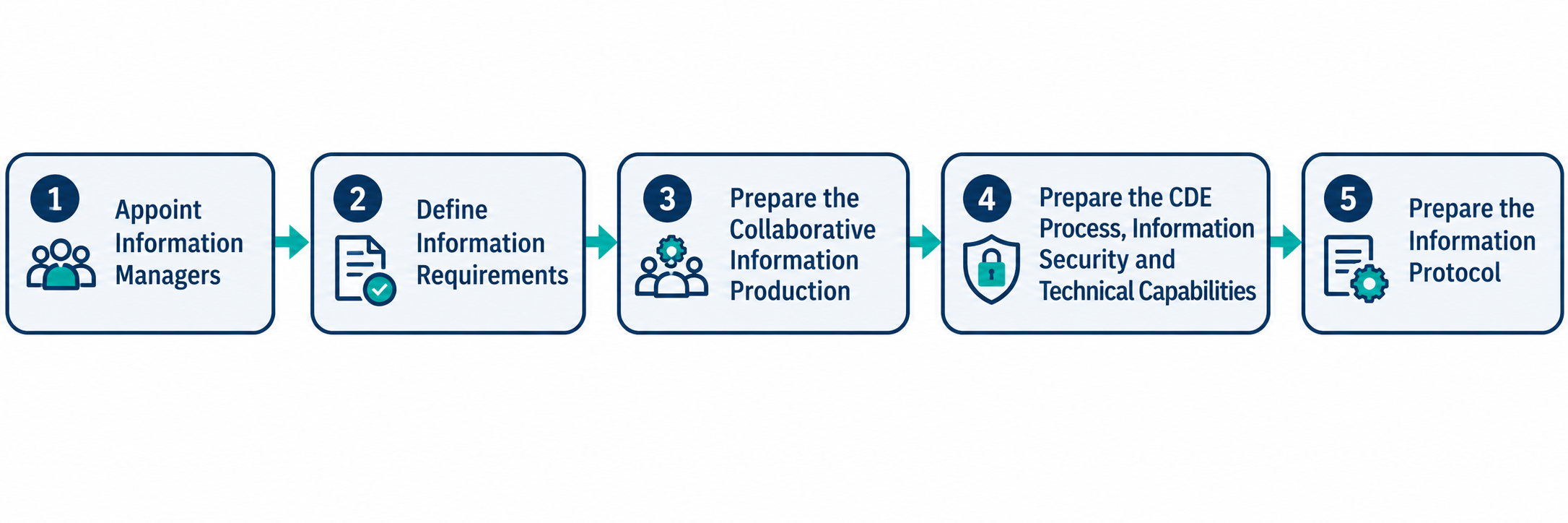
Process 1 brings together three interconnected areas of work:
organising Information Management functions → establishing information demand → preparing common production conditions.
Their coordination provides the basis for the Appointments and information-production activities that follow.
Preparing the Organisation and Identifying Information Needs#
The Appointing Party begins by assigning the necessary Information Management functions to competent Information Managers. These functions connect the organisation’s information demand with the arrangements through which participating Parties will produce, exchange and maintain the required information.
The principal functions include:
Assessing Information Needs arising from Management Activities and identifying the purposes for which information is required.
Developing Information Requirements with the relevant organisational functions, translating identified Needs into structured and assessable specifications.
Coordinating Information Management activities across participating Parties and Information Production Teams.
Facilitating collaboration between organisational functions, technical disciplines and information-production participants.
Coordinating common management arrangements and supporting their consistent application throughout the IMC Cycle.
These functions may be assigned to personnel in existing organisational roles or supported by external specialists. The Appointing Party must ensure that those performing them possess the necessary competence, Authority and resources. Assigning Information Management functions does not transfer the Appointing Party’s overall responsibility for the IMC Cycle, as established in Chapter 5.
Information Managers work with the managers and specialists responsible for the Management Activities that generate information demand. Together, they identify the information needed, clarify its intended purposes and coordinate the development of applicable Information Requirements. These requirements may be organised within OIR, AIR and PIR, as explained in Chapters 3 and 4, while retaining their relationship to the originating Information Needs.
An essential part of this work is determining when information must be available. Some requirements relate to planned Information Delivery Milestones; others arise from Trigger Events affecting a project, an asset or its management context. Information Managers coordinate these delivery needs with the relevant organisational functions so that the timing of information production reflects the activities and decisions it is intended to support.
Existing information must also be considered before additional production is commissioned. Where governed information already satisfies the applicable Requirements, it may be reused. Where it is incomplete, unreliable or unsuitable for the intended purpose, further information production or updating may be necessary.
The result of this preparation is a coordinated understanding of information demand across the IMC Cycle. It establishes what information the organisation requires and when, without yet determining the detailed production approach of an individual Provider. That approach is developed through subsequent appointment-specific processes.
Figure 7.2 provides an overview of the activities and outputs involved in preparing the IMC Cycle, bringing together the organisation of Information Management functions, the identification of information demand and the establishment of common production conditions.
Establishing Common Conditions for Information Production#
Information Requirements alone are insufficient for collaborative production. Different Information Production Teams must work under compatible management conditions so that their contributions can be coordinated, assessed and incorporated into the same governed Information Model. Information Managers therefore coordinate the preparation of these conditions with relevant organisational and technical specialists.
Chapter 6 examined the underlying concepts. During Process 1 — Preparing the IMC Cycle, the following arrangements are established or adapted:
Information Production Standard — common rules for identifying, classifying, structuring and representing information.
Information Production Methods and Procedures — agreed arrangements for information creation, checking, coordination, review and exchange.
Reference Information and Shared Resources — governed starting information and reusable resources for participating teams.
CDE Process and supporting technical capabilities — agreed procedures for governing information production and exchange, supported by appropriate Information Systems and technologies.
Information Security arrangements — proportionate controls over information access, production and exchange.
Information Protocol Template — a common basis for incorporating applicable Information Management conditions into contracts between separate organisations.
These arrangements must operate as a coordinated whole. Common rules and procedures govern information production, while Reference Information and Shared Resources provide the necessary inputs. The objective is to establish what must remain consistent across participating Parties without unnecessarily prescribing how Providers perform their specialist work.
Preparing the CDE Process also requires establishing the technical capabilities needed for its implementation. As explained in Chapter 6, the CDE Process governs information production and exchange; it is not a software system. Technical specialists must prepare the supporting Information Systems and capabilities, including the means to implement applicable Information Security controls. The Appointing Party must ensure that these arrangements can support the agreed procedures. Part II examines how the CDE Process governs Information Containers, their states, revisions, access and exchange in practice.
The Information Protocol Template must also be prepared as a common basis for subsequent external contracts between separate organisations. It provides reusable provisions for establishing contractual Information Management rights, obligations and governance conditions. An Information Protocol is developed for each applicable contract using the Template and the relevant contract-specific Information Particulars. Internal Appointments, by contrast, are governed by the organisation’s internal regulations, procedures and other management documents. Part II examines these contractual arrangements in detail.
Process 1 — Preparing the IMC Cycle establishes a coordinated management basis for collaborative information production. These common conditions can be applied to successive Appointments and updated under appropriate management control.
Process 2 — Preparing an Information Appointment, examined in § 7.3, applies this basis to a particular proposed Appointment, determining its scope, applicable Information Requirements and delivery conditions.
7.3. Preparing an Information Appointment#
Process 2 — Preparing an Information Appointment translates the organisation’s information demand into a request for a defined scope of information production. The Appointing Party, supported by Information Managers, identifies the applicable Information Requirements, establishes the proposed production and delivery conditions, and prepares the basis on which prospective Information Providers can develop their proposals.
Unlike Process 1 — Preparing the IMC Cycle, which establishes common management arrangements, Process 2 applies these arrangements to a particular proposed Appointment. The objective is to specify what information is required and under what conditions, while allowing prospective Providers to explain how they intend to produce it.
The same principles apply whether the request is issued through competitive procurement, direct engagement with an external Provider or an internal organisational arrangement.
Defining the Information Production Requirements#
Information Managers work with the organisational functions responsible for the relevant Management Activities to determine which information must be produced or updated. They select the applicable Information Requirements and, where necessary, refine them within the Information Production Requirements (IPR) prepared for the anticipated Appointment.
As explained in Chapters 3 and 4, Information Requirements remain connected to their originating Information Needs. The IPR bring together the requirements and production conditions applicable to a particular scope. They establish or reference:
Applicable Information Requirements — the required information and its intended management purposes.
Level of Information Need (LoIN) — the necessary extent, granularity and quality of information.
Acceptance Criteria — the conditions against which information results will be assessed.
Delivery timing — applicable Information Delivery Milestones, deadlines or Trigger Events.
Production and delivery conditions — relevant standards, procedures, resources and exchange requirements.
The IPR must enable prospective Providers to understand the expected information results, assess the work involved and evaluate the feasibility of the delivery conditions. They specify the required outcome without prescribing every aspect of its production. Responsibility for defining information demand remains with the Appointing Party, while the Provider contributes professional expertise in determining how that demand can be fulfilled.
At this stage, the IPR are prepared for the anticipated Appointment but are not yet agreed. During Process 3 — Information Provider’s Proposal, prospective Providers assess their feasibility and may propose justified clarifications or amendments. The applicable IPR are subsequently agreed and established during Process 4 — Appointment and Information Production Planning. This progression refines and formalises the conditions of information production without automatically creating new Information Requirements at each stage.
Preparing the Supporting Information and Conditions#
The Information Production Requirements (IPR) must be accompanied by the supporting information and conditions that prospective Providers need to develop informed proposals. During Process 2 — Preparing an Information Appointment, Information Managers determine which common arrangements apply to the proposed scope from those established during Process 1 — Preparing the IMC Cycle. These may include relevant provisions of the Information Production Standard, Methods and Procedures, Reference Information, Shared Resources and the CDE Process.
The Appointing Party does not recreate these arrangements for each request. It identifies the applicable provisions, ensures that the necessary information and resources are available, and establishes appropriate conditions for their use.
Consider an industrial enterprise commissioning a structural assessment before installing heavier equipment in an existing facility. The IPR may specify the structural geometry, material properties, existing conditions and load-bearing capacity to be established. The applicable Level of Information Need and Acceptance Criteria determine the required detail and how the resulting information will be assessed.
Existing drawings, previous surveys and technical records can be supplied as Reference Information, helping prospective Providers evaluate the assignment and identify any additional investigations. However, the availability of existing information does not establish its suitability for the intended purpose. Known limitations, such as outdated drawings or incomplete surveys, must be communicated so that Providers can account for them when developing their proposals.
Access and Information Security conditions must also be defined. Some information may be available during proposal preparation, while sensitive resources may require additional controls or access restrictions until the Appointment is formalised.
The result is a consistent and appropriately qualified information basis against which prospective Providers can assess the work, its dependencies and the feasibility of fulfilling the applicable IPR.
Issuing the Information Production Request#
Once the Information Production Requirements (IPR) and supporting information have been prepared, the Appointing Party specifies what prospective Providers must demonstrate in their proposals. The resulting Information Production Request brings together the applicable requirements, production conditions, supporting materials and expectations for the Provider’s response.
Depending on the proposed Appointment, the request may require prospective Providers to address:
Production approach — how the required information will be produced, coordinated and prepared for delivery.
Competence, capability and capacity — the personnel, experience and resources available to perform the work.
Mobilisation arrangements — how the team, technologies and working conditions will be prepared.
Production risks — foreseeable difficulties affecting information quality, coordination or delivery, and how they will be managed.
The Appointing Party should provide a common structure or template for the preliminary Information Production Plan (IPP), which forms a central part of the Provider’s response. This allows proposals to be compared consistently without requiring Providers to adopt identical production methods.
The request must also establish Proposal Evaluation Criteria. These assess the suitability of a prospective Provider’s approach, capabilities, proposed arrangements and risk management. They are distinct from the Acceptance Criteria included in the IPR: Acceptance Criteria concern the information results to be delivered; Proposal Evaluation Criteria concern the proposed means of producing those results.
The procedure for issuing the request depends on the organisational context. Competitive procurement may require formal tender documentation, while direct engagement or internal Appointments may use simpler arrangements. In every case, the output of Process 2 — Preparing an Information Appointment is a documented Information Production Request rather than an agreed Appointment.
An Information Production Request must define the required information results and the conditions for their acceptance without prematurely prescribing how the Provider must organise every aspect of their production.
Figure 7.3 illustrates how the common conditions established for the IMC Cycle are applied to a particular proposed Appointment.
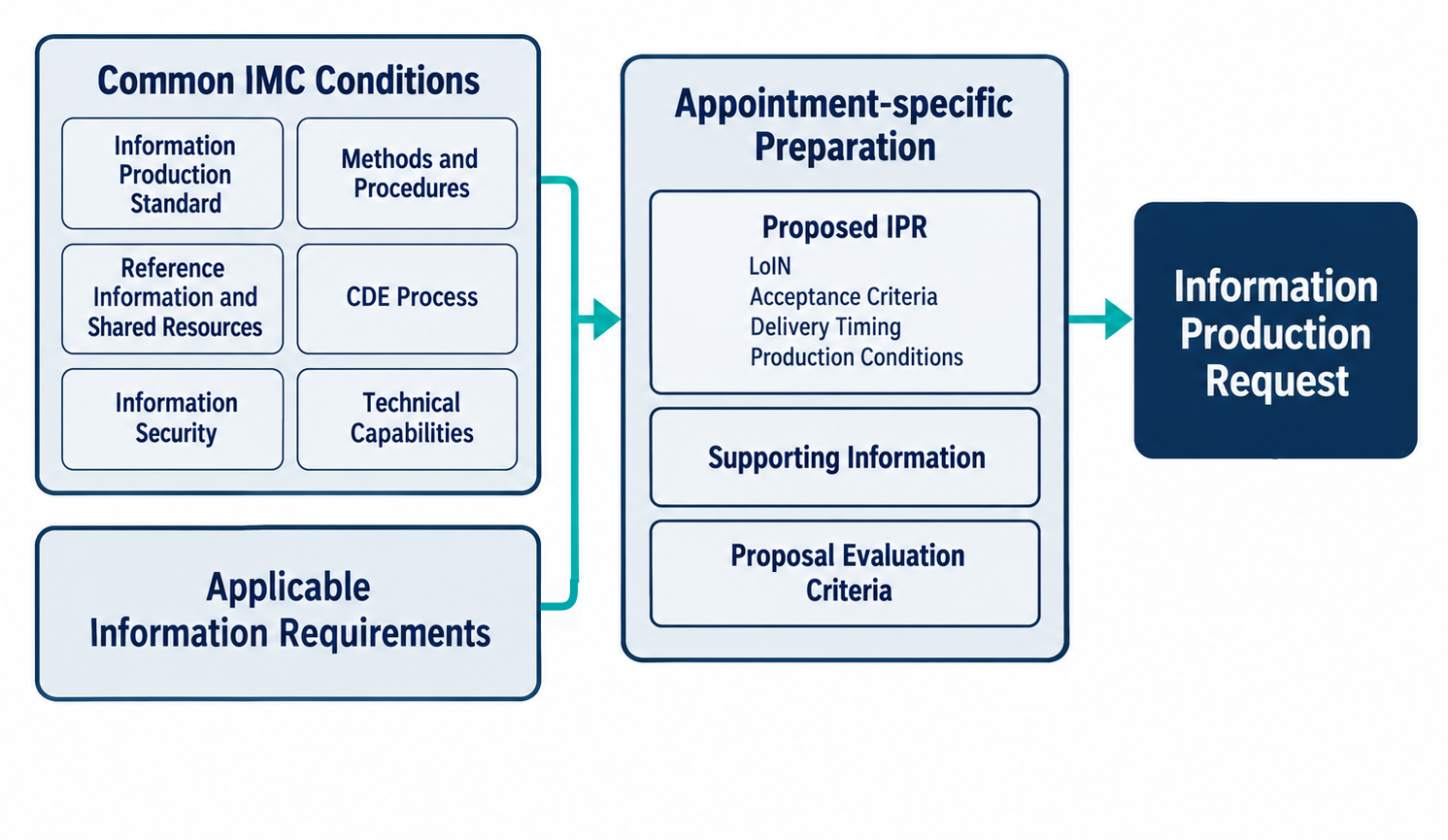
The transition shown in Figure 7.3 is more than the preparation of procurement documentation. It makes selected Information Requirements and common management arrangements applicable to a particular scope while preserving the Provider’s responsibility for developing a feasible production approach.
The Information Production Request becomes the starting point for Process 3 — Information Provider’s Proposal, during which prospective Providers assess the IPR and develop their proposed arrangements. The selected proposal and applicable IPR are subsequently reconciled during Process 4 — Appointment and Information Production Planning, when production plans and responsibilities are agreed and the relevant Appointments formalised.
7.4. Information Provider’s Proposal#
Process 3 — Information Provider’s Proposal begins when a prospective Lead Appointed Party responds to the Information Production Request. Its task is to demonstrate that the applicable Information Production Requirements (IPR) can be fulfilled through a feasible approach to organising, managing and coordinating information production.
The proposal must explain how the required information will be produced, demonstrate the competence, capability and capacity of the prospective Information Production Team, and identify the preparations and risks associated with the proposed work. It is therefore more than a commitment to deliver the specified information results.

The preliminary Information Production Plan (IPP) forms the core of the proposal. It is supported by an Information Production Team Assessment Report, a Mobilisation Plan and a Risk Register. Together, these documents describe the proposed production arrangements, assess the team’s competence, capability and capacity, and identify the measures needed to address capability gaps and production risks.
Organising the Prospective Information Production Team#
The prospective Lead Appointed Party identifies the Information Management functions required for the proposed Appointment and determines how they will be assigned to competent personnel. Information Managers coordinate the development of the proposed management arrangements, support collaboration between participating teams and ensure that relevant Information Requirements, standards and procedures are addressed.
The Lead Appointed Party also develops the proposed composition of the Information Production Team, including the specialist Task Groups responsible for producing and coordinating information. Where several Providers are involved, their prospective contributions, responsibilities and dependencies must be considered together so that the production approach reflects the capabilities of the team as a whole.
At this stage, the proposed team structure and allocation of functions are not yet formal commitments. They are reviewed and subsequently established through the relevant Appointments during Process 4 — Appointment and Information Production Planning.
Developing the Preliminary Information Production Plan#
The Information Production Plan (IPP) is a principal management document of the IMC Cycle. It establishes how collaborative information production will be organised, coordinated and managed to develop a coherent federated Information Model. During Process 3 — Information Provider’s Proposal, the prospective Lead Appointed Party prepares a preliminary IPP describing its intended approach and providing the Appointing Party with a basis for assessing its feasibility.
The preliminary IPP may comprise seven principal components:
Information Management Functions and Responsibilities — the proposed distribution of Information Management functions within the Information Production Team.
Information Production Strategy — the objectives, principles and overall organisation of collaborative production.
Federation Strategy — the intended structure and development of the federated Information Model and coordination of its Information Containers.
High-Level Information Production Responsibility Matrix — the preliminary allocation of production responsibilities among Task Groups.
Proposed Amendments to Information Production Methods and Procedures — justified adjustments to established production arrangements.
Proposed Amendments to the Information Production Standard — necessary changes or additions to common information rules.
Proposed Information Production Technologies — the technologies and resources required to support the intended approach.
These components connect the organisation of the Information Model with the organisation of the teams responsible for producing it. In particular, the Federation Strategy establishes the intended information structure, while the High-Level Information Production Responsibility Matrix identifies the Task Groups expected to contribute to its development.
The prospective Lead Appointed Party coordinates the preliminary IPP with participating prospective Appointed Parties so that the proposed arrangements reflect their capabilities, responsibilities and dependencies. Where the Appointing Party has provided a common IPP template or guidance, these requirements should be followed. The level of detail must remain proportionate to the proposed Appointment while allowing its feasibility to be evaluated.
A preliminary IPP describes an intended production arrangement, not an already established commitment or demonstrated operational capability. During Process 4 — Appointment and Information Production Planning, it is reviewed, refined and agreed alongside the applicable IPR, production responsibilities and Appointment arrangements. The agreed IPP then provides the management basis for collaborative information production.
The structure, development and practical application of the IPP are examined in detail in Part II, together with the related information-production planning instruments.
Assessing the Ability to Implement the Plan#
A well-developed preliminary IPP does not, by itself, demonstrate that the proposed Information Production Team can implement it. During Process 3 — Information Provider’s Proposal, the prospective Lead Appointed Party must assess the team’s competence, capability and capacity against the proposed production arrangements.
Each prospective Task Group evaluates its ability to fulfil its intended responsibilities, considering personnel competence, available resources, technical capabilities and the requirements for collaborative working. The Lead Appointed Party consolidates these findings in an Information Production Team Assessment Report, identifying deficiencies and dependencies that could affect the team’s overall performance.
The assessment concerns the capability of the Information Production Team as a whole, not merely the qualifications of individual specialists. Competent Task Groups may still be unable to deliver a coordinated Information Model if their resources, interfaces or working arrangements are inadequate.
Based on the preliminary IPP and the assessment findings, the prospective Lead Appointed Party prepares two further documents:
Mobilisation Plan — identifies the measures needed to achieve operational readiness, including preparation of personnel, technologies, resources and collaborative working arrangements.
Risk Register — records significant risks affecting the proposed production approach, team coordination or fulfilment of the IPR, together with the intended responses.
These documents address different questions. The Information Production Team Assessment Report establishes what the team can currently perform; the Mobilisation Plan determines what must be prepared or improved; and the Risk Register identifies what could jeopardise successful implementation.
Planning mobilisation is not the same as demonstrating operational readiness. During Process 3, the Provider identifies the necessary preparations. Their implementation and testing take place during Process 5 — Mobilisation, after the relevant Appointments and production arrangements have been established. Operational readiness must therefore be demonstrated, not inferred from the plans and commitments included in a proposal.
Consider the structural assessment introduced in § 7.3. A Provider may propose a team of surveyors and structural engineers whose information must be coordinated. The preliminary IPP describes their production approach; the assessment report identifies whether the proposed team has the necessary capabilities; and the Mobilisation Plan specifies any additional resources, coordination arrangements or tests required before production begins. The Risk Register addresses uncertainties that could affect the assessment or its delivery.
Together, these preparations establish whether the proposed production approach is feasible and what must be done to make the team ready to implement it.
Preparing and Submitting the Proposal#
The prospective Lead Appointed Party brings together the preliminary IPP, the Information Production Team Assessment Report, the Mobilisation Plan and the Risk Register into a coordinated Information Provider’s Proposal. The proposal must respond to the Information Production Request and demonstrate how the proposed Information Production Team intends to fulfil the applicable IPR and meet the Proposal Evaluation Criteria established by the Appointing Party.
Preparing the proposal may reveal limitations in the available Reference Information, uncertainties in delivery conditions or opportunities to improve the proposed production arrangements. The Provider may identify these issues, seek clarification and recommend justified amendments. However, proposing a change does not constitute authorising it. Any changes to Information Requirements or other conditions controlled by the Appointing Party must be considered and authorised by the Party holding the relevant Authority.
A credible Information Provider’s Proposal must combine a coherent approach to collaborative information production with an evidence-based assessment of the team’s ability to implement it and a realistic plan for achieving operational readiness.
Figure 7.4 illustrates how the four supporting documents contribute to the preparation of the Information Provider’s Proposal.
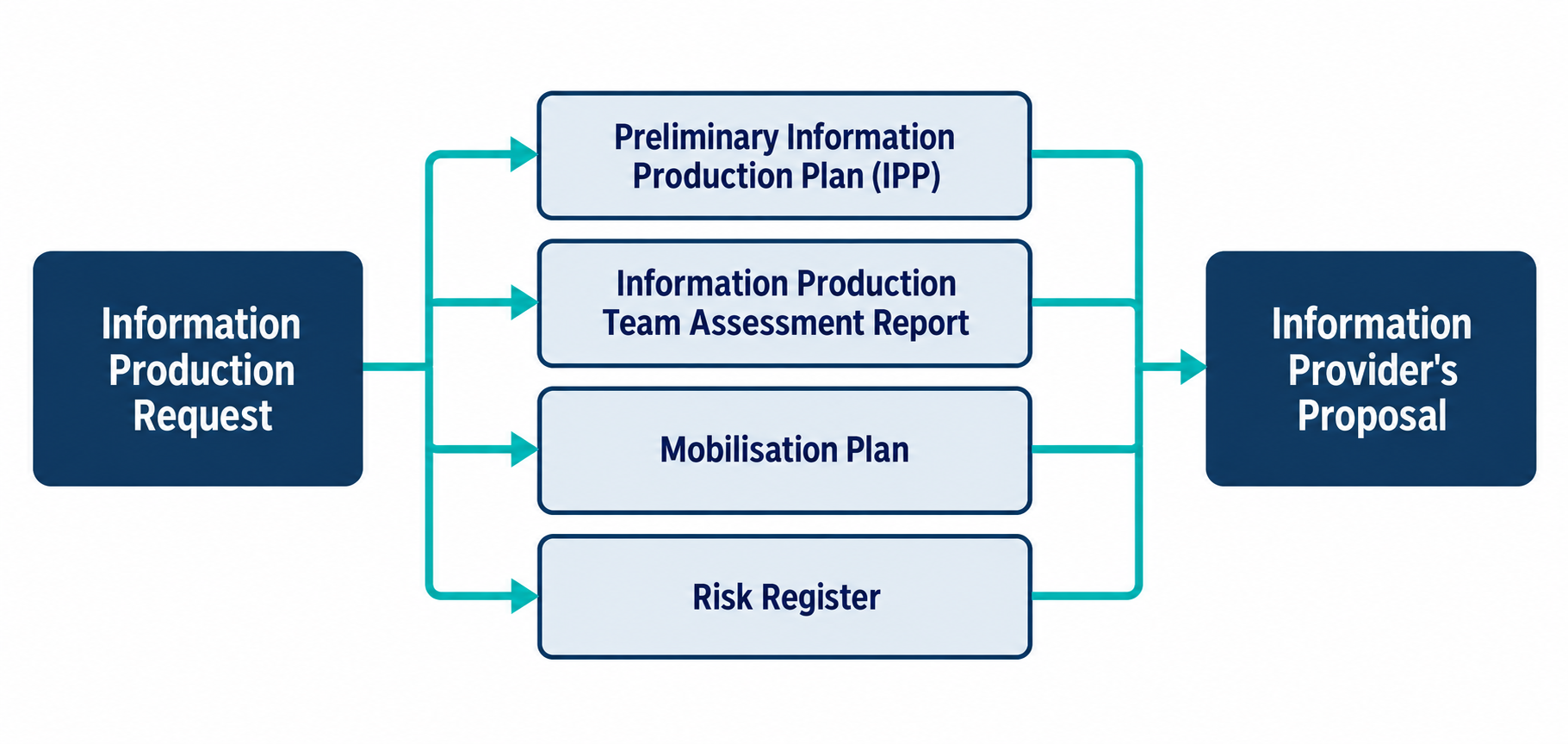
Together, these documents enable the Appointing Party to assess both the suitability of the proposed production approach and the prospective team’s ability to implement it. The proposal provides evidence for selecting a Provider and a basis for agreeing the subsequent production arrangements; it does not itself establish the Appointment or demonstrate operational readiness.
During Process 4 — Appointment and Information Production Planning, the selected proposal and applicable IPR are reconciled, the IPP is refined and agreed, production responsibilities and schedules are developed, and the relevant Appointments are formalised.
Process 3 — Information Provider’s Proposal therefore concludes with a substantiated proposal, not an agreed production arrangement. The distinction between proposed arrangements, formal commitments and demonstrated readiness remains important throughout the subsequent processes.
7.5. Appointment and Information Production Planning #
Process 4 — Appointment and Information Production Planning establishes the agreed arrangements for collaborative information production. Building on the selected Information Provider’s Proposal, the participating Parties reconcile the applicable Information Production Requirements (IPR), agree the Information Production Plan (IPP), allocate production responsibilities, develop Information Production Schedules and formalise the relevant Appointments.
The purpose is not merely to establish contractual or internal commitments. It is to ensure that the required information, assigned responsibilities and agreed production arrangements form a coherent basis for developing the federated Information Model.
Agreeing the Information Production Plan#
The preliminary IPP developed during Process 3 — Information Provider’s Proposal provides the starting point for agreement. Before its adoption, the prospective Lead Appointed Party reviews the plan against the applicable IPR, Appointment conditions and available capabilities and resources. Changes since the proposal was prepared, particularly in team composition or production arrangements, must be taken into account.
The review covers the proposed Information Management functions, Information Production Strategy, Federation Strategy, responsibility allocation, Methods and Procedures, applicable standards and technologies. Relevant participating Parties must be involved to ensure that the arrangements are mutually consistent and feasible. Changes affecting requirements or conditions controlled by the Appointing Party require its agreement.
Once agreed, the IPP becomes the principal management framework for collaborative information production within the Information Production Team. It guides the Lead Appointed Party in coordinating the team’s contributions to the federated Information Model and provides the Appointing Party with a basis for monitoring implementation of the agreed arrangements.
An agreed IPP is a controlled management document, not an unchangeable plan. Changes in responsibilities, production methods, technologies or delivery arrangements may require its revision. Updates must be coordinated and authorised under the applicable procedures so that participating Parties continue to work with consistent and current arrangements.
The detailed development and application of the IPP are examined in Part II. Here, the essential point is the transition from a proposed production approach to an agreed and governed management framework.
Allocating Responsibilities and Defining Downstream Requirements#
The agreed Federation Strategy provides the basis for allocating information-production responsibilities. As the intended structure of the federated Information Model is developed, the required information results, relevant Information Containers and associated Information Tasks can be identified and related to the Task Groups responsible for their production.
The preliminary High-Level Information Production Responsibility Matrix is developed into a Detailed Information Production Responsibility Matrix, establishing the allocation of production responsibilities among Task Groups. This allocation must remain consistent with the Federation Strategy, applicable IPR and the dependencies between Information Tasks.
Information Tasks and Information Containers do not necessarily correspond one-to-one. A task may involve several containers, while a container may be developed through multiple related tasks. Responsibility for producing information must also be distinguished from the Information Management functions assigned to individuals and teams, as explained in Chapter 5.
Alongside this allocation, the Lead Appointed Party prepares Information Production Requirements (IPR) for the Providers it intends to appoint. A Party may act as an Appointee in its relationship with the original Appointing Party and as an Appointer when engaging other Providers. Its responsibilities therefore depend on the particular Appointment relationship, rather than on a permanent organisational position.
Downstream IPR are derived from the applicable higher-level requirements but must reflect the scope, responsibilities, information results and production conditions of each downstream Appointment. They are not mechanical copies of the higher-level IPR: the relevant requirements must be selected, refined where necessary and made applicable to the work assigned to each Provider.
The result is a coordinated relationship between the intended structure of the Information Model, the allocation of information-production responsibilities and the requirements governing each Provider’s contribution. Detailed planning of Information Tasks, responsibilities and their dependencies is examined further in Part II.
Developing Information Production Schedules#
The agreed Information Production Plan (IPP), Detailed Information Production Responsibility Matrix and applicable Information Production Requirements (IPR) provide the basis for scheduling information production. Together, they establish the agreed production arrangements, the allocation of responsibilities and the information results to be delivered.
Each Information Production Schedule (IPS) identifies the Information Tasks and deliveries planned within a particular scope, including their timing, sequence, dependencies and relationship to Information Delivery Milestones. The allocation of tasks must remain consistent with the Detailed Information Production Responsibility Matrix, so that scheduling does not introduce conflicting responsibilities.
The Lead Appointed Party coordinates the individual schedules into a Master Information Production Schedule (MIPS). This integrated schedule connects the activities of participating Task Groups, identifies dependencies and information exchanges between them, and supports coordination against the required Information Delivery Milestones.
Table 7.2 summarises the purposes of the principal planning instruments.
Instrument | Principal purpose |
|---|---|
Information Production Plan (IPP) | Establishes the agreed management framework and arrangements for collaborative information production |
Detailed Information Production Responsibility Matrix | Identifies the Task Groups responsible for producing the required information results |
Information Production Schedule (IPS) | Plans Information Tasks, dependencies and deliveries within the relevant scope, including their timing |
Master Information Production Schedule (MIPS) | Integrates individual schedules and coordinates inter-team dependencies, information exchanges and Information Delivery Milestones |
These instruments are complementary but not interchangeable. The Detailed Information Production Responsibility Matrix establishes who is responsible for producing the required information, while the IPS and MIPS establish when production and delivery are planned and how dependencies are coordinated. The IPP provides the agreed management framework within which these responsibilities and schedules operate.
Consider the structural assessment introduced in § 7.3. Surveyors must provide the necessary information about the existing structure before structural engineers can complete calculations that depend on it. The Responsibility Matrix identifies the Task Groups responsible for these results; their IPS establish the planned tasks and deliveries; and the MIPS coordinates the dependency between the two groups.
The detailed preparation, integration and management of Information Production Schedules are examined in Part II.
Formalising Information Appointments#
Process 4 — Appointment and Information Production Planning concludes by formalising the Information Appointments through which participating Parties undertake their agreed obligations. The original Appointing Party establishes an Appointment with the Lead Appointed Party, which may in turn act as an Appointer when engaging downstream Providers. Depending on the organisational context, these relationships may be formalised through external contracts or internal appointment arrangements.
The applicable Information Production Requirements (IPR), agreed Information Production Plan (IPP), allocation of production responsibilities and supporting schedules must be consistent with the scope of each Appointment. Together, they connect what information must be produced with who is responsible for producing it and how the work will be organised and coordinated.
The Information Protocol provides a contractual mechanism for establishing applicable Information Management rights, obligations and governance conditions in external Appointments. It is developed using the Information Protocol Template prepared during Process 1 — Preparing the IMC Cycle, together with the Information Particulars relevant to the specific contract. Internal Appointments require corresponding organisational arrangements appropriate to their context. The Information Protocol and its development through procurement and Appointment are examined in detail in Part II.
Information Appointments establish the formal obligations of participating Parties in relation to the applicable Information Production Requirements, allocated production responsibilities and agreed arrangements for collaborative information production.
Figure 7.5 illustrates how the selected Information Provider’s Proposal leads to coordinated production arrangements and formalised Appointments.
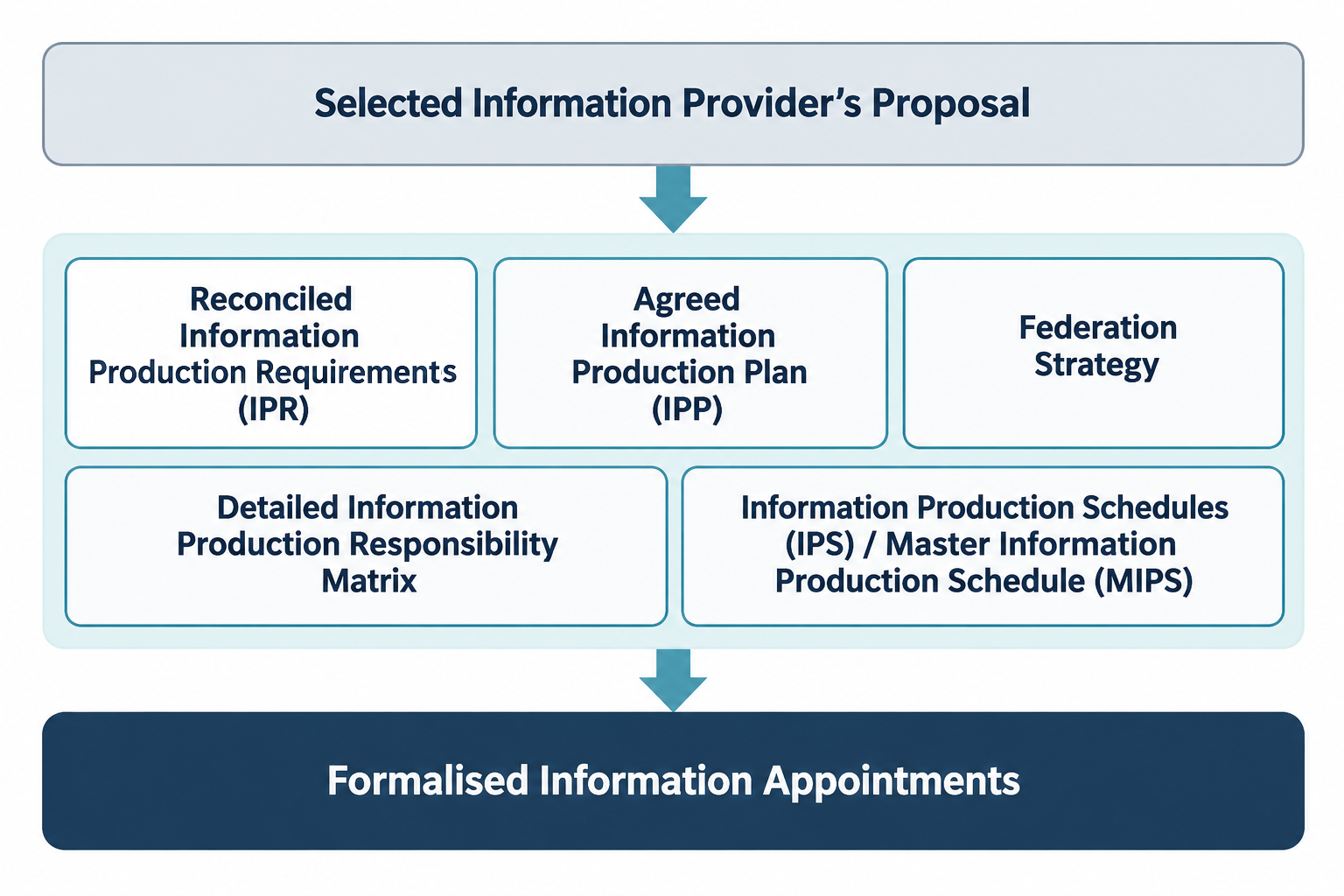
The figure connects the agreed IPR, IPP, responsibility allocation and schedules with the corresponding Appointment relationships. These arrangements establish a common basis for managing production, monitoring obligations and controlling changes across participating Parties.
Formal agreement, however, does not demonstrate operational readiness. Process 5 — Mobilisation implements the necessary preparations and tests whether the Information Production Team can apply the agreed Methods, Procedures and technologies under practical working conditions. This provides the transition from established obligations to demonstrated readiness for collaborative information production.
7.6. Mobilisation and Collaborative Information Production#
Formalised Information Appointments establish obligations, while agreed plans and schedules define how information production is to be organised. Yet having agreed arrangements is not the same as being ready to implement them. Participating Task Groups must have the necessary resources, functioning technologies and practical ability to work together under the agreed Information Management conditions.
Process 5 — Mobilisation establishes operational readiness, while Process 6 — Collaborative Information Production applies the agreed arrangements to create and coordinate information results. Together, they connect formal commitments with actual information-production activities.
Agreed arrangements → Operational readiness → Collaborative information production.
Mobilising the Information Production Team#
Process 5 — Mobilisation implements the preparations identified in the Mobilisation Plan developed during Process 3 — Information Provider’s Proposal. The Lead Appointed Party coordinates these activities with participating Appointed Parties, taking account of the confirmed team composition, available resources and any changes to the agreed Information Production Plan (IPP).
Mobilisation comprises four principal activities:
Mobilising resources — making the necessary personnel, competencies and Shared Resources available for information production.
Mobilising information technologies — preparing the software, equipment, infrastructure and system connections required for production and exchange.
Testing Information Production Methods and Procedures — demonstrating that Task Groups can apply the agreed procedures, including the CDE Process, and coordinate their contributions under realistic working conditions.
Establishing readiness for Trigger Events — preparing the capabilities needed to initiate, maintain or resume information production when relevant events occur, particularly during asset operation.
The essential distinction is between assessed capability and demonstrated operational readiness. During Process 3 — Information Provider’s Proposal, the prospective team assesses its competence, capability and capacity and identifies necessary preparations. During Process 5 — Mobilisation, these preparations are implemented and tested. Operational readiness must be supported by evidence of successful preparation and practical testing, rather than assumed from plans or declarations of capability.
Consider the structural assessment involving surveyors and structural engineers. Both Task Groups may be technically competent, yet their information exchanges may fail because of incompatible formats, inadequate access permissions or unsuitable coordination procedures. Mobilisation provides an opportunity to test these arrangements together and resolve deficiencies before they disrupt information production.

The scope of Mobilisation should be proportionate to the Appointment’s complexity and production risks. A multi-party project may require extensive integrated testing, while a smaller assignment may need only targeted checks. During asset operation, readiness may also need to be maintained or restored between Trigger Events, without unnecessarily repeating preparations whose effectiveness remains established.
Collaborative Information Production#
Once operational readiness has been demonstrated, Process 6 — Collaborative Information Production puts the agreed arrangements into practice. Participating Task Groups perform their Information Tasks under the applicable Information Production Requirements (IPR), agreed Information Production Plan (IPP), allocated responsibilities and Information Production Schedules. Their contributions are developed and coordinated according to the Federation Strategy, progressively developing the federated Information Model.
Collaborative production involves more than Task Groups working simultaneously. Information produced by one group may become Reference Information for another, while subsequent work may reveal deficiencies or dependencies requiring earlier results to be clarified or revised. Collaboration depends on the governed coordination of these contributions, rather than their independent production and eventual combination.
Consider the structural assessment introduced in § 7.3. Surveyors provide information about the existing structure for use by structural engineers. If the calculations reveal insufficient detail or inconsistencies in the survey results, the surveyors may need to supplement or revise their information. The updated results are then exchanged and coordinated with the engineering team. Such interactions allow the participating Task Groups to develop a consistent information outcome.
Throughout Process 6, Information Containers are created, developed, checked and exchanged under the applicable Information Production Methods and Procedures and the agreed CDE Process. These arrangements govern how information is made available, assessed for sharing and coordinated between Task Groups, while allowing the teams to use appropriate specialist production methods.
The work may involve repeated checking, revision and information exchange. Its activities are therefore interdependent and potentially iterative, not a mandatory linear workflow. Part II examines these collaborative production arrangements in detail, including the management of Information Containers and their controlled exchanges.
Mobilisation establishes and demonstrates the operational readiness of the Information Production Team; Collaborative Information Production applies that readiness to produce and coordinate information results in accordance with the applicable requirements and agreed working arrangements.
Figure 7.6 shows how demonstrated readiness supports collaborative production and how changes in working conditions or identified deficiencies may require additional preparation or readiness checks.
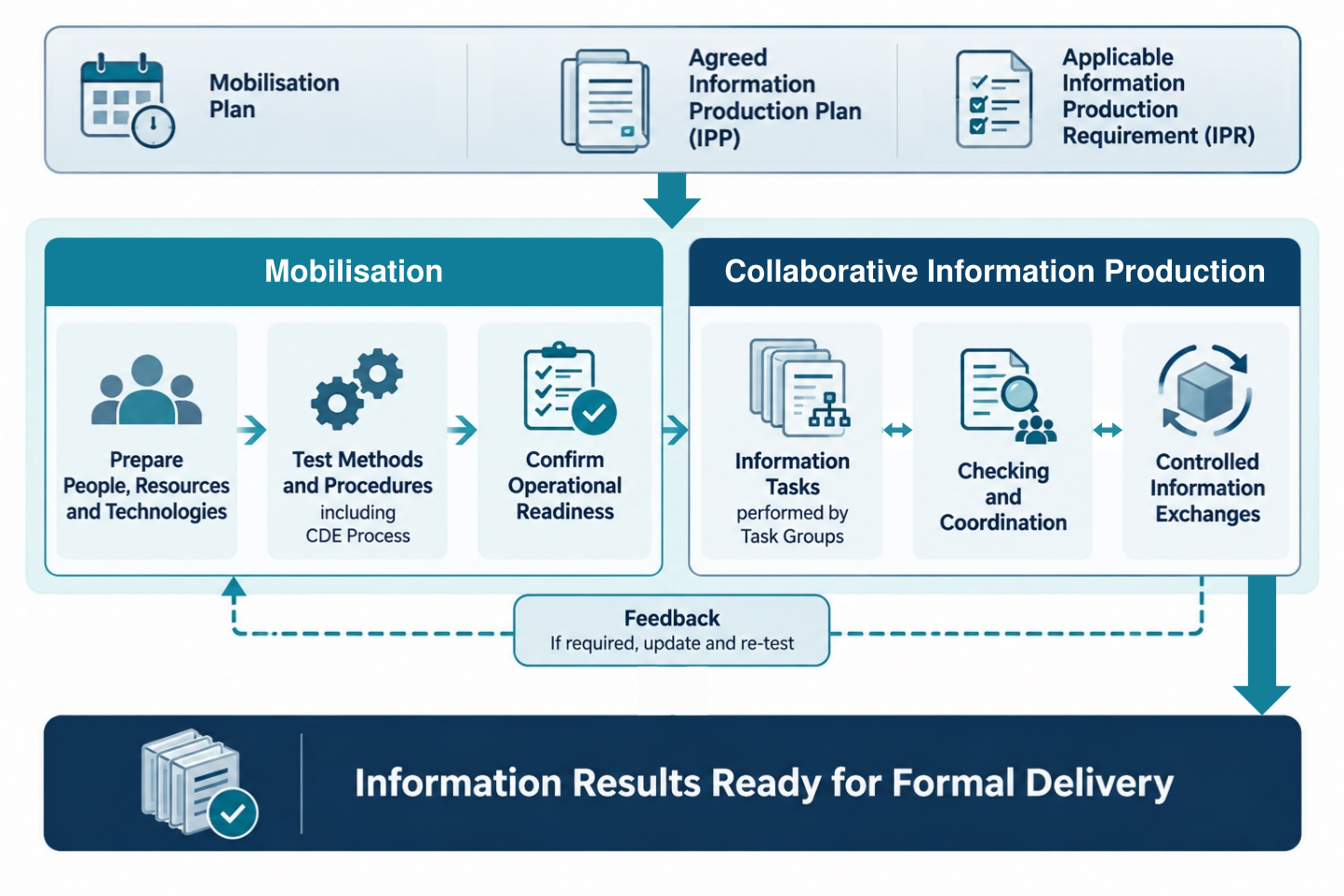
The outcome of Process 6 is information that has been produced and coordinated for the required delivery. However, completion of production is not equivalent to formal Information Delivery or Acceptance. These are separate management activities involving submission, assessment and authorised decisions under Process 7 — Information Delivery and Acceptance, examined in § 7.7.
7.7. Information Delivery, Acceptance and Model Continuity#
Collaborative Information Production creates and coordinates the required information results, but completing production does not fulfil the Provider’s formal delivery obligations. Information must be delivered under the applicable Appointment, assessed against the relevant Information Requirements and Acceptance Criteria, and subjected to an authorised Acceptance Decision.
The final two processes of the IMC Cycle govern distinct transitions. Process 7 — Information Delivery and Acceptance establishes the formal delivery, assessment and authorised decision concerning information results. Process 8 — Information Model Incorporation and Continuity governs their subsequent incorporation into the continuing Information Model and the preservation of its coherence.
The distinction is essential: accepted information is not necessarily incorporated information, and neither Acceptance nor Incorporation constitutes its Actual Use in a Management Activity.
Information results → Formal delivery → Information assessment → Acceptance Decision → Information Model incorporation → Model continuity.
Information Delivery and Acceptance#
During Process 7 — Information Delivery and Acceptance, the Information Provider formally delivers the required results under the applicable Information Production Requirements (IPR) and Appointment conditions.
Information Exchanges during collaborative production may support coordination, checking and the use of Reference Information. However, making information available for collaboration is not equivalent to fulfilling a formal delivery obligation. Formal Information Delivery establishes an identifiable Submission that connects the information results delivered with the relevant Appointment and its requirements.
The Submission must make clear:
What is delivered — the identifiable information results, including relevant Information Containers and their revisions.
Which requirements apply — the applicable IPR and Acceptance Criteria.
Who is responsible — the submitting Provider and the receiving Party or authorised decision-making function.
Which commitment is fulfilled — the relevant Appointment, production scope and Information Delivery Milestone or other delivery condition.
These elements establish the Submission’s management context and traceability. They do not require a particular technical metadata structure or the physical transfer of information between systems.
The receiving Party arranges the necessary Information Assessments to establish whether the submitted information conforms to the applicable requirements and is suitable for its intended purpose. These assessments produce documented findings but do not themselves constitute Acceptance.
The Acceptance Decision is made by the Party or function holding the relevant Authority. It establishes the authorised outcome of the Submission. Where deficiencies are identified, corrections, rejection or resubmission may be required. Information Assessment establishes findings; an Acceptance Decision exercises Authority.
Consider the structural assessment introduced earlier. The Provider submits the required survey records, structural calculations and associated Information Containers. Although these results have been checked within the Information Production Team, the receiving Party must assess them against the applicable IPR and Acceptance Criteria before an authorised Acceptance Decision can be made.
Table 7.3 summarises the distinct management actions connecting Information Delivery with Information Model Continuity.
Management action | Principal purpose |
|---|---|
Information Delivery | Formally submit identifiable information results under the applicable Appointment and delivery conditions |
Information Assessment | Establish documented findings concerning conformity with applicable requirements and suitability for the intended purpose |
Information Acceptance | Make the authorised Acceptance Decision concerning the submitted information results |
Information Model Incorporation | Incorporate the appropriate accepted information into the continuing Information Model through a governed process |
These actions are related but should not be treated as an uninterrupted workflow. Assessment may require correction or resubmission, while accepted information must still undergo a separate governed Incorporation process. Their detailed implementation is examined in the discussion of information delivery and use in Part II.
Information Model Incorporation and Continuity#
Acceptance establishes the authorised outcome of Information Delivery under an Appointment, but does not automatically make the accepted results part of the continuing Information Model. Process 8 — Information Model Incorporation and Continuity governs this separate transition, ensuring that accepted information is incorporated under the applicable Information Management conditions.
Incorporation may involve registering new Information Containers, incorporating accepted revisions of existing containers or establishing governed relationships with information already included in the model. It does not necessarily require information content to be physically transferred or duplicated between systems. What matters is that the incorporated information remains identifiable, accessible under applicable conditions and subject to consistent governance.
Information Model Incorporation is more than adding documents or data to a collection. Information contributed by different Parties, through successive Appointments and IMC Cycles, must remain coherent and traceable. Maintaining this continuity involves four interrelated aspects:
Identity and traceability — preserving the identity of Information Containers and their revisions, together with the history of their production, delivery, assessment, acceptance and incorporation.
Information relationships — maintaining governed connections between information results produced by different Parties, at different times and under different Appointments.
Applicability — establishing which information results and revisions apply to particular Information Requirements, management contexts and intended purposes.
Management context — retaining the information needed to understand why results were required, under which conditions they were produced and accepted, and how they became part of the Information Model.
These controls must remain effective as the Information Model develops. Continuity does not require every Information Container to be constantly updated, nor does incorporating a new revision eliminate the relevance of earlier information. The latest revision is not necessarily the appropriate information for every purpose: applicability must be understood in relation to the relevant Requirements and Management Activities.
This is particularly important throughout the life cycle of a built asset. Different organisations may contribute information through successive projects, inspections, maintenance activities and alterations, sometimes separated by many years. Their results must remain connected through governed identity, applicability and management context, rather than becoming disconnected records.
Consider the structural assessment introduced earlier. Once the survey findings and structural calculations have been accepted and incorporated, they become part of the continuing Information Model alongside previous assessments. Preserving their relationships allows future users to understand how knowledge of the structure’s condition has developed, distinguish historical findings from more recent evidence and identify the information relevant to a particular decision.

However, making information available for use is not the same as actually using it. Incorporation establishes the governed availability of accepted information; Actual Use occurs when that information supports an engineering judgement, management decision or other Management Activity. A decision to strengthen the structure, restrict its operation or commission further investigations therefore remains distinct from the IMC processes through which the supporting information was produced and incorporated.
Information Delivery, Information Assessment, Acceptance Decision and Information Model Incorporation are distinct management actions. Together, they establish the basis for maintaining a governed Information Model and making accepted information available for subsequent use in Management Activities.
Figure 7.7 summarises these transitions and distinguishes the incorporation of accepted information from its Actual Use.
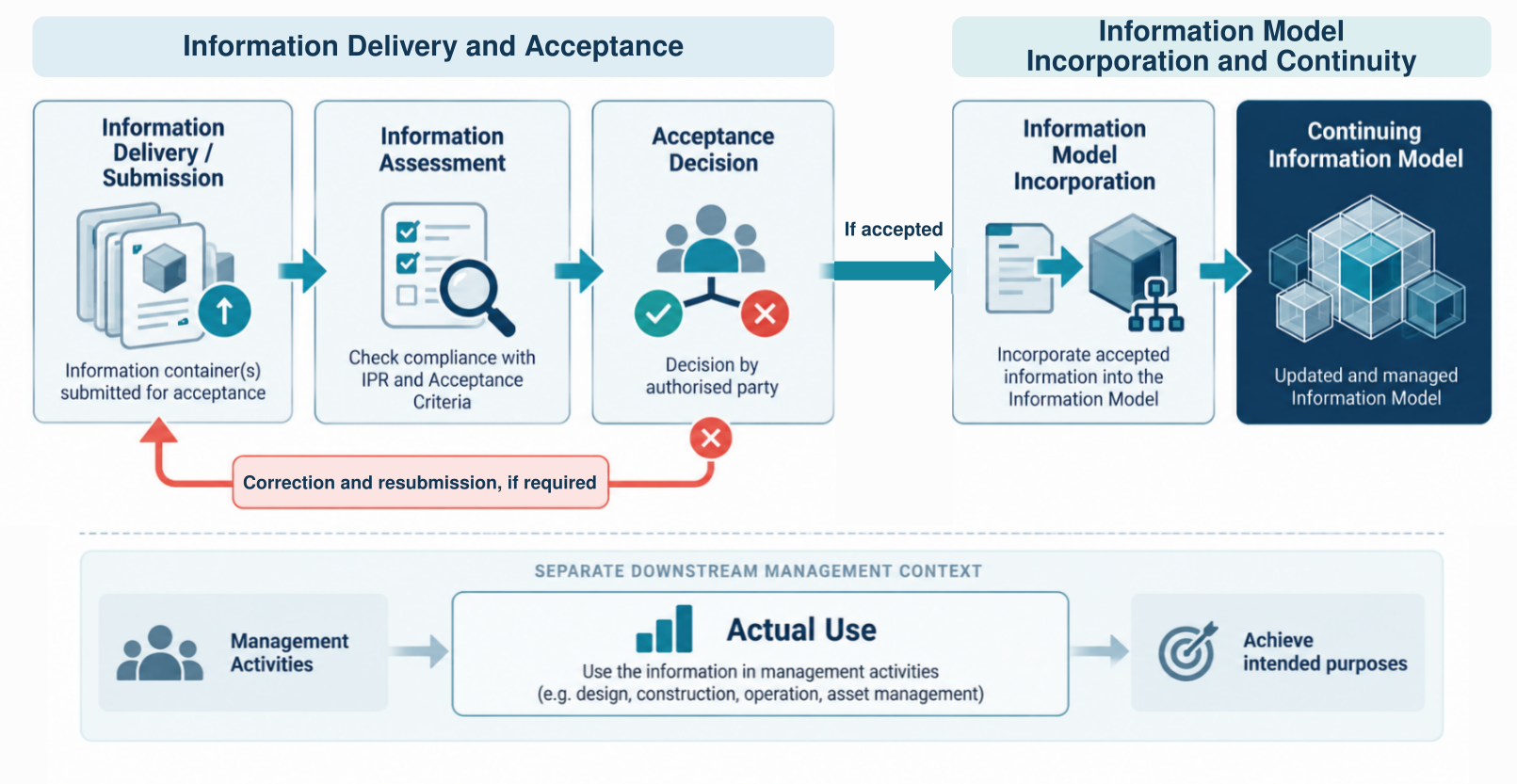
The transitions are governed, but not necessarily uninterrupted. Rejection or required corrections may lead to further production, assessment and delivery before information can be accepted and incorporated. The detailed implementation of these arrangements, including the subsequent use of governed information, is examined in the discussion of information delivery and use in Part II.
The Continuing Purpose of the Information Management Cycle#
The eight processes examined in this chapter form a coherent structure for organising and governing collaborative information production. They connect the preparation of common Information Management conditions with individual Appointments, production planning, mobilisation, collaborative production, formal Information Delivery, Acceptance and the incorporation of accepted results into a continuing Information Model.
The significance of the IMC Cycle lies in the relationships between its processes, not merely in their individual outputs. Information Requirements establish the expected results and their intended purposes. Appointments connect these requirements with the obligations of participating Parties, while plans, responsibilities and schedules coordinate their production. Delivery, assessment and authorised Acceptance Decisions establish the outcomes of information-supply obligations. Incorporation then connects accepted results with the continuing Information Model.
These processes do not constitute a single sequence performed once from beginning to end. Different Information Production Teams may work concurrently, successive Appointments may depend on earlier results, and particular processes may be revisited as Requirements, circumstances or information-production arrangements change. Common management conditions provide continuity while allowing the necessary activities to be organised for each appointed scope.
The outcome is therefore more than a collection of completed information deliveries. Information produced and accepted through different Appointments remains connected within a governed Information Model, preserving its identity, applicability, relationships and management context. This continuity allows information developed at one stage of an asset’s life cycle to remain available for subsequent activities, even when the participating Parties or technical systems change.
At the same time, the IMC Cycle governs information production and its results, not the Management Activities in which that information is used. Actual Use may reveal deficiencies or generate new Information Needs, leading to further Information Requirements and information-production activities. It does not, however, constitute a ninth process of the cycle.
The continuing purpose of the IMC Cycle is thus to ensure that successive information-production efforts contribute to one coherent, governed and evolving Information Model. Each Appointment may have its own scope, responsibilities and delivery obligations, but its information results should remain connected to the Requirements that justified their production and to the model that preserves them for subsequent use.