Information as a Management Resource
In this chapter 1.1–1.5
1.1. Organisations, Objectives and Management Activities#
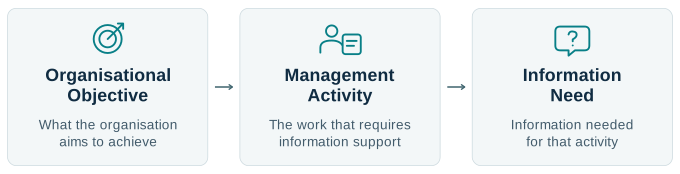
Built assets exist to serve organisational purposes. They provide places to live and work, enable transport and production, support public services, generate income, protect people and property, and allow organisations to fulfil their wider responsibilities. Creating, operating and changing those assets therefore requires ongoing management, and that management depends on information.

A developer considering a new logistics facility needs information about cost, programme, risk and expected return. A transport authority planning maintenance needs reliable information about asset condition, service impact and intervention priorities. A hospital operator needs information to keep critical systems available and safe. A design organisation needs information to coordinate its work and demonstrate that proposed solutions satisfy the relevant Requirements.
Across these contexts, information supports activities such as:
- planning and coordination;
- assessment and control;
- decision-making;
- risk and compliance management;
- operation, maintenance and intervention.
The required information differs because the management activities, responsibilities and purposes differ. In every case, someone is trying to plan, control, assess, coordinate, decide or act, and information is needed to support that work.
We use the term Management Activity for such purposeful activity undertaken to manage an asset, project, organisation or related responsibility. It may involve a formal Decision, but it does not have to. Monitoring performance, coordinating design, reviewing risk, planning maintenance, assessing compliance or preparing an intervention are all examples of Management Activities that can create information demand.
From Management Purpose to Information Demand#
The important point is the direction of causality.
Information management begins with management, not with information.
In practice, organisations often begin from the opposite direction. They ask what data are already available, what a software platform can store, what a previous project delivered or what an established template requires. These questions may become useful later, but they do not establish whether the information is actually needed.
A stronger starting question is:
What are we trying to manage, decide, control, assess or achieve?
Consider a team preparing for a design review of a new logistics facility. The review may require information about structural interfaces, equipment clearances, fire strategy and installation zones. Those resources are valuable because they support a specific Management Activity: coordinating the design before commitments are made that would be expensive or difficult to change.
The same logic applies during asset use. A university may already hold drawings, maintenance records, equipment registers and operational data for a campus building. Their value depends on whether they support real Management Activities, such as investigating repeated plant failure, planning maintenance or deciding whether an energy-efficiency intervention is justified. Possessing information does not by itself create management value.
Who Determines What Information Is Needed?#
This perspective also affects responsibility for Information Management. Information Managers, BIM specialists and other information professionals may help structure Requirements, coordinate processes and maintain governance, but they cannot independently determine all the information an organisation needs. The management meaning of information belongs to the people and functions responsible for the underlying Management Activities.
A project manager understands what must be known before a milestone decision. An engineer understands what evidence is required to assess structural condition. A maintenance manager understands which information is needed to plan an intervention. A finance function understands what information is required to evaluate an investment. In each case, responsibility for the Management Activity carries a corresponding responsibility to understand the information on which that activity depends.
This does not mean that every manager becomes a formal Information Manager. It means that Information Management is part of the organisation’s wider management system rather than an isolated specialist function.
Once the Management Activity is understood, the next question becomes more precise:
What information is actually needed to perform it?
That question leads to the Information Need.
1.2. From Management Activity to Information Need#
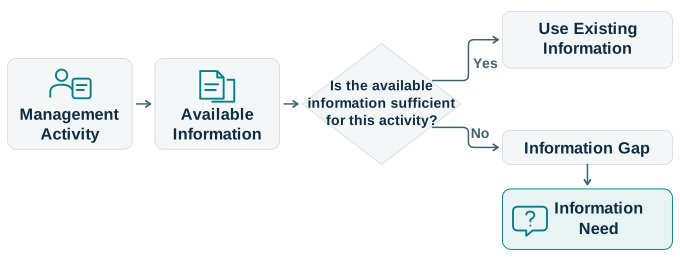
A Management Activity does not automatically create a demand for new information. In many situations, the information already available may be sufficient. A maintenance team may have reliable inspection records, a design team may already possess the survey information required for its next task, or a manager may be able to make a decision using information that remains current and applicable.
A new or changed Information Need arises when the Management Activity cannot be performed adequately with the information already available. The information may be missing, outdated, too general, unreliable, difficult to interpret or otherwise unsuitable for the intended purpose. The underlying logic is:
Management Activity → assess available information → information gap → Information Need.
Consider an industrial operator assessing whether an existing production area can accommodate new equipment. Existing drawings may not reflect subsequent modifications, current structural loads or the service clearances required for the proposed installation. The operator does not initially need “a new model” or “a new survey” as such; the management need is to understand whether the proposed change can be accommodated safely and practically.
The same logic applies when a road authority plans an intervention on a bridge. Previous inspection information may exist, but if it no longer provides sufficient confidence about the condition of a critical component, the maintenance activity creates a new Information Need.
In both cases, the Need exists before anyone decides how the required information should be produced.
From an Information Gap to an Information Need#
We use the term Information Need for the structured expression of information required to support a Management Activity.
At this stage, the organisation is not yet specifying the technical characteristics of the future information result. It is establishing the management demand that justifies further specification.
A useful Information Need should answer four basic questions.
Question | Meaning |
|---|---|
Why? | What is the Intended Purpose? Which Management Activity will the information support? |
What? | What information is being sought in management terms? |
Who? | Who is the Receiver — the person, role, team or organisational function that needs the information? |
When? | At what point, milestone, trigger or recurring interval is the information required? |
These questions are deliberately management-oriented.
Why establishes the Intended Purpose. Information needed to assess safety may differ from information needed to estimate cost even where both concern the same asset.
What identifies the information sought without prematurely prescribing its technical representation.
Who identifies the Receiver. The same information may have different value for a maintenance manager, regulator or commercial manager because each supports a different Management Activity and purpose.
When connects the information demand to the point at which it has management value. Information that arrives after the relevant activity may still be technically correct while being managerially useless.
Together, the four questions turn a vague request into a structured statement of management demand.
Information Need Is Not Information Requirement#
A common problem is to move too quickly from a management problem to a technical solution.
A manager identifies uncertainty, and the response immediately becomes:
- produce a survey;
- update the model;
- add these attributes;
- create a report;
- build a dashboard.
Any of these may ultimately be appropriate. But each already begins to prescribe how the demand will be satisfied. Before deciding on the form of the response, the organisation should first establish what information is needed and why.
Suppose a project team must determine whether a retaining wall can safely accommodate revised site loads before design approval. The Information Need establishes the management demand: the wall’s adequacy must be understood before the approval decision is made.
Only then should that Need be translated into one or more Information Requirements defining what information must be provided in a sufficiently precise and assessable form.
Management problem → Information Need → Information Requirement.
An Information Need expresses the management demand for information. An Information Requirement specifies what information must be provided to satisfy that demand.
One Information Need may lead to several Information Requirements where different pieces of information are necessary to support the same Management Activity. More complex relationships between Needs and Requirements are examined in Chapter 3.
The important point here is simpler: Information Requirements should remain connected to the management demand that gave rise to them. Otherwise, organisations risk specifying information because it was requested before, because a template contains it or simply because technology makes it possible to produce it.
Recognising an Information Need establishes why information is worth obtaining. But satisfying that Need requires resources: information may have to be found, produced, checked, managed and maintained.
That introduces another management question: what does information cost, and where does its value actually come from?
1.3. Information as a Resource and as Value#
Information is an organisational resource, but it is not a free one. Reliable information may require surveys, engineering work, modelling, analysis, measurement, specialist judgement, coordination and review. It must also be classified, stored, protected, maintained and, in many cases, updated over long periods of time. All of this consumes resources. Yet the fact that information is costly to obtain and maintain does not mean that it is valuable. Cost and value arise in different ways.
A water-treatment operator may commission a detailed condition assessment of pumping equipment. The cost arises from inspection, measurement, analysis and preparation of the resulting information. The value is realised if that information helps the operator identify an impending failure, plan an intervention and avoid an unplanned outage.
A commercial property owner may hold extensive records across a portfolio: maintenance histories, equipment data, inspection results, lease information and energy-performance data. Maintaining those records creates continuing cost, but their value depends on whether they support Management Activities such as maintenance planning, compliance, refurbishment, investment or operational improvement.
The distinction can be summarised as follows.
Cost of information | Value of information | |
|---|---|---|
Arises from | Obtaining, producing, managing and maintaining information | Using information in Management Activities |
Primary concern | Resource consumption | Management usefulness |
Key question | What does this information require from us? | What can this information enable us to do? |
This distinction matters because organisations can easily confuse the amount of information they possess with the value they derive from it. An asset owner may inherit hundreds of information fields because a previous specification required them, while a project team may request highly detailed information “in case it is needed later”. Both situations may be justified, but both may also create continuing cost without corresponding management benefit.
Information should therefore be proportionate to the Management Activity it is intended to support.
A new Information Need does not automatically require new information production. Existing information may already satisfy the Need if it remains relevant to the current purpose, sufficiently reliable, current and applicable, understandable to the Receiver, and available under appropriate conditions of use.
This creates an important management question:
Can existing information reliably satisfy the new Need?
Reuse can create value by avoiding unnecessary, duplicated or repeated production. Information created during design may later support construction, commissioning or operation; inspection information may contribute to maintenance planning or investment decisions; previous project information may remain useful when an asset is modified years later. Reuse, however, should never be assumed simply because information exists. Context changes, and information that was suitable for one Management Activity may be unsuitable for another.
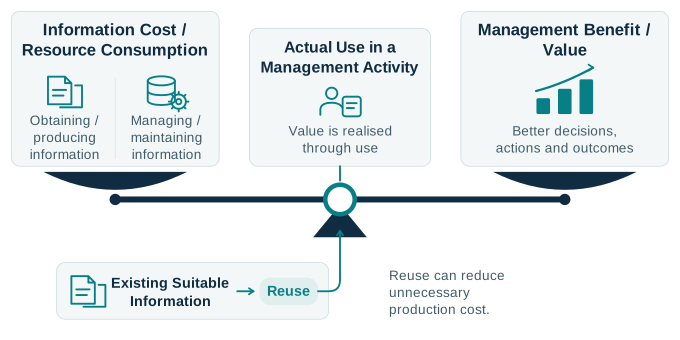
The existence of information does not prove that value has been created. A technically correct report may never influence a Management Activity. A complete dataset may arrive after the decision it was meant to support. An Information Model may contain extensive detail that no one actually uses. For this reason, it is important to distinguish between the Intended Purpose of information and its Actual Use.
Intended Purpose explains why information is expected to be useful. Actual Use concerns what the organisation actually does with that information in practice. Information may be produced, assessed and even accepted without ever contributing to management.
Information creates cost through production and management; value is realised through use.
Value is not only financial. Information may create value by reducing safety risk, demonstrating compliance, improving coordination, supporting resilience, avoiding delay, preventing unnecessary work or enabling a better-informed Decision. What matters is the contribution that information makes to a Management Activity.
Once this distinction is clear, another follows naturally. Producing information is only one part of the value chain. The next question is how Information Production differs from Information Management.
1.4. Information Production and Information Management#
Once an Information Need has been identified and translated into Requirements, information may have to be produced. Designers develop models and drawings. Engineers prepare calculations and technical assessments. Surveyors collect measurements. Contractors produce construction records. Operators update registers and maintenance information. Analysts prepare reports and forecasts.
These activities differ in form, but they have something in common: they create or change information. We use the term Information Production for this work.
Information Management performs a different function. It connects production to the management context in which the resulting information is required, assessed and used. At an appropriate level, this means establishing:
- why the information is required;
- what Requirements it must satisfy;
- who is responsible for providing and receiving it;
- when it must be available;
- how its suitability will be assessed;
- how it is expected to support subsequent Management Activities.
The distinction is functional rather than organisational. The same person or team may perform both Information Production and Information Management activities. In a small engineering organisation, for example, one professional may help define what information is required, produce part of it, coordinate its assessment and later use the result in another Management Activity. The functions remain distinct even when the people performing them are the same.
Information Production creates information. Information Management makes that production purposeful, governed and traceable.
Technical Quality Is Not the Whole Management Result#
Consider a railway-station refurbishment. An engineer may produce a technically sound structural assessment of an existing roof. The calculations may be correct, the assumptions appropriate and the engineering judgement competent. Yet the wider information-management outcome may still fail if the wrong area was assessed, the applicable Requirements were unclear, the result arrived after the relevant Decision, or later users cannot determine which assessment was relied upon.
The same distinction applies during asset use. A maintenance contractor may produce accurate inspection information for critical hospital equipment, but that information may still have limited management value if it cannot be connected to the correct asset, does not address the operator’s Information Need or reaches the maintenance team too late to influence planning.
Technical quality and information-management quality are therefore related but not identical. Good Information Management does not replace professional competence in producing information; it connects competent production to the right purpose, Requirements, responsibilities, timing and use.
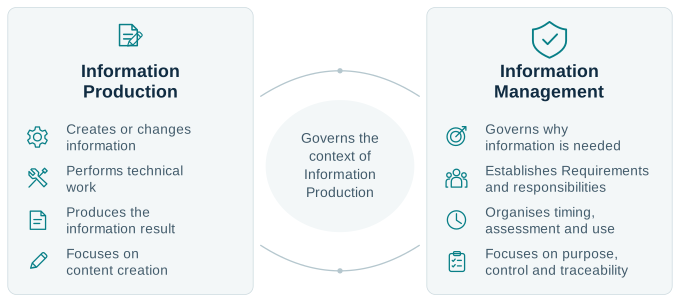
The distinction also helps clarify how information work is organised. Information Management must separate what work is required, how that work is performed and how the activity is governed.
In later chapters, these questions are expressed more precisely through the concepts of Information Task, Method and Procedure. At this stage, the important point is simply that they describe different aspects of information work and should not be treated as interchangeable.
Information Management therefore does not attempt to control every technical action undertaken by information producers. Its role is to govern the conditions that matter for obtaining information that is suitable for its Intended Purpose.
Technology fits into the same logic. Authoring software, databases, document systems, sensors, collaboration platforms and analytical tools can support both Information Production and Information Management. They can improve coordination, automate checks, provide access and reduce manual effort, but they do not determine the underlying Management Activity or Information Need.
Technology enables Information Management; it does not replace it.
Information may be produced and stored in different technical environments. What matters is not that all production occurs in one system, but that the relevant management context remains understandable and governed. The implications of distributed information environments are examined in § 2.5; here it is enough to recognise that where information is produced is not the same question as how it is managed.
Information Production is therefore one part of a wider discipline. Produced information must still be delivered, assessed, accepted where necessary and, ultimately, used.
That broader continuity is what we mean by Information Management in Construction.
1.5. Information Management in Construction and the Closed Loop#
By this point, a broader pattern becomes visible. Information is not an independent product moving through a technical pipeline. It originates in a Management Activity, consumes resources when it is produced and governed, and creates value when it is used to support the purpose that justified it.
This broader continuity is the basis of Information Management in Construction — IMC.
Information Management in Construction (IMC) is the coordinated management of information needs, requirements, production, delivery, assessment and use to support the management of built assets throughout their life cycle.
The definition is deliberately broader than BIM, document control or information technology. These may all form important parts of the information environment, but none of them defines Information Management as a whole. IMC begins with management purpose, connects that purpose to governed information production and delivery, and extends to the Actual Use of information.
At this level, IMC can be understood as a closed management logic linking purpose, information demand, governed production and use.
The management focus changes as information moves from demand through production and into use.
Stage | Management focus |
|---|---|
Before production | What is the organisation trying to achieve? Which Management Activity requires information? What Information Need arises? Which Information Requirements make that Need sufficiently explicit for production and assessment? |
During production and delivery | Who is responsible? What information work must be performed? What governing conditions apply? When must information be available? How will it be coordinated, assessed and made available to the Receiver? |
After production and delivery | Is the information suitable for its Intended Purpose? Has it been accepted or otherwise permitted for use? How is it actually used? What Decision or Action does it support? What changes as a result? |
These are not isolated administrative stages. They are different parts of one management logic connecting purpose, responsibility, production, assessment and use.
Delivery Is Not the End#
A common temptation is to treat delivery as the natural end of the information process. A model may be submitted, a report issued, a dataset made available or a document moved to the required state. These may all be important governance events, but they do not by themselves demonstrate that the information has created value.
A coordination model may be produced, assessed and delivered correctly, yet if it is never used to support planning or resolve interfaces, successful delivery has not translated into management value. A condition survey may likewise be technically sound and formally accepted, but its purpose is not merely to exist as an approved record. Its value is realised when it supports a Management Activity such as a maintenance Decision, investment prioritisation or an assessment of whether an asset can remain safely in service.
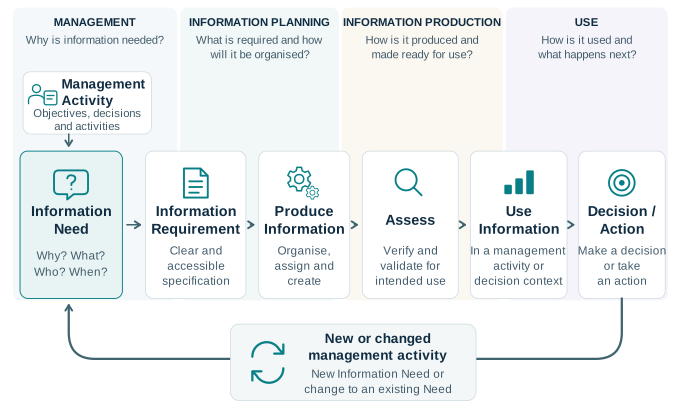
IMC should therefore be understood as a closed management loop, not as a one-way flow ending at delivery. At this level, the causal logic can be expressed as:
Management Activity → Information Need → Information Requirement → Information Production → Delivery → Assessment → Actual Use → Decision or Action → changed management context → new or changed Information Need.
This is a management logic rather than a formal process model. The detailed Information Management Cycle, including planning, appointments, mobilisation, production, delivery, acceptance and information-model continuity, is developed in Chapter 7.
Actual Use may change the management context. A design Decision may alter project conditions; a maintenance intervention may reveal another defect; operating conditions may change; an assumption may prove wrong; an asset may deteriorate; or a regulatory obligation may change. Any of these outcomes may create a new or changed Information Need (Figure 1.5).
Where relevant, the organisation should be able to understand:
- which Management Activity created the Information Need;
- which Information Requirements expressed that Need;
- which information was produced in response;
- how that information was assessed;
- whether and how it was actually used;
- what Decision or Action it supported.
This is a broader meaning of traceability than simply knowing where information is stored or which revision is current. It preserves the management context that explains why the information exists and what it can legitimately support.
Without such traceability, information becomes detached from purpose. Requirements may accumulate without a clear origin, information may be produced simply because established processes expect it, and later users may inherit large volumes of information without knowing which management problem it was intended to address.
With traceability, a later user can understand not only the information itself, but also the Need from which it arose, the Requirements it was intended to satisfy, how it was assessed and how it contributed to subsequent management activity. The same continuity also supports learning: information that is repeatedly produced but rarely used may indicate unnecessary Requirements, while repeated recreation of existing information may reveal opportunities for reuse.
IMC preserves the connection between management purpose, required information, produced information and its Actual Use.
One Logic Across the Asset Life Cycle#
This principle is particularly important in construction because built assets are managed over long periods, through changing circumstances and often by many different organisations.
During asset creation, information may be required to support investment, design, procurement, construction and commissioning. Designers, contractors and specialists produce information in response to applicable Requirements, and that information is assessed and used to support Management Activities associated with the developing asset.
During asset use, owners and operators require information for maintenance, safety, compliance, performance, adaptation and future investment. Existing information may be reused, updated or supplemented through new production.
The activities, participants and technical environments may change, but the underlying IMC logic remains the same:
Management purpose → information demand → governed information → Actual Use.
The same logic therefore applies across different lifecycle stages, asset types, activities and organisational contexts.

This also explains why Information Management cannot be delegated entirely to specialist Information Management roles. Specialists remain important: they may coordinate processes, establish governance arrangements, manage information environments, support compliance and maintain consistency. But they cannot determine every management purpose for every part of an organisation.
The people responsible for projects, assets, finance, safety, design, procurement, construction, operation and maintenance participate in Information Management whenever they define what information is needed, judge whether available information is sufficient, or use information to support a Management Activity.
Information Management is therefore not an isolated specialist function. It is part of the wider management system of the organisation.
Managers do not need to perform specialist Information Management functions themselves. They do, however, need to understand the information on which their Management Activities depend and to be able to judge whether that information is adequate for its Intended Purpose.
The role of IMC is to make these relationships explicit, governed and manageable. The following chapters develop the mechanisms through which this is achieved, beginning with the resource through which related information is organised, connected and understood together: the Information Model.
Information Management in Construction keeps information connected to the management purpose that requires it — from Information Need to Actual Use, and from use back into management.