Information Requirements in the Organisation and Asset Lifecycle
In this chapter 4.1–4.7
4.1. Organisational Sources of Information Requirements#
Information Requirements do not arise in isolation. They reflect the organisation’s objectives, Management Activities, obligations, asset performance and risks. Requirement development should therefore begin with the organisation’s management system rather than with available software, existing data fields or inherited delivery templates.

This applies equally to asset creation and asset use. A project organisation may aim to deliver a new facility within an agreed programme and budget while maintaining quality, safety and readiness for operation. Those objectives create Management Activities concerned with design coordination, programme control, procurement, approval and commissioning. An asset operator may instead aim to improve reliability, reduce lifecycle cost or increase service performance through condition assessment, maintenance planning, performance monitoring and investment decisions.
The contexts differ, but the management logic is the same: organisational objectives are pursued through Management Activities, and those activities create information demand.
Organisational Information Requirements should originate in the organisation’s management system, not in available technology.
Strategies, business plans, policies and obligations are therefore important starting points, but they do not by themselves define all the information the organisation will need. They establish objectives and constraints; concrete information demand also emerges from the people and functions performing Management Activities, from asset performance, from external obligations and from the risks the organisation must control.
What Shapes Organisational Information Demand?#
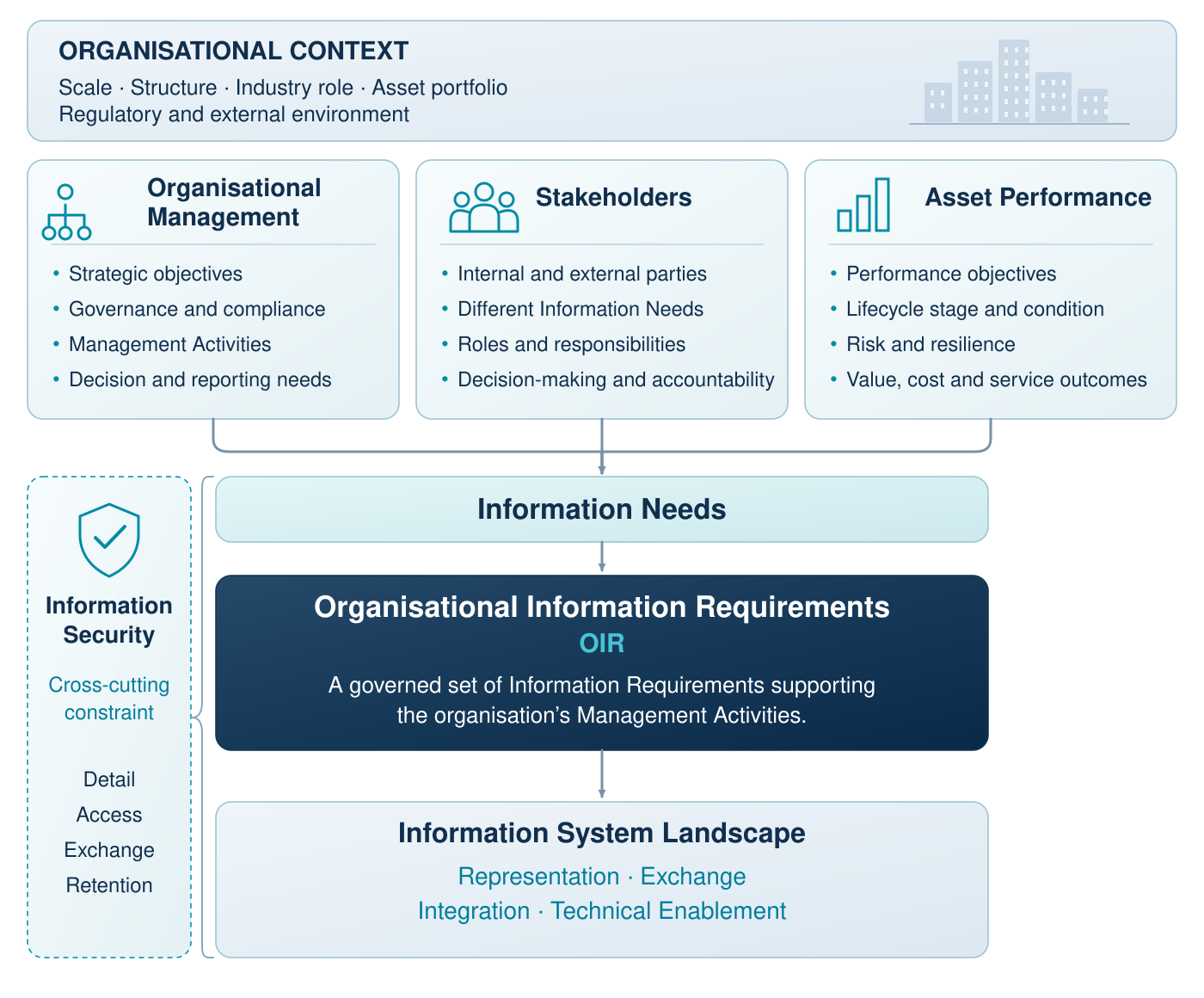
Several connected sources shape organisation-level information demand.
The organisation’s own management system provides the primary context. Strategic, tactical and operational objectives lead to different Management Activities and therefore different Information Needs. A project owner concerned with programme, cost and delivery risk will require different information from an operator concerned with condition, reliability and maintenance; even within one organisation, different functions may depend on different information about the same project or asset.
Stakeholders provide another major source of demand. Internal functions and external parties such as regulators, lenders, insurers or customers may require information for different legitimate purposes. These demands arise from the Management Activities and responsibilities they perform, not simply from their position in an organisational structure. Their detailed identification and reconciliation are examined in § 4.3.
Asset performance also creates information demand. Managing reliability, availability, lifecycle cost, energy use, service capacity, utilisation or financial return requires information that allows performance to be measured, interpreted and acted upon. The relevant measures vary by organisation and asset; the information needed to support them must therefore be identified deliberately.
The resulting Requirements are also shaped by the organisation’s wider context, including:
- organisational scale and structure;
- industry and business role;
- asset and project portfolio;
- regulatory and contractual environment;
- technical maturity and relationships with external stakeholders.
A transport authority, healthcare operator, industrial manufacturer, design consultancy and commercial property owner may therefore apply the same IMC principles while requiring substantially different information. Templates can provide useful prompts, but they cannot substitute for understanding the organisation’s actual Management Activities and management context.
Information Security and Information Systems#
Information Security and Information Systems affect organisational information demand in different ways.
Information Security is a cross-cutting management constraint. A legitimate Need for detailed operational, spatial or technical information does not mean that the information should be produced, exchanged or made accessible without restriction. Applicable Security Requirements may influence the appropriate level of detail, access, exchange conditions and retention of information.
Information Systems play a different role. They enable the Management Activities through which information is produced and used and may impose practical conditions on structure, classification, identifiers, exchange formats or interfaces. An asset-management system, for example, may depend on consistent asset identifiers and maintainable-asset attributes, while project-control systems may require information that can be reliably integrated into programme, cost or reporting processes.
These technical conditions matter, but they should follow the management need rather than define it. The intended direction is:
Management Activity → Information Need → Information Requirement → technical representation and system use,
not:
existing system → available fields → information to be required.
Figure 4.1 brings these influences together.
From Multiple Sources to Organisational Information Demand#
Organisational information demand rarely emerges as one coherent set. It comes from different Management Activities, stakeholders, performance objectives, obligations, risks and operational contexts. Individual demands may therefore overlap, use different terminology, require different timing or even conflict.
The organisation must compare, validate and reconcile these demands while preserving the management purposes that justify them. Unnecessary duplication should be removed, but distinct Receivers, Intended Purposes, timing and provenance should not disappear merely because related information can be produced or used together.
Once these sources of demand have been identified, the next question is how they should be organised and governed as a coherent set of Information Requirements without becoming an exhaustive catalogue of potentially useful information.
That is the role of Organisational Information Requirements — OIR.
4.2. Organisational Information Requirements#
Organisational information demand comes from several legitimate sources, but those sources do not automatically form a coherent organisation-level Requirement context. They may overlap, use different terminology, operate at different levels of management or change at different times. The organisation therefore needs a governed way to organise its Information Requirements while preserving the purposes that gave rise to them.
This is the role of Organisational Information Requirements — OIR. OIR organise the Information Requirements needed to support the organisation’s Management Activities, objectives, obligations, performance, risk and other responsibilities.
OIR are a managed set of organisational Information Requirements, not an inventory of all potentially useful data.
From Organisational Demand to OIR#
OIR should not be created by starting with a catalogue of fields, documents, model attributes or data already available in existing systems. As established in Chapter 3, the governing logic remains:
Organisational objectives → Management Activities → Information Needs → Information Requirements.
OIR then organise the relevant Requirements within an organisation-level context that reflects how the organisation actually manages its business, projects and assets.
Because organisations perform many different Management Activities, the scope of OIR can be broad. Depending on the organisation, Requirements may relate to:
- organisational, financial and investment management;
- project governance and control;
- operation, maintenance and condition assessment;
- procurement and supplier management;
- compliance, safety and risk;
- performance, resilience and business continuity.
These categories are illustrative rather than a universal template. A transport authority may emphasise service continuity, condition and investment planning, while a healthcare operator may place greater weight on availability, safety and compliance. Different organisations can therefore apply the same IMC principles while developing substantially different OIR.
The governing question is not What information could the organisation collect? but What information must it be able to rely on to perform its Management Activities effectively? Whatever the context, each Requirement should remain connected to a legitimate management purpose.
Organising and Governing OIR#
OIR may be organised in different ways according to the organisation’s management system. One useful distinction is between strategic, tactical and operational contexts.
Strategic Requirements may support long-term direction and major investment Decisions; tactical Requirements may support medium-term planning, coordination and resource allocation; operational Requirements may support recurring or immediate activities such as inspection, maintenance and work execution.
These are management contexts, not successive levels through which every Requirement must pass. The same information may support several contexts. Condition information about a critical asset, for example, may inform an operational maintenance Decision, tactical intervention planning and longer-term replacement planning.
Management context | Organisational concern | Example Information Requirement |
|---|---|---|
Strategic | Portfolio investment | Information needed to compare lifecycle performance and risk across major assets |
Resilience and long-term planning | Information needed to identify critical dependencies and future investment priorities | |
Tactical | Maintenance planning | Condition, failure and intervention information needed to prioritise expenditure |
Budget allocation and risk control | Forecast asset cost, planned work and risk information needed to allocate resources | |
Operational | Inspection and compliance | Current inspection status, findings and evidence needed to demonstrate applicable conditions |
Maintenance execution | Asset identity, location, access and current technical information required to perform work |
OIR may be represented through a controlled document, requirements register, database or digital requirements-management environment. As established in Chapter 3, however, the representation is not identical to the managed Requirements it contains.
OIR are governed Requirement Set Versions. This allows organisation-level information demand to change without losing the identity, history and provenance of the individual Requirements involved. A new regulation may introduce a compliance Requirement; a revised maintenance strategy may change operational information demand; an existing Requirement may be refined, superseded or cease to apply.
OIR should therefore be maintained rather than prepared once and left unchanged. Strategies evolve, assets are acquired or disposed of, responsibilities change, regulations are revised and new Management Activities emerge. The organisation’s governed information demand must be able to evolve with them.
Information Value and the Golden Thread#
Because OIR span many Management Activities, there is a natural temptation to make them increasingly comprehensive. Chapter 1, however, established that information has a cost to produce and maintain, while its value depends on use. At organisation level, the objective is therefore not to maximise information volume, but to require information that supports legitimate Management Activities and to preserve it where continuing value justifies doing so.
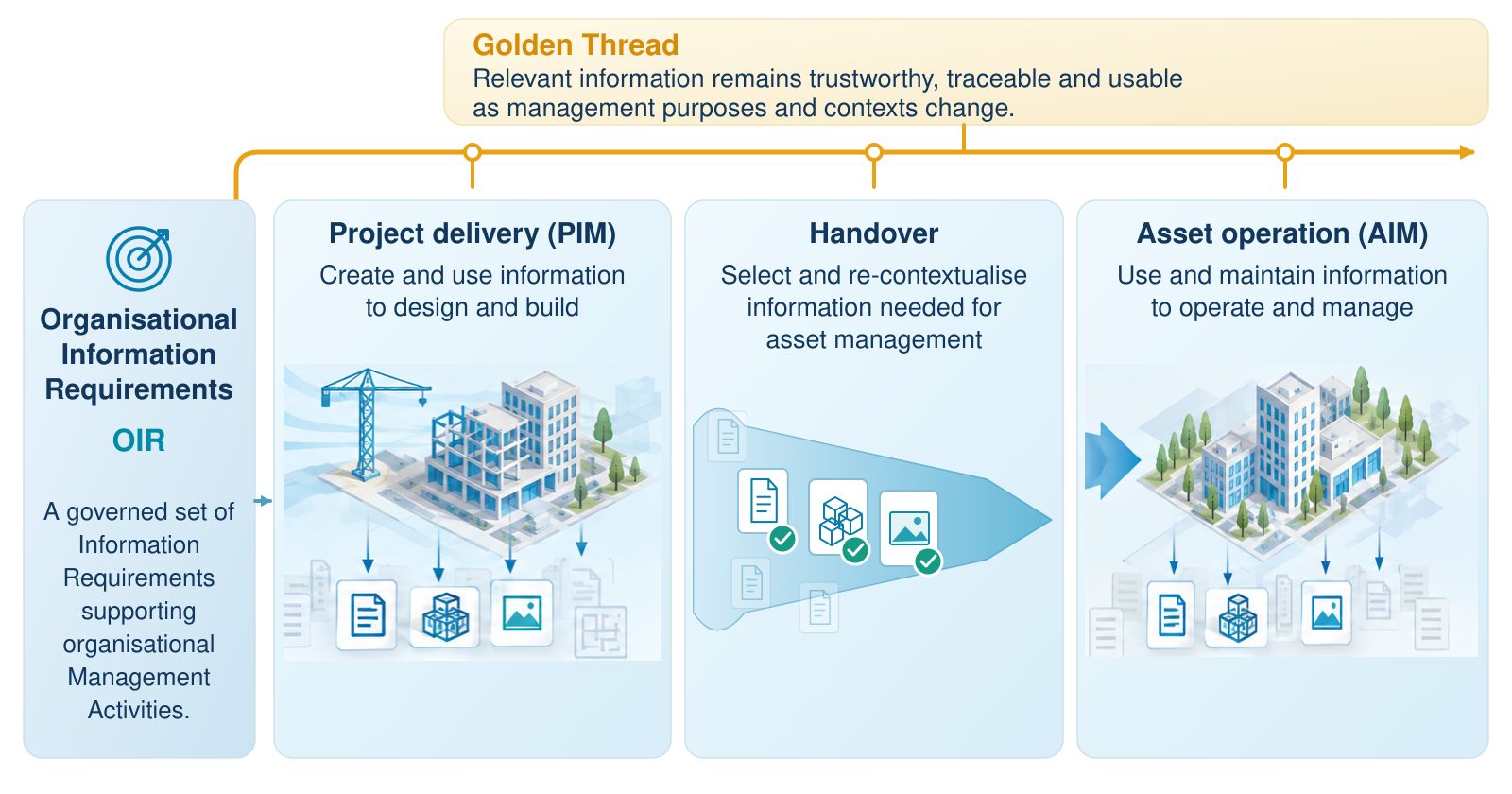
This relationship between purpose and continuing value leads to the Golden Thread of Information. The Golden Thread is not an ever-growing archive of everything that has ever been produced. It is the continuity of information that remains relevant, trustworthy, traceable and usable as Management Activities and contexts change.
In IMC terms, this continuity can be considered through the chain:
Information Need → Information Requirement → produced information → assessment → Actual Use.
Information created during a project may later support operation, maintenance, refurbishment or regulatory review. Operational information may in turn support investment Decisions or contribute to the information context for a new project. What matters is that information with continuing management value remains understandable and usable while its purpose and provenance remain traceable.
The Golden Thread preserves valuable information continuity; it does not justify keeping everything.
Figure 4.2 uses project-to-asset continuity as one example of this broader lifecycle principle.
The Golden Thread should also be distinguished from Level of Information Need. LoIN specifies the characteristics that make information sufficient for a defined Information Need and Intended Purpose; the Golden Thread concerns continuity where information retains management value across time or changing contexts.
OIR provide the governed organisation-level context for this information demand, but much of that demand becomes visible through the people and functions performing Management Activities. Understanding how OIR are developed therefore requires a closer examination of how stakeholder Information Needs are identified, expressed and reconciled.
4.3. Stakeholder Information Requirements#
An organisation may maintain clear objectives and governed OIR, but much of its concrete information demand becomes visible through the Management Activities performed by people, teams and organisational functions.
A maintenance manager, finance function and regulator may all require information about the same asset, but for different purposes: to plan an intervention, forecast expenditure or demonstrate compliance. The information they use may overlap, but the Management Activities and Intended Purposes creating the demand remain distinct.
An organisation should therefore not be treated as a single homogeneous Information Receiver. Its information demand is distributed across the stakeholders who make Decisions, perform work, manage risk and fulfil obligations.
Stakeholder Information Requirements should reflect real responsibilities and Management Activities, not organisational labels alone.
From Stakeholder Activity to Information Demand#
Stakeholders may be internal or external to the organisation. Internal stakeholders include managers, specialists, teams and functions involved in project delivery, operation, maintenance, finance, procurement, safety and compliance. External stakeholders may include regulators, lenders, insurers, customers, suppliers, users and other organisations with legitimate information interests.
What matters is not simply where a stakeholder appears on an organisational chart, but which Management Activity, Decision or responsibility creates the information demand.
A job title may encompass several Management Activities, while the same activity may involve several people or functions. The Receiver of an Information Need should therefore normally be identified through a stable role, team or organisational function rather than through the name of a particular individual.
A property manager, for example, may manage warranties, respond to incidents, monitor contractual commitments and report against performance objectives. Each activity may create a different Information Need. Recording only “Property Manager” in a requirements register says little about what information is required or why.
A useful elicitation formulation is:
As [role or function], I need [information or capability], so that [management purpose].
For example:
As a maintenance manager, I need to know the current condition and failure history of critical equipment so that I can prioritise maintenance interventions.
Or, in a project context:
As a project manager, I need to know which design packages have been approved and which critical interfaces remain unresolved so that I can determine whether the project is ready for the next milestone.
The formulation deliberately uses management language. Its purpose is to expose the Receiver, information demand and Intended Purpose before technical specification begins; it is not the final Information Requirement.
Eliciting and Structuring Stakeholder Requirements#
Stakeholders usually understand their Management Activities better than they understand formal Information Requirement structures. Asking immediately for metadata fields, file formats, model attributes or software-specific outputs is therefore often the wrong starting point.
Information Needs can be explored through interviews, workshops, questionnaires, analysis of recurring Management Activities, reviews of Decision points, and examination of regulatory or reporting obligations. The appropriate method depends on the organisation and the number and diversity of stakeholders involved.
Whatever method is used, the purpose of elicitation is to clarify stakeholder information demand, not to invent it on the stakeholder’s behalf. Useful questions include:
- Who needs the information, and which Management Activity or Decision must it support?
- What information is needed?
- Why is it needed — what is the Intended Purpose?
- When is it needed, or what event creates the Need?
- What are the consequences if the information is unavailable, unreliable or late?
As established in Chapter 3, an elicited Information Need is not yet a complete Information Requirement. The next step is to formalise that demand sufficiently for production and assessment while preserving its management purpose and provenance.
A practical readiness check is therefore simpler than repeating the full Requirement structure. Before a stakeholder demand is incorporated into a governed Requirement Set, it should be possible to determine:
- the Receiver and relevant Management Activity;
- the Intended Purpose;
- the information required;
- the applicable timing, frequency or Trigger Event;
- whether the Requirement is sufficiently specific and assessable.
A valid Information Need may still require clarification before it is ready to govern information production.
Technical conditions should then be added only where they are justified by the Intended Purpose. File formats, schemas, classifications, systems or presentation methods may legitimately constrain a Requirement, but they should not replace the management problem that made the information necessary.
An operations team, for example, may require structured information that can be imported into an asset-management system. In that case, the structure and exchange conditions have a clear operational justification. Requiring a particular technical output merely because it was used on a previous project does not.
This distinction also leaves Information Providers appropriate freedom to select efficient production methods. A Requirement should define the required information and necessary constraints without prescribing the production solution more tightly than its Intended Purpose requires.
The variety of stakeholder information demand is illustrated in Table 4.2.
Stakeholder / role | Information demand | Management purpose |
|---|---|---|
Project manager | Approved design status, unresolved interfaces and key dependencies | Determine readiness for a project milestone |
Commercial manager | Quantities, committed cost and forecast changes | Assess cost exposure and update the commercial forecast |
Maintenance manager | Asset condition, failure history and planned maintenance information | Prioritise interventions and reduce unplanned downtime |
Operations team | Operating limits, system status and relevant technical instructions | Operate the asset safely and reliably |
Finance function | Utilisation, operating cost and forecast expenditure | Support budgeting and investment decisions |
Safety / compliance function | Inspection status, hazards and compliance evidence | Control risk and demonstrate compliance |
The examples in Table 4.2 also show that stakeholder Requirements are not defined by a particular information format. What matters is the governed connection between the information, the Receiver, the Management Activity and the Intended Purpose.
Reconciling Stakeholder Requirements#
Elicitation rarely produces a neat set of unique Requirements. Different stakeholders may use different terminology, see only part of the wider management context, or require related information at different times and for different purposes. Their Requirements may therefore overlap, duplicate one another or conflict.
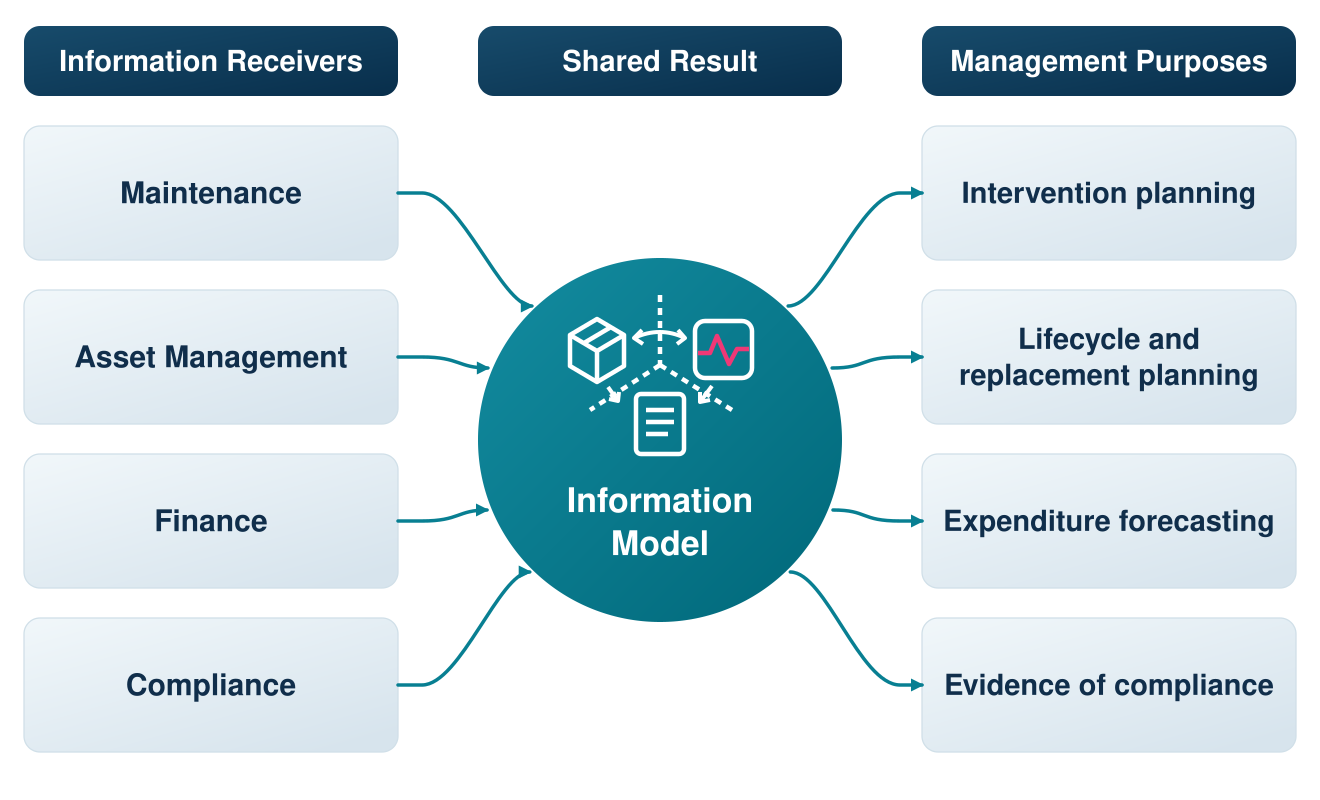
Consider a structural inspection. Its findings may be required by maintenance to plan an intervention, by asset management to consider longer-term replacement, by finance to forecast expenditure and by a regulator or compliance function as evidence. Producing the same information independently for each purpose would be wasteful. Treating all those purposes as one anonymous Requirement would lose equally important management context.
The organisation therefore needs to compare stakeholder Requirements and determine where common information can be produced and reused while preserving the provenance and Intended Purpose of each legitimate demand.
A practical reconciliation sequence is:
identify → compare → clarify → consolidate → reconcile → prioritise.
Consolidation should remove unnecessary technical duplication without erasing who needs the information, why it is required, when it is needed or which Management Activity depends upon it.
Shared information may satisfy several stakeholder Requirements without erasing their distinct management purposes.
Not every conflict can be resolved through consolidation. Stakeholders may require different timing, levels of detail or access conditions, or may disagree about whether the value of particular information justifies the effort required to produce and maintain it. Information Management should make these differences explicit and governable; decisions about organisational priority remain management decisions.
Stakeholder Requirements therefore contribute to OIR rather than forming a separate Requirement architecture. They originate in real Management Activities, are structured so that they can be governed and assessed, and are reconciled with other legitimate organisational information demand.
The same logic must then be applied within more specific management contexts. A project creates its own objectives, Decisions, constraints and timing and therefore its own Information Requirements — Project Information Requirements.
4.4. Project Information Requirements#
A project may produce hundreds of drawings, models, schedules and reports and still leave its managers unable to make an important Decision.
Consider a project approaching a major design approval. Considerable information may already exist, yet the Decision cannot be made if critical interfaces remain unresolved, cost implications are unclear, required assessments are incomplete or the relevant information has not been assembled in a form that can be reviewed. The problem is not necessarily a shortage of information, but a failure to connect information production with the Management Activities and Decisions that the information must support.
A project creates its own management context through its objectives, scope, programme, constraints, participants and Decisions. These conditions generate project-specific Information Needs and Requirements.
Project Information Requirements — PIR — organise the Information Requirements needed to support Management Activities and Decisions within a defined project context. They provide the governed project-level Requirement Set context against which required information can be planned, produced, delivered and assessed.
Start with Project Decisions#
PIR should begin with what the project must manage, understand and decide rather than with a predetermined list of documents or digital outputs.
A project may need to determine whether a design is sufficiently developed, whether critical interfaces have been coordinated, whether procurement can proceed, whether information is ready for construction, whether cost and programme remain acceptable, or whether a system is ready for commissioning. Each of these Management Activities and Decisions creates information demand.
The distinction in starting point is important:
- What documents do we normally deliver at this stage? begins with established production habits.
- What must we be able to understand, assess or decide at this point in the project? begins with management purpose.
The Project Plan provides important context because its objectives, scope, programme, organisational arrangements and key stages indicate what must be managed. PIR may also draw on:
- key project Management Activities and Decisions;
- Information Needs of the organisation managing the project;
- legitimate Information Needs of other project stakeholders and participants;
- relevant organisational Requirements;
- known future asset-management Needs that the project must help satisfy;
- Information Delivery Milestones and other timing constraints.
These sources interact. An organisation-level Requirement may become applicable within a project, while information produced during the project may also have continuing value for future asset management. This does not make PIR a more detailed form of OIR or an early version of AIR. PIR organise Requirements within a distinct project-management context.
For significant Decisions, information planning should therefore work backwards from the intended management outcome to determine what information must be available to support it. This helps distinguish genuine project information demand from Requirements copied from earlier projects simply because they have become customary.
From PIR to the PIM#
PIR connect project-management demand with the information that contributes to the Project Information Model — PIM. The relationship can be expressed as:
Project Management Activity → Information Need → Information Requirements organised within PIR → governed information in the PIM.
The PIM is not the starting point from which Requirements are derived. As established in Chapter 2, it is the governed Information Model through which project information becomes available for management, coordination, assessment and Decision-making.
The information within the PIM may take different forms and may be created, maintained or accessed through different Information Systems. Those technical arrangements matter, but they follow the management purpose. The governing question remains whether the information is sufficient and suitable for the Management Activity or Decision it is intended to support.
Table 4.3 illustrates this management perspective.
Management question | Information needed | Possible PIM context |
|---|---|---|
Can the design proceed to approval? | Design status, unresolved issues, interfaces and compliance evidence | 2D/3D information, calculations, review records and issue status |
Are we ready to procure? | Approved scope, quantities, specifications, interfaces and constraints | Specifications, structured quantities, geometric information and schedules |
Can construction start? | Approved information, access conditions, sequencing, dependencies and outstanding risks | Construction information, programme, coordination and risk information |
Are we still within budget? | Quantities, commitments, changes and forecast information | Cost information, quantity data and approved changes |
Can the system be commissioned? | Completion status, test results, unresolved defects and operating information | Test records, system data and completion information |
Can we move to the next project stage? | Evidence that defined conditions and preceding decisions have been satisfied | Relevant federated information, assessments and Decision records |
The PIM does not replace professional judgement or the Information Systems through which individual project activities are performed. Its role is to provide a governed information context upon which those people, activities and systems can rely.
The PIM is a management resource for project Decisions, not merely a record of information production.
A Changing Project, a Changing PIM#
A project does not require the same information from beginning to end. Early Decisions may depend on contextual information, surveys, assumptions, feasibility studies and high-level technical or financial assessments. Later Decisions may require developed design information, procurement information, construction records, test results and completion evidence.
The PIM therefore evolves as the project’s Management Activities and Decisions evolve. This is not simply a process of accumulating more information. Information may be added, refined, superseded, assessed or cease to be relevant to the current project context. An early assumption may be replaced by an approved technical solution; design information may later be supplemented by installation and commissioning evidence.
As established in Chapter 2, the PIM is also federated: different production scopes contribute information at different times, and one activity may depend on information produced elsewhere.
Not all project information demand can be fully anticipated at the outset. Legitimate Information Needs may emerge as work progresses. Design may reveal a need for additional survey or interface information; construction planning may require further logistics or sequencing information; specialist work may depend on information that must first be produced elsewhere.
Such emerging Needs do not bypass the Requirement architecture. They must be recognised, clarified and incorporated into the governed project information demand where they are legitimate.
Information produced for one purpose may also support another Management Activity where its meaning, status and suitability are understood. Reuse can reduce unnecessary information production without erasing the distinct purposes for which the information is required.
The production relationships through which Requirements are allocated, refined and satisfied are examined in § 4.7, while their organisational governance is introduced in Chapter 5. For now, the important point is that the PIM evolves as a federated management resource, not as a static package assembled at the end of the project.
Plan Information Backwards from the Decision#
Determining what information is required is only part of project information management. The information must also become available early enough to be reviewed, assessed and used.
Suppose a key design Decision is scheduled for Friday. Delivering the required information on Friday morning may satisfy a nominal delivery date while still making sound Decision-making impossible. The Receiver may need time to review the information, assess it against applicable Requirements, identify deficiencies and obtain clarification or correction.
Information planning should therefore work backwards from the Decision. The management reasoning is:
What must be decided? → What must be known? → What information will provide sufficient evidence? → When must that information be available?
The corresponding sequence is:
information production → delivery → review and assessment → Decision.
An Information Delivery Milestone and the Decision it supports are therefore related but distinct events. The milestone establishes when the required information must be available to the Receiver. The Decision occurs only after sufficient time has been allowed for review and assessment of that information.
Information must be delivered early enough to be assessed before the Decision it is intended to support.
Figure 4.4 expresses this planning logic visually.
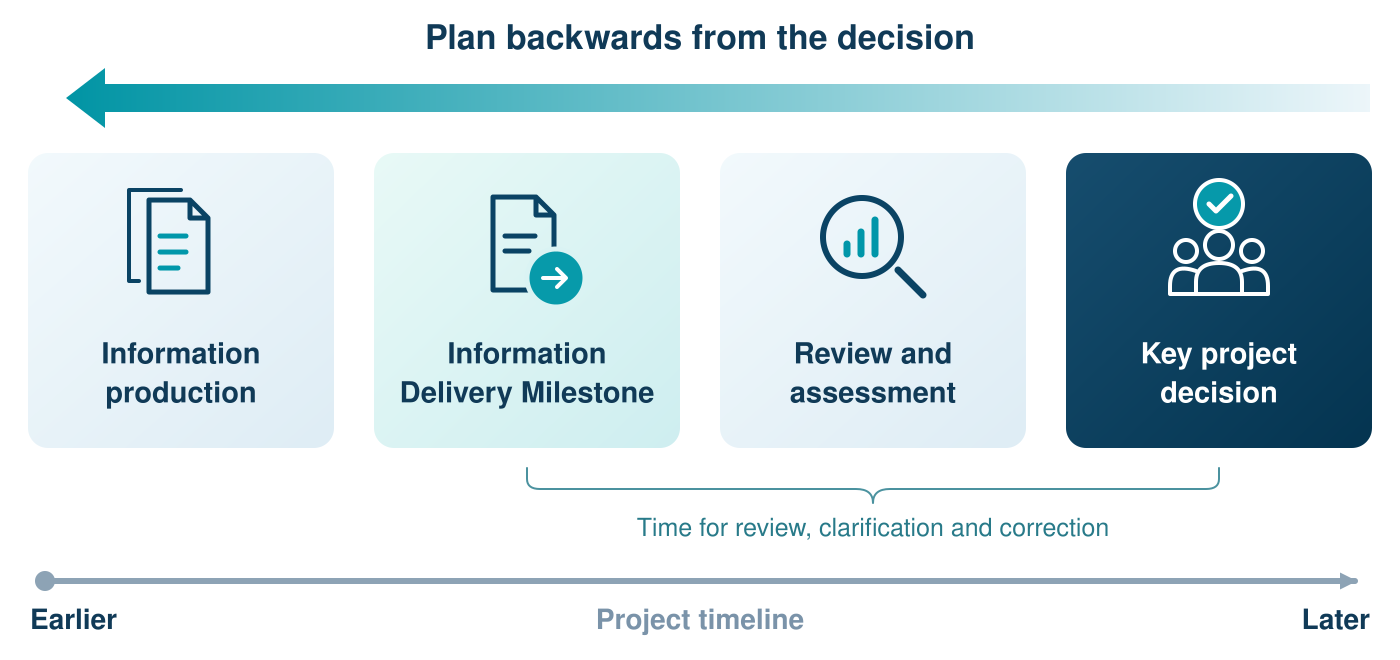
The interval between delivery and Decision will depend on the nature of the information, the complexity of the assessment, dependencies between information sources and the consequences of error. Assessment time should therefore be planned deliberately rather than treated as something that happens after delivery if time remains.
Information That Remains Valuable Beyond the Project#
A project eventually ends, while the asset it creates or changes may continue to be managed for decades. This raises an additional question for project information planning: which information produced during the project must remain useful after the project context has ended?
The answer is not to retain everything in the PIM. Some information serves temporary project purposes such as tender evaluation, design coordination, construction sequencing, temporary works or internal project control. Other information may have continuing value because it supports future operation, maintenance, compliance, performance assessment or other asset-management activities.
Where future asset-management Information Needs are already known, they should influence project information production while the relevant knowledge, evidence and production capability are still available.
Project value and continuing asset-management value are nevertheless different. Information should not become part of the continuing asset information context simply because it was important during project delivery. Its future relevance depends on the Management Activities and Decisions it will need to support after the project.
The transition can therefore be framed by a simple question:
What information will the organisation need in order to manage the asset after the project context has ended?
That question leads from Project Information Requirements to Asset Information Requirements.
4.5. Asset Information Requirements#
Projects have defined beginnings and endings. Asset management is different. An asset may remain in use for decades while its physical condition, operational status, organisational purpose, regulatory environment and management priorities change repeatedly.
The information required to manage the asset must therefore support the Management Activities performed in relation to it over time, not merely describe its physical characteristics.
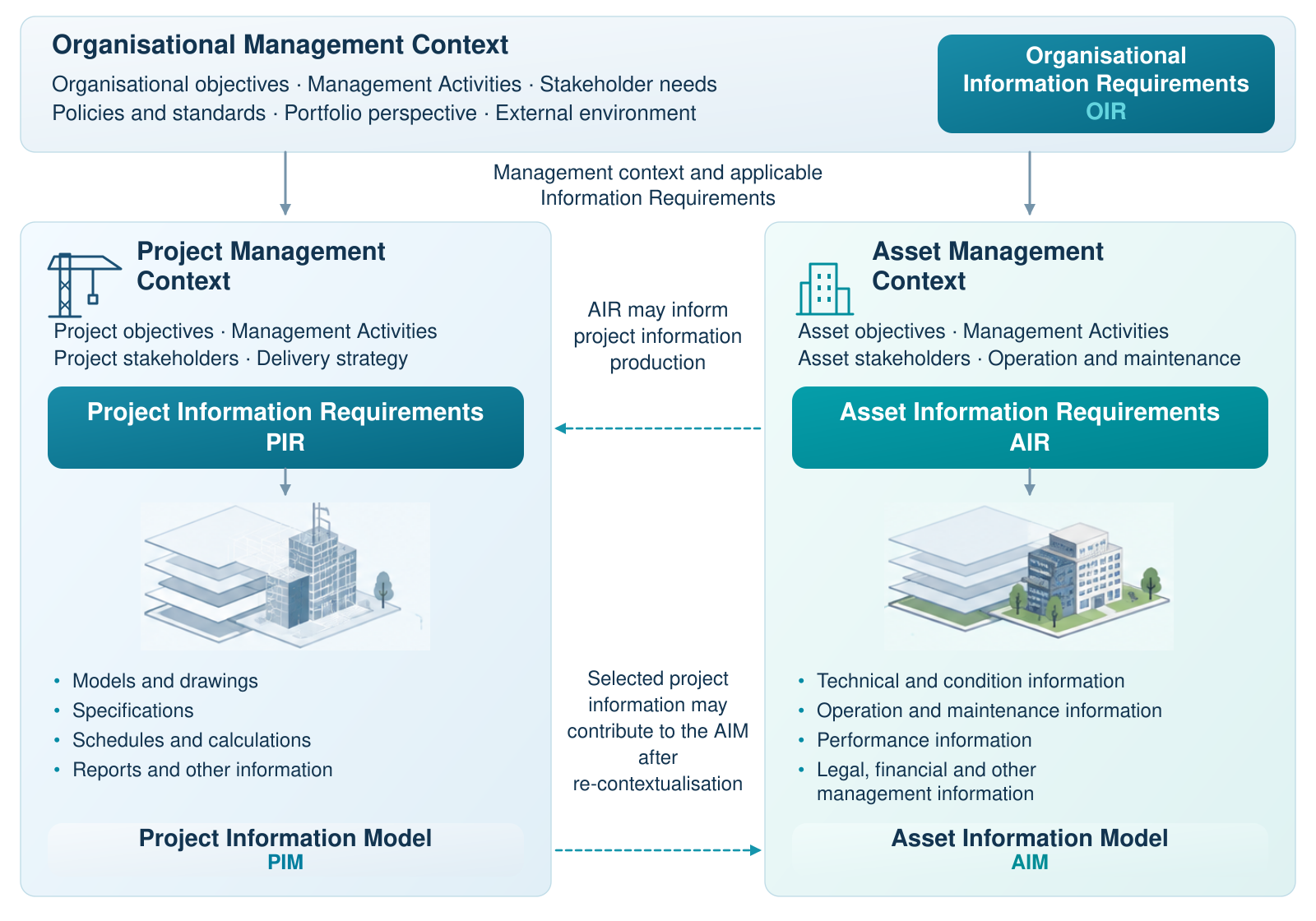
Asset Information Requirements — AIR — organise the Information Requirements needed to support Management Activities associated with a particular asset or defined group of assets within a governed asset-level Requirement Set context. The information produced to satisfy those Requirements may contribute to the Asset Information Model — AIM.
PIR and AIR are parallel, interacting Requirement Set contexts. PIR organise information demand arising from the project management context; AIR organise information demand arising from the management of assets. They may influence one another, but neither is a stage through which the other passes.
Figure 4.5 shows this relationship.
The central management question is therefore:
What information must the organisation be able to rely on in order to manage the asset effectively over time?
The AIM contains governed information associated with the asset and its management, not only information describing the physical asset itself.
From Management Activities to AIR and the AIM#

When organisations first consider asset information, it is tempting to begin with available data: geometry, equipment characteristics, inspection results, maintenance records or sensor measurements. All may be useful, but availability alone does not establish that information should be systematically governed within the AIM.
The starting point should instead be the Management Activities the organisation intends or is required to perform. These may include operation, maintenance, inspection, compliance, safety and risk management, performance assessment, financial planning, investment appraisal, refurbishment, change of use, acquisition or disposal.
The management logic is:
Management Activity → Information Need → Information Requirements organised within AIR → governed information in the AIM.
The same asset may support very different Management Activities. Maintaining a ventilation unit may require technical characteristics, maintenance history and access information. Deciding whether to replace it may additionally require failure history, remaining life, energy performance and lifecycle cost. Deciding whether a building should be refurbished, repurposed or sold may require legal, commercial, financial, occupancy and market information.
The asset provides the common context, but the information required to manage it can extend far beyond its physical characteristics.
The extent of systematic information management should also be proportionate to the asset and its management context. Relevant considerations may include:
- organisational importance, criticality and consequences of failure;
- safety, regulatory and security obligations;
- asset condition, complexity and expected life;
- frequency and significance of relevant Management Activities;
- consequences of incomplete, inaccurate or unavailable information;
- expected management value compared with the cost of maintaining the information.
Similar assets may share common Requirements, with additional or refined Requirements introduced where individual assets differ in risk, condition, use or management importance.
AIR are therefore developed from the Management Activities and legitimate information demand associated with the asset. Their sources may include organisational Requirements, stakeholder Needs, asset-management plans, recurring operational and maintenance activities, performance measures, legal obligations, risk, financial considerations and existing asset information.
The result should not be an unrestricted catalogue of everything that might conceivably be known about an asset. Each Requirement should remain connected to an Intended Purpose and a legitimate Receiver.
Table 4.4 illustrates the breadth of information that may form part of an AIM.
Information context | Examples |
|---|---|
Technical and spatial | Configuration, characteristics, 2D/3D information, system relationships, capacities, operating limits |
Operation and maintenance | Maintenance requirements, inspection history, failures, work records, warranties, spare parts, access requirements |
Performance | Condition, energy use, reliability, utilisation, service performance, KPI results |
Legal and regulatory | Applicable obligations, permits, inspection requirements, restrictions, compliance evidence |
Safety and risk | Hazards, risk information, safety constraints, emergency information, resilience requirements |
Organisational and managerial | Responsibilities, management plans, policies, planned interventions, Management Decisions |
Financial and commercial | Lifecycle costs, budgets, investment assumptions, relevant commercial or valuation information |
Historical and evidential | Significant changes, assessments, Decisions, provenance and information required to understand previous asset states |
The table is illustrative rather than exhaustive. Information belongs within the governed asset information context because there is a management reason to maintain, relate, assess and use it — not merely because it can be associated with the asset.
The AIM may span several Information Systems. Engineering information, maintenance records, legal information, operational measurements and financial information may be maintained in different technical environments. As established in Chapter 2, the unity of an Information Model depends on governed identity, meaning and relationships rather than physical co-location in a single application.
Trigger Events and Keeping the AIM Current#
The AIM does not remain current automatically. Changes to the asset, its status or the wider management context may make existing information, Information Needs or Requirements no longer current or sufficient.
A Trigger Event is an event indicating that such a change may have occurred and that the affected management and information context should therefore be reviewed.
A Trigger Event may relate to:
the asset — for example, deterioration, damage, modification, repair or replacement;
its status — for example, restriction of use, transfer, acquisition or withdrawal from service;
its management context — for example, new legislation, revised organisational plans, changed contractual obligations, risk assumptions or material market conditions.
The third category is particularly important. The physical asset may remain unchanged while the information required to manage it changes. New legislation may introduce a compliance obligation; a revised organisational strategy may change the intended use of a property; changing market conditions may alter the basis for an investment Decision.
A Trigger Event does not automatically create a new Management Activity, project or information-production activity. It indicates that the organisation should review what has changed and determine whether existing Information Needs, Requirements and governed information remain appropriate.
The logic can therefore be expressed simply as:
Trigger Event → review asset / status / management context → review affected Information Needs, Requirements and information → determine whether a response is required.
A Trigger Event prompts review; it does not predetermine the management or information-production response.
Sometimes the existing information remains sufficient. Sometimes a limited update is required. In other cases, the event creates substantial new information demand or contributes to the need for a new project.
Planning the Response to Trigger Events#
Recognising a possible Trigger Event and preparing a response to it in advance are different management decisions.
Some events are sufficiently foreseeable, significant and time-sensitive that advance preparation is justified. Planned inspections, statutory examinations, major maintenance or scheduled replacement may require information to become available quickly once the event occurs. In such cases, relevant Requirements and information-management arrangements can be prepared beforehand.
Other foreseeable events may be too rare, uncertain or low-risk to justify maintaining a dedicated response capability. The organisation may deliberately wait until the event occurs and then determine whether existing information remains sufficient or whether additional Requirements and production arrangements are needed. Truly unforeseen events — such as an accident, unexpected failure or sudden external change — may provide no opportunity for event-specific preparation.
Table 4.5 summarises these alternatives.
Trigger situation | Before the event | After the event |
|---|---|---|
Foreseen and worth planning | Relevant Requirements and information-management arrangements are prepared in advance | Information production or update can begin promptly where required |
Foreseen but not worth planning in advance | Event is recognised, but no dedicated response arrangement is maintained | If review identifies new information demand, the required arrangements are established after the event |
Unforeseen | Event-specific preparation is normally impractical | If new information is required, the necessary Requirements and production arrangements are established after the event |
Where advance preparation is justified, Information Delivery Milestones may be defined relative to the Trigger Event rather than by arbitrary calendar dates — for example, within a defined number of working days after an inspection or repair.
The appropriate degree of preparation depends on probability, consequences, urgency, organisational capability and the cost of preparedness. Excessive preparation can consume resources without corresponding value; insufficient preparation can delay critical information when management needs it most.
The response should therefore be proportionate to the value, risk, urgency and complexity of the information demand.
Part II examines how Provider relationships are organised and information production is planned. At this stage, the important point is that planning for a Trigger Event is a management choice, not a requirement to prepare a complete production structure for every conceivable event.
Acquiring an Asset with an Existing AIM#
When an organisation acquires or leases an asset with an existing AIM, it receives information that was produced and governed within another management context. Acquisition or lease therefore represents a particular type of Trigger Event.
The immediate task is not to recreate that information, but to determine whether the existing AIM is suitable for the Management Activities and AIR of the acquiring organisation.
Relevant questions include:
- Does the existing information satisfy the organisation’s AIR?
- Are its provenance, status and reliability sufficiently understood?
- Which information remains current and applicable?
- Which Requirements, obligations or Intended Purposes have changed?
- What information must be supplemented, reclassified or otherwise re-contextualised before it can be relied upon?
An existing AIM does not automatically become suitable merely because it accompanies the asset. The relevant information standards, classifications, permissions, policies, risk assumptions, responsibilities and Intended Purposes may differ even where the physical asset itself remains unchanged.
The appropriate approach is therefore assessment and re-contextualisation rather than automatic adoption. Information that already satisfies the applicable Requirements should be reused; identified gaps or incompatibilities may require existing Requirements to be revised or new Requirements to be established.
AIR Across Project Contexts#
AIR do not begin when a project ends, and PIR do not replace them while a project is under way.
An organisation may maintain AIR for an existing asset long before any project is contemplated. A later Management Activity — for example, responding to repeated equipment failure, improving performance or changing the use of a building — may create a project context with its own Management Activities and PIR.
Relevant AIR may influence the information the project must produce for future asset management, while PIR also contain Requirements arising specifically from the management and delivery of the project.
AIR and PIR therefore remain distinct, interacting Requirement Set contexts rather than successive stages of one Requirement hierarchy.
When the project ends, some project information may retain continuing management value and contribute to the asset information context, while other information remains relevant only to the completed project.
This interaction raises a broader lifecycle question: how do distinct Requirement and Information Model contexts recur and interact as assets are operated, maintained, changed and periodically subject to new projects?
That is the focus of § 4.6 — Requirements Across the Lifecycle.
4.6. Requirements Across the Lifecycle#
Project and asset information management should not be understood as two consecutive phases connected by a single handover. Projects begin and end, while organisations may manage assets through repeated periods of operation, inspection, maintenance, modification, investment and eventual disposal.
The AIM provides a continuing governed information context for asset management. Particular projects may arise within that wider context when the organisation needs to create, renew, modify or otherwise intervene in an asset. Each project establishes its own Management Activities, PIR and PIM without replacing the continuing asset-management context.
Lifecycle Information Management is therefore recurrent. Management conditions change, Information Needs and Requirements may change with them, and information that was suitable in one context may need to be reviewed in another.
Requirements Recur as Management Conditions Change#
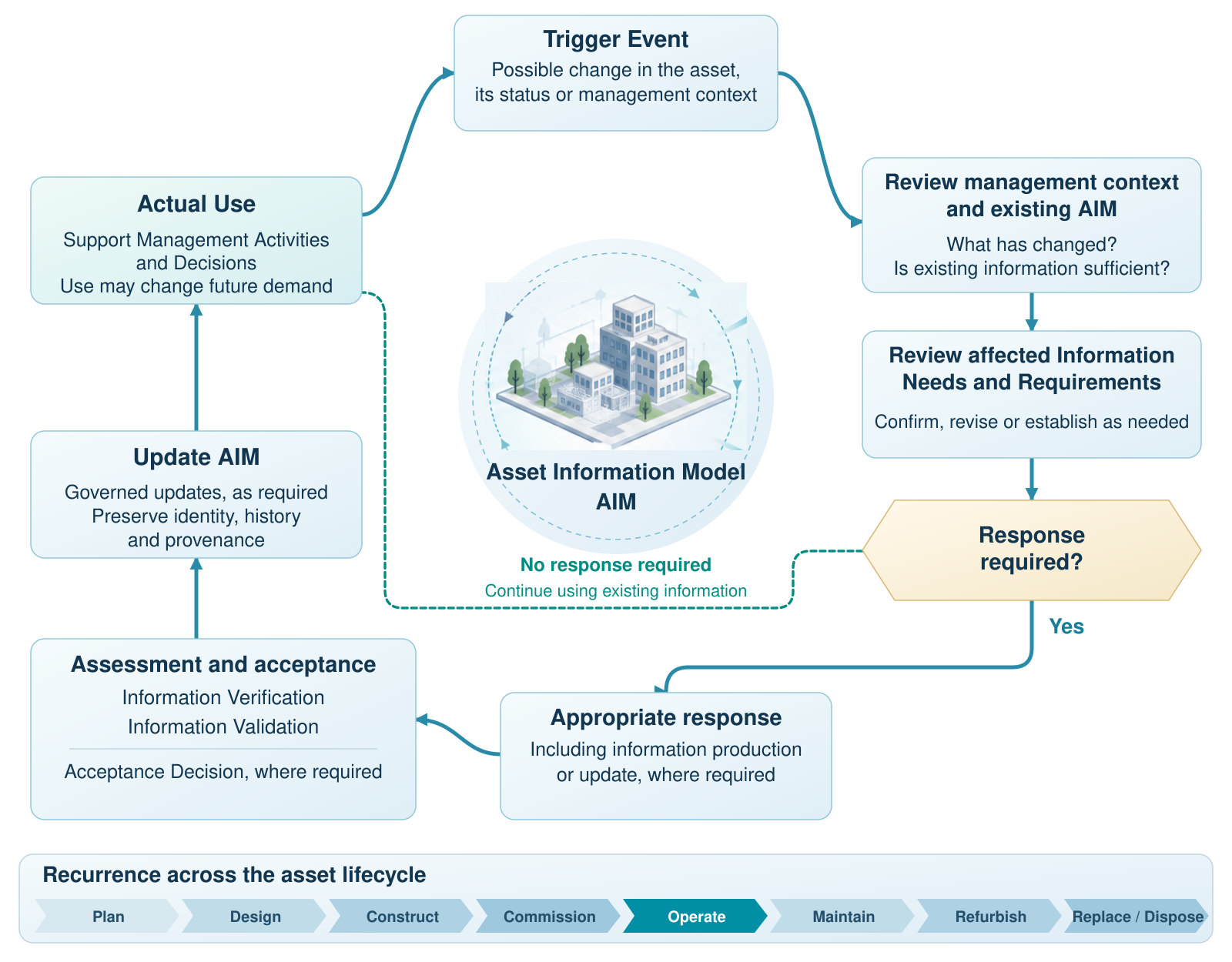
As established in § 4.5, a Trigger Event may indicate that the asset, its status or its management context has changed. The first response is not automatically new information production, but a review of whether existing Information Needs, Requirements and governed information remain current and sufficient.
The recurring logic can be expressed simply as:
Trigger Event → review affected Information Needs, Requirements and information → determine and execute an appropriate response where required.
A Management Decision or Action may itself change the asset, its status or its management context and thereby create new Information Needs or alter existing Requirements. Information demand can therefore recur without following one fixed beginning-to-end sequence.
Figure 4.6 illustrates how changing management conditions can repeatedly create reasons to review, confirm or revise information demand over the life of an asset.
This recurrence also explains why lifecycle information cannot be limited to the physical description of an asset. A regulation, risk assumption, management plan, commercial condition or intended use may change even when the physical asset does not. If such a change affects a Management Activity, it may also change the information required to perform that activity.
When Asset Management Creates a Project#
Not every change in an asset-management context requires a project. Routine maintenance, periodic inspection or a regulatory update may be handled within continuing asset-management arrangements. Other situations — such as repeated failures, major refurbishment, replacement of a technical system, an extension, change of use or a significant performance-improvement programme — may create a distinct project context.
Consider a technical system whose failure history and lifecycle cost have become unacceptable. Information in the AIM may support an asset-management Decision to investigate replacement. That Decision may establish a project context with its own Management Activities concerned with options, design, cost, procurement, installation and commissioning. Those activities create their own Information Needs and PIR.
The relationship can be expressed as:
Asset-management Need or Decision → Project Context → project Management Activities → PIR.
A project may therefore originate from an asset-management Need without its Requirements simply being AIR converted into PIR. Relevant AIR may influence the information the project must produce for future asset management, while PIR also contain Requirements arising specifically from planning, coordinating and delivering the project.
Over the life of an asset, this pattern may recur several times. One continuing asset-management context may interact with several successive project contexts and PIMs while remaining distinct from each of them.
Closing a Project: Preserve, Select and Re-contextualise#
When a project ends, its information-management context must also be deliberately closed. This means more than transferring a final package of files. Project information may need to be preserved for different reasons: some records what happened during the project, some retains continuing value for asset management, and some has only temporary project, contractual or evidential value.
Table 4.6 illustrates these different futures.
Future of the information | Management purpose |
|---|---|
Project history | Preserve evidence of what was produced, assessed, changed and decided during the project |
Continuing asset information | Support future operation, maintenance, inspection, compliance, performance management, investment or later change |
Temporary project information | Retain only for as long as required for project, contractual, legal or evidential purposes |
These categories may overlap. Information required for future asset management may also remain important as part of project history. The distinction concerns why the information continues to be governed, not simply where a file is stored.
Closing the PIM as a completed project information context should also be distinguished from individual Container Revisions reaching an Archived state during the project. Individual Revisions may become historical while the project continues; closing the PIM concerns the completed project information context as a whole.
Project-to-asset continuity should not be understood as a pipeline in which the PIM simply becomes the AIM. The two Information Models support different Management Activities and are governed under different Requirement contexts. Much project information has no continuing asset-management purpose, while information that does remain valuable may need to be governed differently after project completion.

Consider an equipment record created during the project containing manufacturer, type, capacity, serial number and maintenance characteristics. Its technical content may remain valid after commissioning, but within the asset-management context it may become subject to different Requirements, classifications, responsibilities, access arrangements or update rules.
Re-contextualisation is the process of preserving information with continuing management value and its provenance while governing it according to the new management context in which it will be used.
Project-to-asset continuity preserves valuable information and its provenance while adapting it to the management context in which it will subsequently be used.
This distinction also affects Information Container identity. A governed Information Container belongs to one Information Model. Content may be reused or remain technically unchanged, but information incorporated into the asset-management context must be governed there with appropriate identity, relationships and provenance.
Conceptually:
PIM information → determine continuing value → preserve provenance → re-contextualise under AIR and asset governance → AIM.
Figure 4.7 develops this distinction.
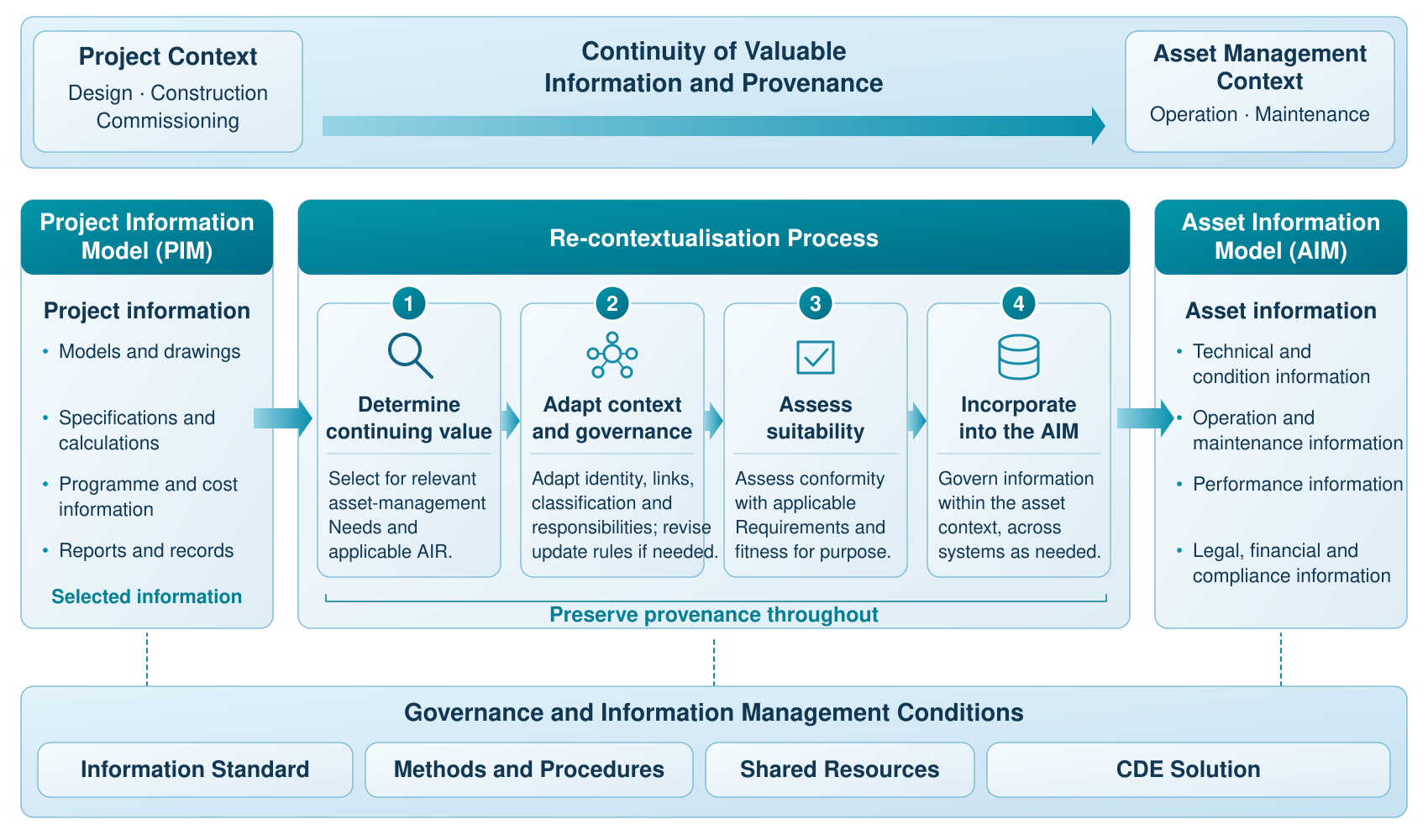
Re-contextualisation does not require all relevant information to be physically imported into one asset-management application. The AIM may remain distributed across several Information Systems. Continuity depends on being able to identify relevant information, understand its provenance and relationships, determine whether it remains current and applicable, and govern its future use.
Once the relevant information has been incorporated into the asset-management context, the updated AIM provides the governed information context for the next period of asset use.
Lifecycle Traceability and the Golden Thread#
As Management Activities and contexts change, Information Requirements may also change. A Requirement may be revised, superseded, cease to apply or be replaced by another Requirement arising from a new Need. Previous Requirements should nevertheless remain traceable where information was produced, assessed or used under them, because later users may need to understand what was required at that time and why.
For example, an earlier inspection regime may have required particular information every five years, while later regulation introduces annual assessment and additional evidence. The current Requirement changes, but previous Decisions must remain interpretable against the Requirement that applied when they were made.
Lifecycle traceability requires both current Requirements and the history of the Requirements under which previous information and Decisions were produced.
The updated AIM then provides the governed information context for further Management Activities. Information is used, Decisions are made, conditions change and new Information Needs may arise. Where a Decision leads to a substantial intervention, a new project context may begin; otherwise, Information Management continues within the asset-management context.
This recurring movement gives practical meaning to the Golden Thread of Information introduced in § 4.2. Across changing contexts, the traceable relationship remains:
Management Activity → Information Need → Information Requirement → produced information → assessment → Actual Use → Decision or Action.
Where a Decision or Action gives rise to a new Need, the relationship continues into another management context. The Golden Thread is therefore not the accumulation of everything ever produced about an asset, but continuity of purpose, provenance and governed use across changing Requirements, Information Models and management contexts.
Chapter 4 has now established how information demand arises and is organised. OIR provide the organisational context; PIR and AIR organise Requirements around project and asset Management Activities; lifecycle changes create recurring Information Needs and Requirements; and information with continuing value can remain traceable as contexts change.
The remaining question is operational: how does this organised demand become an information supply system in which required information is produced and reaches its Receiver when needed?
That question leads to § 4.7 — From Information Requirements to Information Logistics.
4.7. From Information Requirements to Information Logistics#
By this point, the organisation may understand what information it needs, why it needs it and when that information must support a Management Activity or Decision. OIR, PIR and AIR organise this demand within different management contexts, but they do not by themselves explain how the required information will be produced and reach its Receiver.
That requires another set of questions: who will provide the information, under what production and delivery conditions, what intermediate information may be needed, and how multiple contributions must be coordinated so that the required result is available when management needs it.
Information logistics is the organisation of information production and exchange through the relationships by which information moves from Providers to Receivers.
Information Requirements define demand; Information Production Requirements organise the applicable Requirements and conditions for production and delivery.
From Information Requirements to IPR#
OIR, PIR and AIR organise Information Requirements arising from management demand. Before a Provider can act on that demand, however, the Requirements applicable to the particular production relationship must be brought together with the conditions needed for production, delivery and assessment.
As established in Chapter 3, Information Production Requirements — IPR — are an appointment-specific Requirement Set Version. In the present context, its important function is to provide the practical interface between management demand and information production.
The IPR may bring together or reference the applicable Information Requirements, Level of Information Need, Acceptance Criteria, timing, the applicable Information Production Standard, Reference Information and Shared Resources, relevant Methods and Procedures, security and access conditions, and other conditions needed for production and exchange.
A Requirement may be meaningful to its Receiver while still requiring additional production context before a Provider can act on it. For example, a Requirement for reliable information about installed equipment for future maintenance expresses a legitimate management purpose, but the Provider must also understand the required scope, information characteristics, timing and Acceptance Criteria.
The IPR provide this production context without replacing the original Information Requirements or obscuring their Intended Purposes.
Organising the Information Supply Chain#
Information production rarely consists of one Provider producing one isolated result. A Management Decision may depend on several information deliveries, while one Provider may contribute information to several Receivers or management purposes. The same management demand can therefore be satisfied through different arrangements of Provider–Receiver relationships.
A major investment Decision, for example, may depend on geological, design and cost information supplied either by one integrated Provider or by several specialist Providers. During asset use, an asset-performance assessment may similarly depend on information supplied by an operator, maintenance Provider and independent inspection organisation. The management demand may remain essentially the same while the production structure differs.
IPR must therefore reflect not only the information required, but also the production and delivery relationships through which that information will be supplied.
Timing is part of the same logistics problem. Information must become available early enough to be assessed and used for its Intended Purpose. In a project, delivery may be organised around an Information Delivery Milestone preceding a Decision; in asset management, it may be related to a Trigger Event, recurring Management Activity or defined frequency.
Information logistics therefore connects three elements that should not be planned independently:
management demand → production relationships → required timing.
The objective is not merely to establish delivery dates, but to organise a supply arrangement through which the required information reaches the appropriate Receiver in time to support its intended management use.
Dependent Information Tasks and Exchanges#
Defining Provider–Receiver relationships does not by itself explain all the work required to produce the final information result. A delivery may depend on several preceding Information Tasks, intermediate results and exchanges.
A design activity may depend on survey information produced elsewhere; a technical analysis may require inputs from several disciplines; a cost assessment may depend on quantities derived from another information result. During asset use, a condition assessment may similarly depend on inspection results, operating data and maintenance history.
The dependency may be represented simply as:
required input → Information Task → intermediate result and exchange → dependent Information Task → coordinated result.
The result of one Information Task may therefore become an input to another. Production activities must be coordinated so that required inputs are available when downstream work depends on them and separate results can ultimately contribute to a coherent delivery.
A participant may consequently be a Provider in one information relationship and a Receiver in another. A Provider responsible for a coordinated result may itself require survey, interface, analytical or other information before its own work can be completed.
Some downstream Requirements refine or carry forward Requirements already established higher in the information supply chain. Others arise from legitimate Information Needs created by production dependencies. In either case, they should remain traceable to the wider management purpose of the required result.
For example, a Provider responsible for a coordinated design Information Model may require interface information from several specialist Providers. Those intermediate Requirements exist because the coordinated result cannot otherwise be produced. The same principle applies in asset management where an assessment depends on information supplied by operators, inspectors or maintainers.
Requirement Cascade can therefore contribute to an information supply network in which Requirements become more specific as production responsibilities and dependencies are resolved. The result is rarely a simple linear chain.
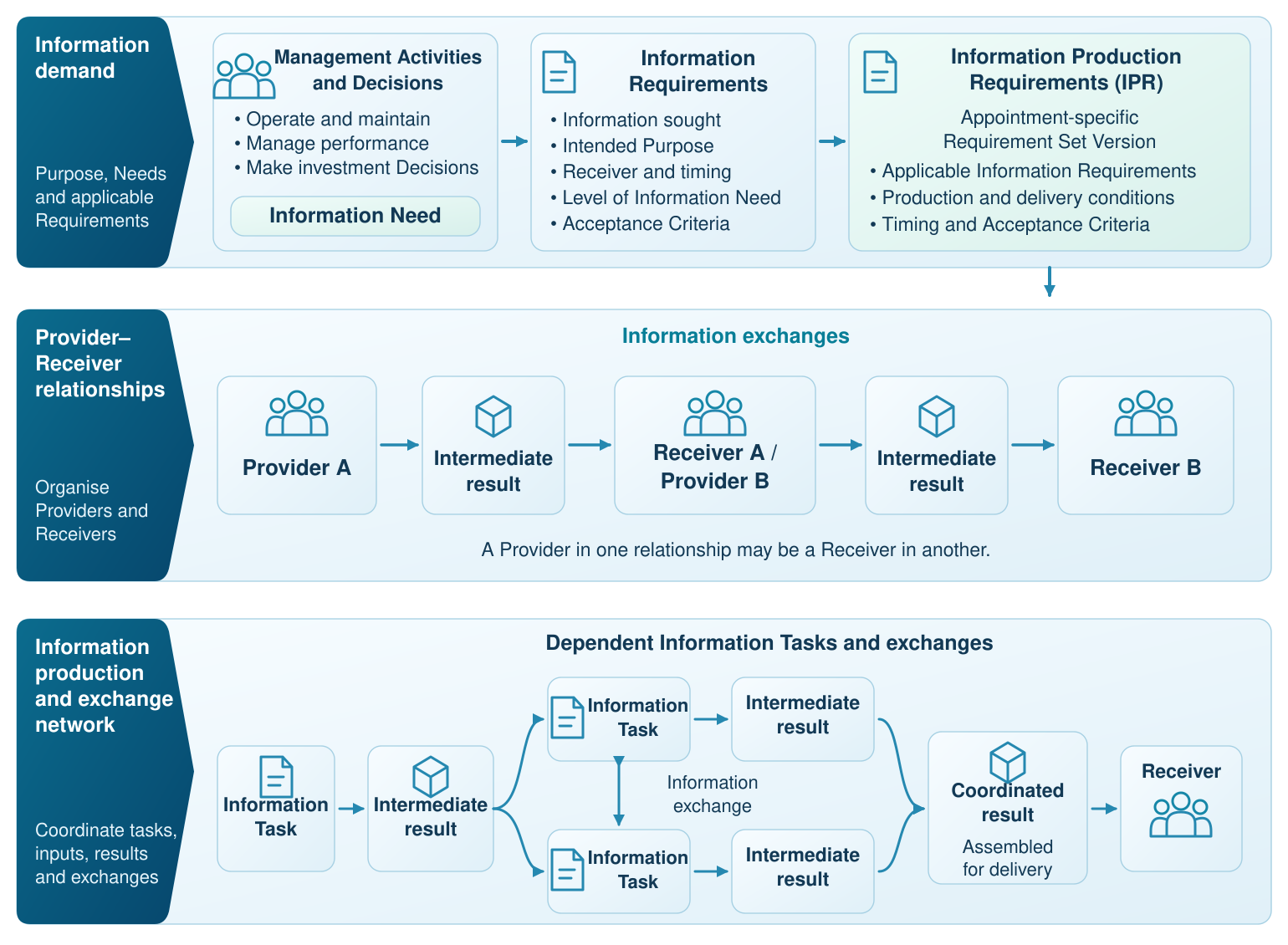
The overall relationship can be represented as:
management demand → Information Requirements → IPR for Provider–Receiver relationships → dependent Information Tasks and exchanges → coordinated information result → Receiver.
Where several Providers are involved, intermediate results may move between participants, one result may depend on several inputs, and clarification or correction may flow in more than one direction.
Figure 4.8 brings these relationships together.
A final information delivery is usually the result of dependent information exchanges rather than one isolated act of production.
Managing Completeness Across the Supply Chain#
When information production is distributed among several Providers, completeness becomes a management issue. Information may be duplicated, omitted, delivered in the wrong sequence or become disconnected from the purpose of the final result. The supply network must therefore be considered as a whole rather than as a collection of independent transactions.
Management needs to determine whether all required information results are covered, whether downstream activities will receive the inputs they depend upon, whether intermediate timing supports the required Information Delivery Milestones, and whether separate results can be combined into the required Information Model.
Table 4.7 summarises these different levels of information logistics.
Logistics level | Primary concern | Typical mechanism |
|---|---|---|
Management demand | What information must be available, for what purpose and when? | Information Requirements, Intended Purpose, Information Delivery Milestones, Trigger Events |
Production relationship | Which Provider is expected to supply which information for which Receiver? | IPR, defined scope, delivery conditions, Provider–Receiver relationship |
Production coordination | What intermediate information must be produced and exchanged so that the required result can be completed? | Information Tasks, dependencies, intermediate information results and exchanges |
Integrated delivery | Do the individual results combine into the required Information Model and support the intended management purpose? | Coordination, assessment, integration and delivery |
This progression also clarifies an important distinction. IPR organise the applicable Requirements and production conditions for a defined Provider–Receiver relationship; Information Tasks describe the work that must be planned and performed to satisfy that demand.
Completeness is therefore not achieved merely by distributing Requirements among Providers. It depends on coordinating required results, production scopes, dependencies, exchanges and timing so that the final delivery remains connected to its management purpose.
From IPR to Production Planning#
At this point, information demand has been organised into a form from which production can be planned, but the required information has not yet necessarily been produced. Each Provider must determine how the applicable Requirements will be satisfied: which Information Tasks must be performed, what inputs are required, what intermediate results must be exchanged, and when the work must be completed.
Individual production plans can then be coordinated so that Information Tasks, dependencies and exchanges support the required Information Delivery Milestones.
The progression can be summarised as:
Management Activity → Information Need → Information Requirements → applicable Requirements organised within IPR → Information Tasks and dependencies → production and exchange planning → information production → delivery.
This is not a universal workflow to be followed identically in every organisation. It expresses the management logic through which defined information demand becomes coordinated information production.
IPR provide the bridge between defining what information is required and planning how that information will be produced and delivered.
Information logistics therefore brings us to the boundary between information demand and the organisation of information production. Moving beyond that boundary requires an explicit organisational model: who participates in these relationships, where Responsibility and Authority lie, how work is Assigned, and what Access is required.
Those questions are addressed in Chapter 5 — Parties, Responsibilities and Appointments.